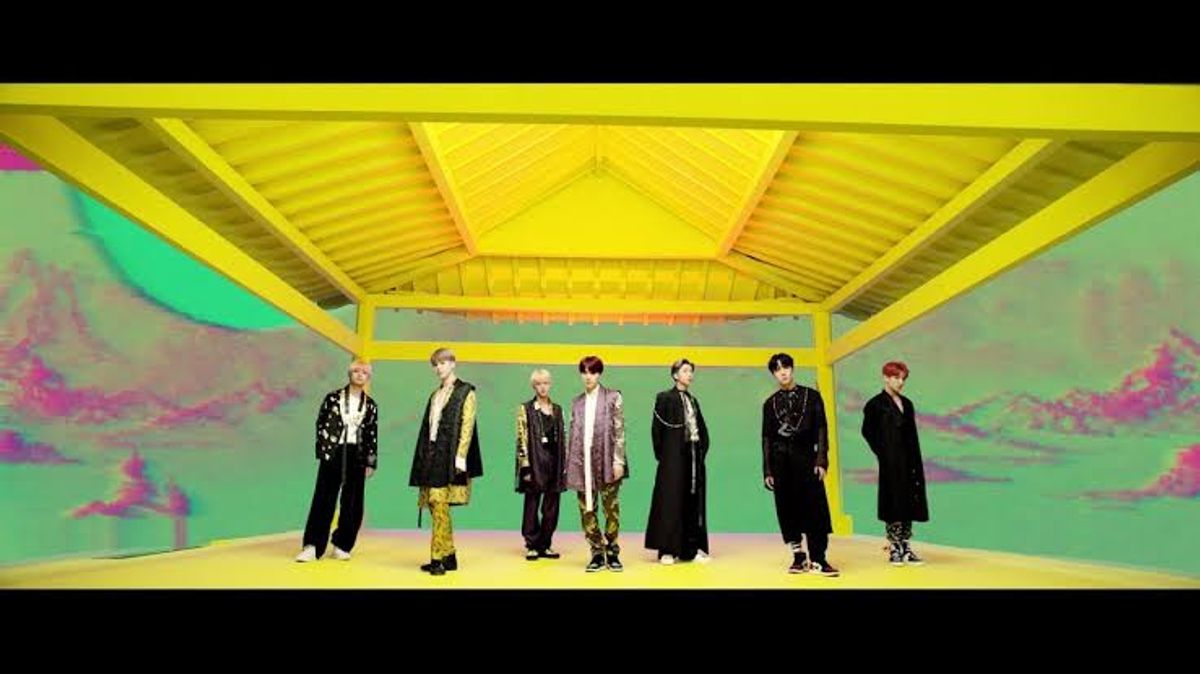
*Editor's note: "One Track" is a series that uses a single song to illuminate broader trends in the K-pop industry. The eighth instalment examines "IDOL" by BTS — a record that made the opposite artistic choice from "Dynamite", the subject of the series' first edition.*
Released on 24th August 2018, "IDOL" served as the lead single from BTS's third compilation album, *Love Yourself: 結 Answer*. It arrived two years before "Dynamite" — the English-language track with which BTS would mount a direct assault on the Billboard charts — and it took the opposite approach entirely: rather than accommodating Western audiences, "IDOL" planted the most distinctively Korean elements of the group's identity at the very centre of its sound, and found a global audience regardless.
Origins: Korean court music meets African rhythm
"IDOL" is an EDM track built on Gqom — a genre originating in Durban, South Africa — layered with the rhythms and vocal interjections (*chuimsae*) of Korean traditional music (*gugak*). The song was written by Bang Si-hyuk, Roman Campolo, Kang Hyo-won, Kim Nam-joon (RM), Shin Dong-hyuk, Ali Tamposi and Onika Maraj (Nicki Minaj), with production and arrangement handled by Pdogg. Korean exclamations such as *eolssu*, *jihwaja* and *deonggi-deok kung-deoreoreo* — the spontaneous calls that punctuate traditional Korean performances — are woven through an African-influenced beat, creating a sound that critics described as genuinely original precisely because its two source traditions are so far apart.
The release itself was carefully staged. A teaser video dropped on 22nd August, and on launch day the announcement that a bonus track featuring Nicki Minaj had been added generated a further wave of attention. Minaj's version received its own music video on 6th September.
The music video: a compressed portrait of Korean culture
The video packed in a remarkable range of traditional Korean imagery: *hanbok* (traditional dress), the *Bukcheongsajannoreum* lion dance, octagonal-roofed pavilions, *samullori* percussion performance and *talchum* mask dance — all rendered alongside vivid computer-generated graphics. The choreography blended African dance styles, including *gwaragwara*, with Korean dance forms. Against sets evoking tropical savannah alongside European and Asian architectural styles, Korean cultural heritage was placed emphatically in the foreground. The fire-breathing dragon depicted in the video was reportedly painted by BTS member Jungkook himself.
Commercial performance
"IDOL" debuted at number 11 on the Billboard Hot 100 and number 21 on the UK Official Singles Chart. Combined first-week download sales in the United States — counting both the original and the Nicki Minaj versions — reached 43,000 copies, and the Recording Industry Association of America (RIAA) subsequently certified it platinum. The music video has continued to accumulate views steadily over the years; in July this year it surpassed 1.4 billion views, making it the fifth BTS video to reach that threshold.
Its influence extended beyond pop chart metrics into the world of traditional music. According to the National Gugak Centre, demand for gugak instrument samples among both domestic and international musicians rose noticeably after "IDOL" was performed on major awards-show stages. The song has also proved durable in broadcast contexts: it was used as background music on a popular comedy programme and, at the 2022 FIFA World Cup in Qatar, played as the goal-celebration soundtrack for the South Korean national football team.
Significance
"IDOL" sits in precise counterpoint to "Dynamite", the first song examined in this series. Where "Dynamite" reached number one on the Billboard Hot 100 by adopting English lyrics and American disco, "IDOL" achieved international impact by doing the opposite — foregrounding the most Korean elements available to it. At the time, *Rolling Stone* noted that BTS were charting new territory on their North American tour despite the fact that most of their material remained in Korean — territory that no K-pop act had previously reached. "IDOL", then, stands as evidence that two apparently contradictory strategies can each succeed on their own terms: that adapting to foreign markets works, and that radical cultural specificity works too.
In a sentence
Rather than reaching out to the world in English, BTS pulled the world in with the spontaneous calls of Korean traditional music.