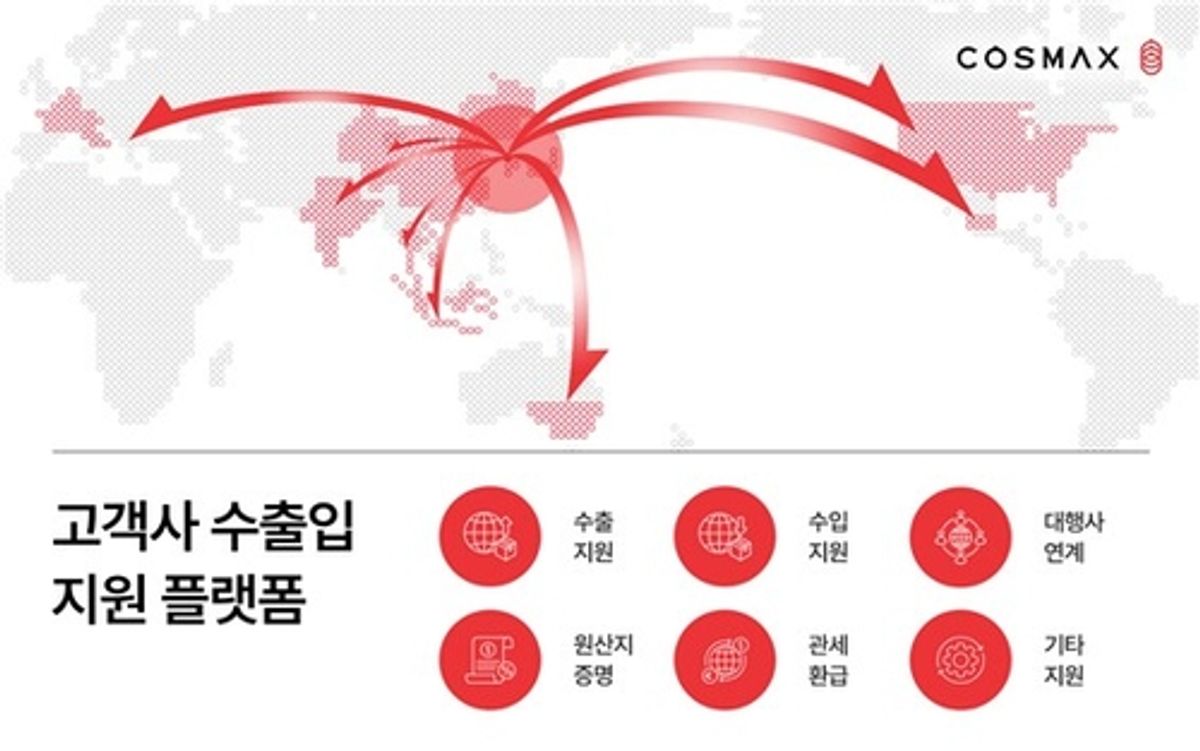
Cosmax, South Korea's biggest ODM (original design manufacturer) in cosmetics — a model in which manufacturers both develop and produce products on behalf of brand clients — has launched a comprehensive client-support platform designed to help smaller brands expand abroad. The move signals a deliberate shift from pure contract manufacturing to something more ambitious: a fully integrated export infrastructure business. Industry observers are calling it the opening shot of a "K-Beauty 2.0" era.
The shadow side of K-Beauty's export boom
South Korea's cosmetics exports hit a record $8.5bn in 2023, according to the Korea Health Industry Development Institute. Yet the headline figure obscures a deep structural imbalance. The bulk of those earnings flows to a handful of large conglomerates — most notably Amorepacific and LG H&H — while smaller brands, which account for more than 90% of all domestic cosmetics companies, repeatedly run into walls: unfamiliar foreign regulations, costly local certifications, and logistics networks they cannot afford to build alone.
A survey of 500 small cosmetics firms by the Korea Cosmetic Industry Institute found that 68% cited a lack of information on overseas regulations as their biggest export obstacle, while 54% pointed to difficulty finding local partners. The patchwork of country-specific requirements — US FDA registration, Europe's CPNP notification system, China's hygiene licensing regime — is, in practice, insurmountable for companies without dedicated compliance staff.
From manufacturer to platform: Cosmax's strategic pivot
The new platform is designed to fill precisely that gap. It bundles four services into a single offering: overseas regulatory consultancy, local certification support, connections to global logistics and distribution networks, and digital marketing solutions. What makes the proposition credible is the underlying asset base: decades of operating subsidiaries in the United States, China, Indonesia, Thailand and elsewhere, giving Cosmax a regulatory network and trove of market data that few rivals can match.
The company currently has production facilities in five countries — the United States, China, Australia, Indonesia and one further market — and serves more than 3,000 clients worldwide. That network is now being repurposed as the platform's core infrastructure. "The regulatory know-how Cosmax has built up locally is an asset that no consultancy could replicate quickly," said one industry executive.
A global playbook: how leading ODMs have gone upmarket
Cosmax's pivot follows a trail blazed by more established players. Intercos, the Swiss group that is the world's largest beauty ODM, has since the mid-2010s operated a "Beauty Solutions" model that integrates brand development, trend research and regulatory services, pushing it well beyond the margins available in pure manufacturing. ODM affiliates within France's LVMH group have similarly evolved towards vertically integrated services spanning raw-material sourcing through to distribution.
The common thread is a service-revenue model that transcends simple manufacturing margins. By diversifying into knowledge-intensive services, these companies have escaped the race to the bottom on unit costs against low-price Chinese and South-East Asian rivals. Cosmax is now attempting the same manoeuvre.
Small brands: enthusiasm tempered by caution
Reaction from South Korea's independent beauty brands has been broadly positive. "For a start-up that cannot afford its own export team, having a major partner handle compliance and logistics could dramatically lower the cost of going global," said one executive at an indie brand. The appeal is obvious: market entry expenses that once required building internal expertise from scratch could instead be absorbed into a platform fee.
But sceptics raise legitimate concerns. Chief among them is the risk of platform dependency. Brands that outsource their entire export operation to Cosmax may find, over time, that they have forfeited the chance to develop their own overseas networks and negotiating leverage. "You need to scrutinise the partnership terms and the question of data ownership very carefully," warned the chief executive of one beauty start-up.
Transparency over pricing is another sticking point. When ODM manufacturing contracts and platform service agreements are bundled together, it becomes difficult for smaller companies to assess what each component actually costs — a dynamic that could produce contract structures tilted in favour of the larger party.
Reshaping the K-Beauty ecosystem
Should the platform gain traction, the effects on South Korea's broader beauty industry could be substantial. The most immediate beneficiary would be the category of brands with strong product concepts but no export infrastructure. Greater overseas access for such companies would add genuine diversity to K-Beauty's global presence — complementing the marketing firepower of the major groups with a long tail of distinctive indie labels carried by the wave of South Korean cultural influence.
KOTRA, South Korea's trade and investment promotion agency, has noted that interest in K-Beauty is rising steadily across emerging markets in India, South-East Asia and the Middle East, yet actual market penetration consistently falls short of expectations because of weak local distribution and regulatory capacity. If Cosmax's platform narrows that gap, it could meaningfully broaden the export base beyond its current concentration at the top.
Policy implications
There is a wider lesson here for government, too. South Korea's official K-Beauty support programmes have tended towards one-off interventions — trade fair participation grants, buyer-matching events — rather than durable infrastructure. Cosmax's model represents private capital building something more lasting.
Analysts argue that policymakers should actively explore ways to link such private platforms with existing small-business export support schemes. Concrete proposals in circulation include export vouchers for brands using the platform, and the joint public-private development of a shared regulatory-information database.
K-Beauty's long-term competitiveness will not rest solely on the global marketing budgets of its largest brands. It will depend equally on how robust and accessible the foundations become for a much wider range of companies to compete internationally. Whether Cosmax's platform experiment can provide that foundation is a question the industry is watching closely.