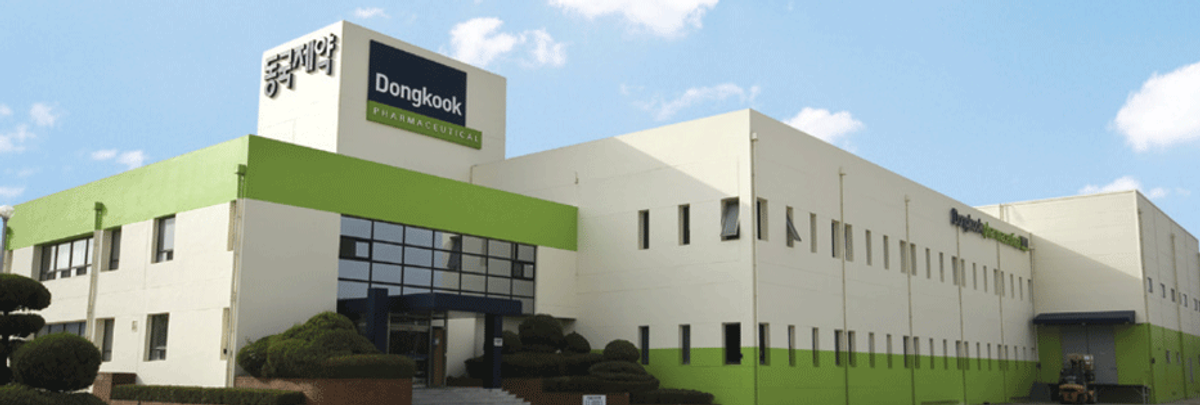
IBK Investment & Securities has initiated coverage of Dongkook Pharmaceutical (KOSDAQ: 086450) with a buy recommendation and a target price of 30,000 won, based on the closing price of 22,150 won on 1st October 2026. The target implies upside of 35.4%.
The brokerage's bullish case rests on two pillars: the accelerating international expansion of Dongkook's derma-cosmetics brand Centellian24, and the high growth of its cosmetics-led healthcare division. The target price was derived by applying a blended price-to-earnings multiple of 14.1 times to a 12-month forward earnings-per-share estimate of 2,098 won. That blended multiple combines the average P/E of domestic pharmaceutical peers — Daewoong Pharmaceutical and HK inno.N — at 9.8 times, and branded cosmetics peers — APR and Dalba Global — at 20.5 times, weighted 60% and 40% respectively.
A cream that has sold 100 million units
The driving force behind the transformation is Madeca Cream, Dongkook's flagship skincare product. Cumulative sales surpassed 100 million units as of July 2026. Annual volumes rose 18.8% from 16 million units in 2024 to 19 million in 2025, and 12 million units were sold in the first half of 2026 alone. IBK estimates that if the current pace holds, full-year 2026 sales could reach approximately 24 million units — a year-on-year increase of more than 25%.
A rapid march into American retail
Dongkook's international push has been striking in its speed and breadth. In May 2026, the company secured shelf space in 1,400 Ulta Beauty stores across the United States. June brought listings in around 89 Nordstrom department stores and on the retailer's website, while July saw entry into roughly 200 Costco warehouse outlets. In Japan, the company has gained distribution through Don Quijote. The successive entry into such varied retail formats within a matter of months has sharply broadened the brand's footprint in America.
That commercial momentum is showing up in the export figures. Healthcare-segment exports surged from approximately 30 billion won for the whole of 2025 to more than 50 billion won in the first half of 2026 alone. Total healthcare revenue — which includes cosmetics — reached 202.9 billion won in the first half of 2026, up 28.7% year on year. The healthcare division's share of group revenue is expected to rise from 31.9% in 2023 to 39.3% in 2026.
For the second half of 2026, IBK forecasts consolidated revenue of 547.5 billion won (up 16.6% year on year) and operating profit of 60.1 billion won (up 22.5%). Seasonal demand around Black Friday and the year-end shopping period is expected to push second-half healthcare revenue to 213.2 billion won, a 34.3% increase. For the full year, the brokerage projects revenue of 1.0574 trillion won, operating profit of 113.6 billion won, and an operating margin of 10.8%.
A pharmaceutical pipeline to watch
Change is also under way in Dongkook's prescription drugs division. The company launched the first domestic one-month formulation of the prostate cancer treatment Lorelin Depot in 1999. It completed Phase 3 clinical trials for a three-month formulation in February 2026 and entered the regulatory review process with the Ministry of Food and Drug Safety in September of the same year, with a 2027 launch as the target. By reducing the injection frequency to one-third of the current regimen, the new formulation could win a larger share of South Korea's leuprorelin market, which is worth roughly 80 billion won annually. Over the longer term, Dongkook is also applying its microsphere drug-delivery technology to the development of a long-acting injectable version of semaglutide-class obesity treatments.
Reasons for caution
As an initiating report from a single brokerage, the analysis is not free of the usual optimistic bias that accompanies such coverage. Several risk factors deserve attention.
First, the durability of the American retail push is unproven. Entry into major chains such as Ulta and Costco requires an upfront stock commitment. If initial shipments are not followed by meaningful reorders, the second-half earnings uplift may prove to be a one-off rather than the beginning of a sustained trend. Reorder volumes will be the clearest gauge of genuine sell-through.
Second, there is a structural tension in Dongkook's profitability. The over-the-counter drugs segment — the most profitable part of the business — is shrinking as a share of revenue, while the higher-cost healthcare and cosmetics division grows. Gross margins face modest but unavoidable downward pressure. Improvement in the operating margin depends on selling, general, and administrative costs growing more slowly than sales — a condition that cannot be taken for granted as the company invests in overseas distribution.
Third, the performance of subsidiary Widnix warrants scrutiny. The beauty-device maker posted revenue of 3.5 billion won in the first half of 2026, a 14.5% decline year on year, as competition in the category intensified. Converting Madeca's brand recognition into device sales will take time.
Fourth, while IBK argues that the current share price — implying a 2026 P/E of 11.7 times — is cheap relative to pharmaceutical peers, the justification for applying a blended cosmetics multiple (and thus a target P/E of 14.1 times) hinges on the high-growth narrative remaining intact. Should the overseas expansion fail to translate into sustained earnings growth, the premium valuation would be difficult to defend.
Company background
Founded in 1968 and listed on KOSDAQ, Dongkook Pharmaceutical has built its business on well-known over-the-counter brands such as Madecassol (a wound-healing cream) and Insa-dol, supplemented by a portfolio of generic prescription drugs. These have provided a stable cash-flow base from which the company is now funding its cosmetics ambitions. Consolidated revenue grew at a compound annual rate of 12.6% from 731.0 billion won in 2023 to 926.9 billion won in 2025. As of 1st October 2026, the company's market capitalisation stood at approximately 1.0002 trillion won.