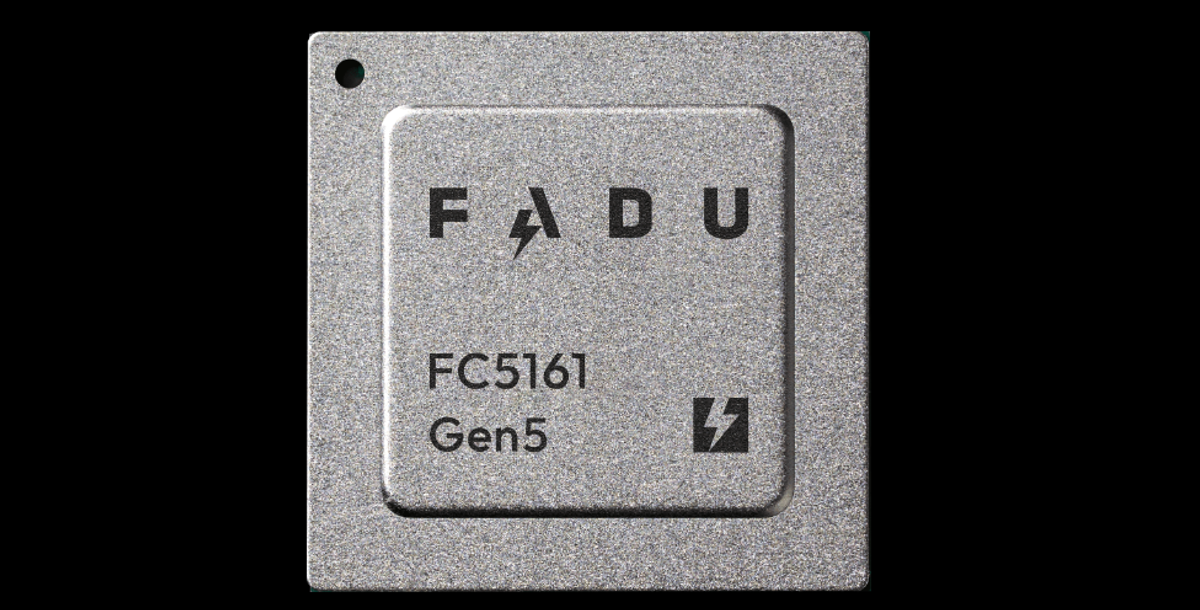
Eugene Investment & Securities raised its target price for Fadu (KRX: 440110), a specialist designer of enterprise solid-state drive (eSSD) controllers, from 100,000 won to 110,000 won on 23 September, whilst maintaining its buy recommendation.
The new target is derived by applying a price-to-earnings multiple of 27.9 times — the 12-month forward average for global peers including Marvell, Microchip, and Phison — to Fadu's projected earnings per share of 3,859 won for 2027. At the prevailing share price of 72,300 won as of 22 September, the stock offers implied upside of 52.1% to the target.
Sharp recovery under way
Eugene forecasts Fadu's results for the third quarter of its 2026 fiscal year (July–September) at revenue of 122.1 billion won and operating profit of 35.5 billion won — up 67% and 119%, respectively, from the prior quarter. Year-on-year, revenue would be 376% higher, with the business swinging from an operating loss to a profit. The projected operating profit also exceeds the market consensus of 32.1 billion won.
The turnaround is striking given how recently the company was loss-making. For full-year 2025, Fadu recorded revenue of 92 billion won alongside an operating loss of 65 billion won. This year, however, the ramp-up of shipments to hyperscale cloud customers has driven rapid quarter-on-quarter growth: revenue rose from 59.5 billion won in the first quarter to 73.2 billion won in the second, with the 120 billion won threshold in sight for the third. On an annual basis, Eugene projects revenue of 399.1 billion won in 2026, 730.6 billion won in 2027, and 1.02 trillion won in 2028.
Margins set to transform
The trajectory of operating margins is equally striking. After recording a margin of minus 70.8% in 2025, Fadu is expected to reach 25% in 2026, 33% in 2027, and 35% in 2028. Eugene notes that these estimates already incorporate conservative assumptions for rising selling, general, and administrative expenses — including additional engineering headcount to support new clients and development costs for next-generation Gen7 eSSD products. Even so, the operating leverage generated by rising shipment volumes is judged to dwarf the cost increases.
Growing the customer roster
Diversification of the customer base is the central growth driver. Fadu is deepening supply to its second hyperscale customer, while revenues from a third have begun to appear in the numbers from the second half of this year. Eugene believes a fourth hyperscaler relationship is now coming into view. Because each hyperscaler specifies distinct functional requirements for its eSSD controllers, Fadu's ability to deliver customised solutions is emerging as a meaningful competitive advantage.
The underlying market is also gaining momentum. As supplies of high-bandwidth memory (HBM) remain severely constrained amid the AI infrastructure build-out, some AI companies have turned to conventional DRAM and eSSD as a substitute for KV cache storage. Growing demand driven by the expansion of scale-up interconnect architectures is providing an additional boost. In response, the major NAND manufacturers — Fadu's direct customers — are extending long-term supply agreements, providing Fadu with a stable, fixed-price order base.
The AI capex angle
Eugene also highlights the strategic ambitions of Fadu's principal hyperscaler client, which commands a dominant position in social media and has entered the agentic AI arena with an application called "Muse." Having invested heavily in talent acquisition and the establishment of an AI research laboratory over the past year, the client is said to be approaching frontier-model capabilities. As its AI capital expenditure grows, so too will Fadu's controller shipments.
Risks worth noting
Investors should weigh several risks carefully. Fadu's shares have already fallen more than 44% from their 52-week high of 129,400 won, with recent selling pressure cited as the primary culprit. Yet the stock still trades at a forward price-to-earnings ratio of 202.3 times on 2026 estimates — a valuation that leaves no margin for error. Any shortfall in quarterly results or delay in securing new hyperscaler customers could trigger sharp share-price volatility.
Exchange-rate assumptions also bear watching. Eugene lowered its won-dollar rate assumption from 1,440 to 1,400 for this report, concluding that volume growth offsets the currency impact. However, a further appreciation of the won or any softening in big-tech AI investment cycles could prompt downgrades to earnings estimates.
This latest price-target upgrade comes barely a month after Eugene initiated coverage on 18 August with a buy recommendation and an initial target of 100,000 won — at which point the stock traded at an average discount of 34.9% to that target.