Introduction
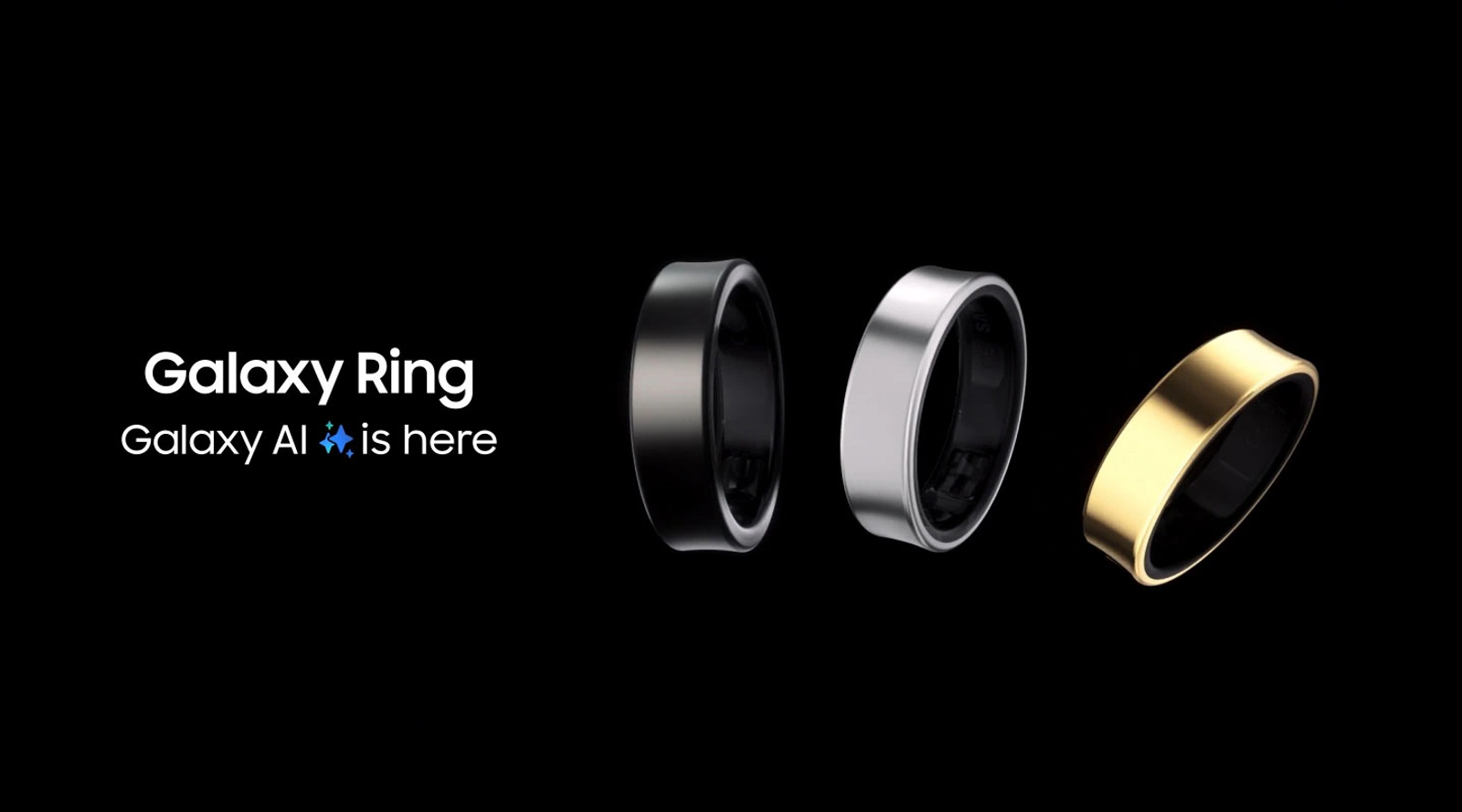
The Galaxy Ring is Samsung's biometric smart ring, launched in July 2024 alongside the Galaxy Watch 7 and Watch 7 Ultra. Stripped of a screen and speaker, it focuses entirely on round-the-clock tracking of sleep, physical activity, and recovery—worn simply as a ring on the finger. Health data is viewed through the Samsung Health app on a paired smartphone. Since launch, the ring has been made available in 11 sizes (US sizes 5 through 15), and retails in South Korea for ₩499,400 (approximately $370).
Specifications
The ring measures 7.0mm wide by 2.6mm thick and weighs between 2.3g and 3.3g depending on size. It is equipped with an accelerometer, a PPG (photoplethysmography) optical heart-rate sensor, and a skin-temperature sensor, communicating with a paired smartphone via Bluetooth Low Energy 5.4. Water and dust resistance is rated at IP68 with a pressure rating of up to 10ATM (some product listings cite 5ATM), making it safe to wear in the shower or pool. Battery life is rated at up to seven days on a full charge, though some users report approaching seven weeks—almost certainly a misprint or outlier; real-world reviews suggest the seven-day figure is realistic. The ring requires a smartphone running Android 11 or later with at least 1.5GB of RAM, Samsung Health app version 6.27 or above, and a Samsung account. It comes in three finishes: Titanium Black, Silver, and Gold.
Strengths and Limitations
The ring's most praised feature is its sleep tracking. By analysing sleep duration, sleep stages, and heart-rate variability (HRV), it calculates a daily "Vitality Score"—a measure of physical recovery that reviewers consistently rate as more precise than comparable wearables. A gesture-based camera shutter—triggered by pinching the fingers into a clip shape—has also drawn appreciation as a small but genuinely useful trick.
The absence of a screen and notifications is simultaneously the ring's greatest weakness and its defining virtue. Many users welcome the freedom from constant alerts, finding it easier to focus purely on health data; others miss the ability to glance at real-time readings in the way a smartwatch would allow. The ring's profile—noticeably thicker than a conventional piece of jewellery—can feel intrusive for wearers unaccustomed to chunky rings. The upfront cost has also been a recurring objection.
Verdict
The Galaxy Ring makes a deliberate trade-off: it surrenders the versatility of a smartwatch in favour of deep, uncluttered insight into sleep and recovery. Those expecting a miniature smartwatch will be disappointed. But as a dedicated health-tracking device for sleep and daily condition monitoring, it is impressively well-realised. Samsung has signalled that future versions will be thinner and more tightly integrated with its SmartThings home platform and Galaxy XR devices—raising the intriguing prospect that the ring could evolve from a simple health monitor into a broader controller within the Galaxy ecosystem. That transition will be the next milestone to watch.
★★★★☆ (4.0 / 5.0)
In a word: Health, inscribed on the finger—no screen required.