Introduction
Samsung launched the Galaxy Z Tri-Fold in South Korea on 12th December last year, unveiling what it bills as the world's first in-folding three-panel foldable smartphone. The device distils six years of design and engineering lessons accumulated since the original Galaxy Fold in 2019, and has since rolled out sequentially to China, Taiwan, Singapore, the United Arab Emirates and the United States. It is available in a single configuration — 16GB of RAM, 512GB of storage, in Crafted Black — priced at 3,590,400 won (roughly $2,600).
Specifications
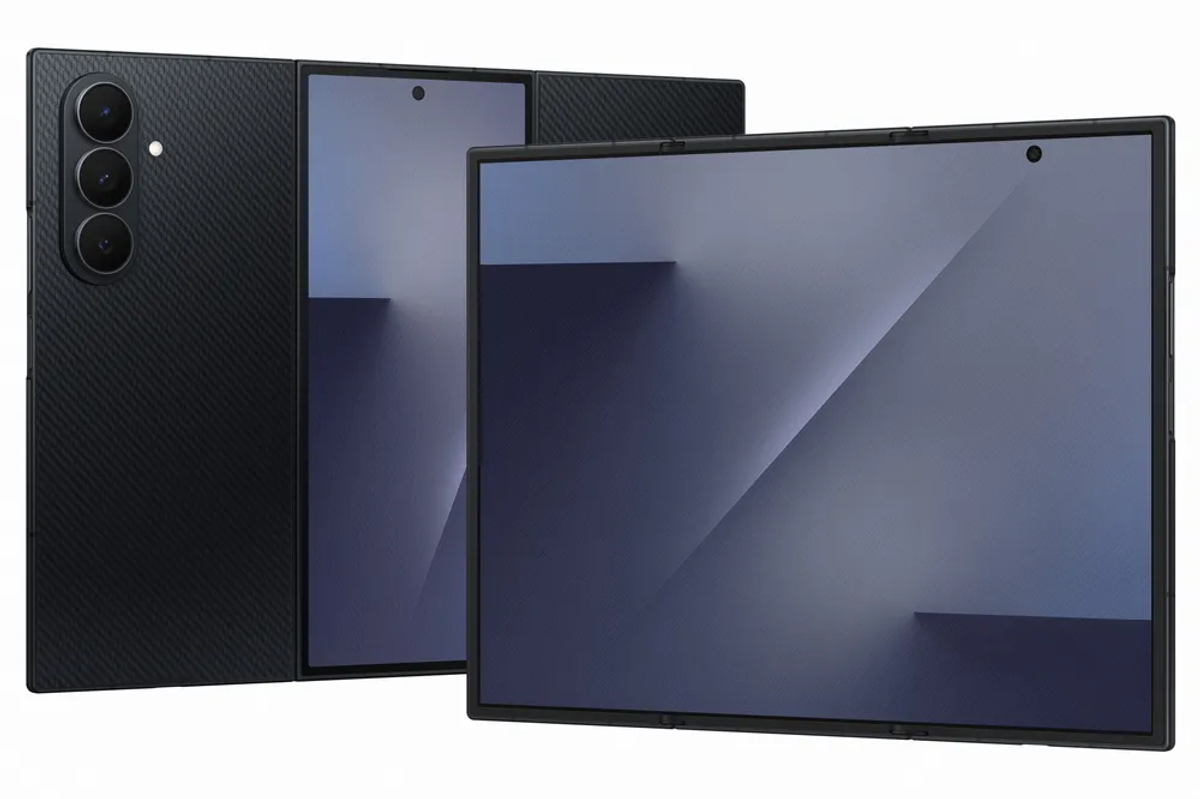
The defining feature is the form factor itself. Fully unfolded, the device opens into a 253mm (10-inch) tablet-sized display; folded shut, it collapses to a 164.8mm (6.5-inch) conventional candy-bar phone, matching the footprint of the Galaxy Z Fold 7. At 3.9mm when open and 12.9mm when closed, it is the slimmest handset in the Galaxy Z Fold lineage to date. The in-folding design tucks the main display inward on both sides, shielding it from damage; should anything go awry during the folding process, the phone alerts the user with an on-screen notification and a haptic vibration.
The large display amplifies the device's artificial-intelligence features considerably. With the screen fully extended, users can run up to three applications simultaneously in a multi-window arrangement — effectively replicating the experience of operating three smartphones at once. The camera system incorporates Samsung's Pro Visual Engine, which leverages the main processor to sharpen image quality, and includes Nightography, the company's low-light photography mode. The expansive canvas also enhances the AI-powered generative editing suite: Photo Assist allows users to view and retouch images with far more screen real estate than a conventional handset affords, though a Samsung account and an active internet connection are required. Transcription tools that convert recorded audio to text are available within Samsung's Phone, Notes and Interpreter applications. A wireless dual-screen feature, which mirrors the display to an external monitor, rounds out the productivity offering.
Strengths and Limitations
The device's clearest selling point is the AI experience it unlocks only when fully unfolded. Running three applications at once alongside generative editing tools represents a level of multitasking that a standard smartphone — or even a conventional two-panel foldable — simply cannot match. The technical achievement of a world-first in-folding three-panel mechanism is itself a genuine distinction.
The drawbacks, however, are equally plain. The handset weighs 309 grams, making it heavier than even the earliest Galaxy Fold models. That is an unavoidable consequence of the three-panel structure, but it represents a meaningful sacrifice in portability. More troubling is the cost of repairs: replacing the internal display assembly runs to 1,657,500 won — nearly half the purchase price — and Samsung's own Care+ insurance programme does not cover the device, leaving customers with no option but to rely on carrier-provided insurance. The 3,590,000-won asking price alone is a formidable barrier for most consumers.
Verdict
The Galaxy Z Tri-Fold is an unambiguous statement of intent about where foldable phones are headed. The multitasking and generative AI editing experience on a 10-inch screen offers genuine, differentiated value. Yet the device also carries real-world burdens: considerable weight, steep repair bills and no path to manufacturer insurance. For early adopters eager to possess the technological vanguard, it is a compelling proposition. For those who prize practicality above novelty, it demands careful consideration.
★★★★☆ (3.5 / 5.0)
In a word: "The third fold reveals its true potential — but it also reveals how much you have to take on."