In a battery-industry research note published on the 6th, Hana Securities projected that the convergence of South Korea's AI data-centre mega-projects and semiconductor fabrication plant expansions will drive domestic demand for energy storage system (ESS) batteries to an annual average of at least 7GWh over the next ten years.
The report draws on two official sources: the government's 11th Basic Plan for Electricity Supply and Demand, released in 2025, and a research paper (25-23) by the Korea Energy Economics Institute. The institute estimates that the expansion of renewable energy will generate annual surplus electricity of 12.5TWh by 2038, requiring the installation of 20GW (119.4GWh) of ESS capacity to absorb it. Of that total, 14GW (77.4GWh) is proposed to be met using lithium iron phosphate (LFP) batteries. Spread over twelve years from 2027 to 2038, that implies an average of 6.5GWh of new LFP ESS installations annually.
Hana Securities argues that actual demand will substantially exceed that baseline once the power requirements of AI data centres and semiconductor fabs are added in. The 11th electricity plan was finalised before the mega-project announcements of 2026 and therefore does not account for the sharp power fluctuations associated with AI inference workloads or the incremental consumption from new chip factories. The report states that the upcoming 12th electricity plan will "almost certainly reflect a larger ESS demand estimate," and sets 7GWh per year as a floor.
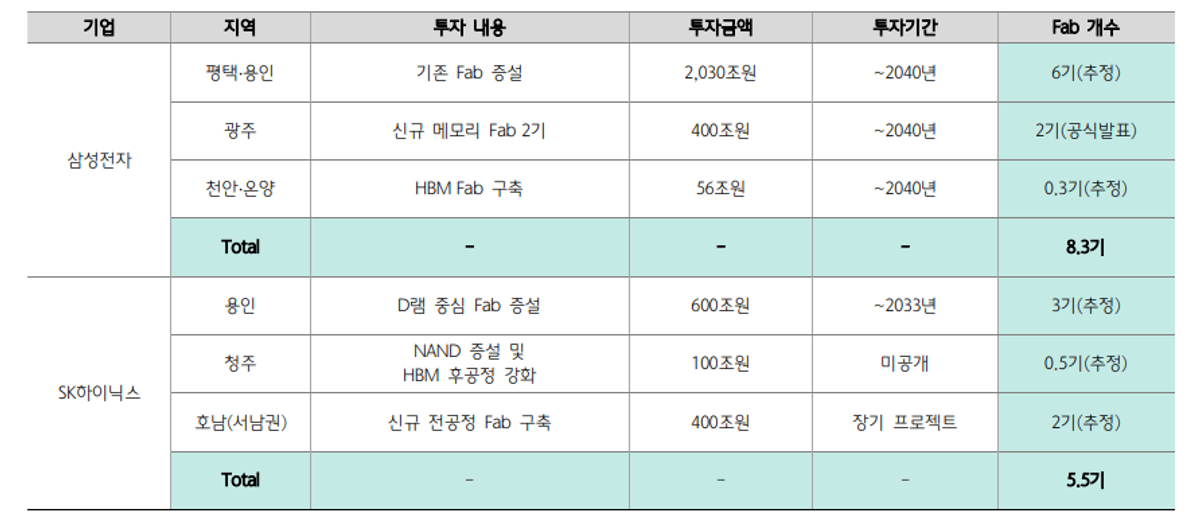
Data-centre-related ESS demand was calculated from the first phase of planned capacity: 5GW from SK Group, 2.4GW from GS, and 1GW from Naver, totalling 8.4GW. SK Group intends to expand its data-centre footprint to 18.4GW by 2035. Applying a 20% ESS attachment rate and a four-hour storage duration yields cumulative ESS demand from data centres of 14.4GWh through 2035. For semiconductor fabs, planned expansions by Samsung Electronics (8.3 new fab-equivalents) and SK Hynix (5.5) point to an additional 4.1GWh of ESS demand by 2040.
The report's focus on ESS as critical infrastructure rather than mere storage reflects the distinctive power profile of AI inference computing. When inference tasks begin, GPU utilisation surges abruptly, creating instantaneous demand spikes of hundreds of megawatts; when tasks end, consumption drops just as sharply. The grid must be sized to handle peak load, which inevitably produces substantial surplus capacity at other times. ESS serves a dual function: storing that surplus for release at peak moments, and acting as a grid buffer that absorbs violent load swings.
South Korea's attractiveness as a location for AI factories reinforces the demand outlook. The country's System Average Interruption Duration Index (SAIDI) — a standard measure of power reliability — stands at under ten minutes per household per year, compared with more than 40 minutes in the United States and Europe. Transmission and distribution losses run at 3.5%, roughly half the OECD average of around 6%. SK Telecom is building an Nvidia multi-tenant AI factory targeted for operation in 2027, and Samsung SDS is reportedly in discussions with OpenAI and Anthropic about leasing AI factory capacity — both trends consistent with the country's power-grid advantages.
South Korea's three major battery makers are positioning themselves to capture this demand. LG Energy Solution is preparing to launch LFP production lines domestically, with output of around 1GWh expected to begin in early 2027 and the capacity to scale quickly to 5GWh. Samsung SDI operates an ESS factory in Ulsan with roughly 10GWh of capacity, but it relies entirely on nickel-manganese-cobalt (NMC) chemistry; transitioning to LFP remains a strategic imperative. Since the company is already planning LFP production at a US facility from late 2026, the technical transfer is not considered a major obstacle. SK On, meanwhile, is converting 3GWh of its 7GWh Seosan plant to an ESS LFP line and in February secured 284MW — half of the total volume on offer — in South Korea's second ESS central-contract market tender.
That said, the rosy demand projections deserve scrutiny. The projected annual 7GWh-plus figure is roughly equivalent to the total current global annual ESS shipments of South Korean battery makers combined — a volume that itself falls below 10GWh. By 2027, however, global ESS shipments are expected to surge past 30GWh, which means domestic demand, however strong, may account for a modest share of the overall business opportunity. The 20% ESS attachment rate and four-hour duration assumption used in the report also represent a mid-range, optimistic scenario; actual contract terms could push demand materially in either direction.
The pace of mega-project investment is a further uncertainty. Although the first-phase plan of 8.4GW has been announced, large infrastructure undertakings routinely slip behind schedule owing to permitting delays, grid-connection bottlenecks, and financing constraints. The estimates of surplus renewable power generation are themselves revised with each new electricity plan.
Hana Securities rated LG Energy Solution (target price: KRW 480,000), Samsung SDI (target price: KRW 667,000), and Hanjung ENCIS as Buy recommendations among ESS beneficiaries. Samsung SDI's ESS division recorded operating profit of KRW 249bn in the second quarter of 2026, with a 32% operating margin, signalling a clear recovery. On an annual basis, the division is expected to swing from an operating loss of KRW 47bn in 2025 to a profit of KRW 328bn in 2026.