Hana Securities has reiterated its "Buy" recommendation on Samyang Foods (KRX: 003230) and confirmed a target price of 1.8m won — implying upside of roughly 26% from the closing price of 1.43m won on 25th August.
Strong second-quarter results
Samyang Foods reported consolidated revenues of 770.3bn won and operating profit of 176.2bn won for the second quarter (April–June), up 39.3% and 46.7% respectively year on year. The operating margin came in at 22.9%. Hana Securities notes that once a one-off charge of around 5bn won is stripped out, the underlying quarterly earnings run-rate has risen to more than 180bn won in operating profit — a meaningful step up in the company's earnings quality.
Overseas revenues reached 645.8bn won in the quarter, up 46.7% year on year. The United States (203.6bn won, +54.2%) and China (181.0bn won, +44.1%) led the charge. Notably, exports to Europe crossed the 100bn won quarterly threshold for the first time, establishing the region as a new growth pillar.
Europe: a market barely scratched
Europe's long-term potential is reflected in how little ground has been covered so far. Annual per-capita instant-noodle consumption in major European countries stands at roughly four servings — about one-tenth of the Asian average and less than a third of the figure for North and South America (approximately 13 servings). Hana Securities argues that Europe, where Samyang's country coverage remains limited, offers greater expansion potential than either the United States or China, both in terms of market penetration and growth prospects. In Latin America, a new supply arrangement with OXXO, the Mexican convenience-store chain, began in the second quarter, contributing to improved performance at the company's Americas subsidiary.
China factory to unlock capacity for the West
On the supply side, investors are watching the commissioning schedule of Samyang's new factory in China, which will have an annual production capacity of 1.13bn units. A trial run is planned for early 2027. Hana Securities believes the resulting profit leverage from incremental revenues will more than outweigh the roughly 3bn won in additional quarterly depreciation charges. Once Chinese domestic production is fully under way, spare capacity at the Miryang plant in South Gyeongsang Province is expected to be redeployed towards shipments to the United States and Europe.
Third-quarter outlook
For the third quarter (July–September), Hana Securities forecasts revenues of 811.4bn won (+28.4% year on year) and operating profit of 187.5bn won (+43.2%). These estimates do not include any potential refund of US tariffs; the timing of such a refund remains unclear. Customs data show that South Korean instant-noodle exports grew by only 15.2% year on year in July, missing market expectations somewhat — a shortfall that Hana Securities attributes to shipping delays caused by a typhoon rather than any weakening of underlying demand. Same-store sales of Samyang products at Walmart in the United States are estimated to have grown 14% year on year in the second quarter.
Outpacing the global competition
Samyang Foods is pulling ahead of its global rivals. According to Hana Securities, the company's sales growth in the Americas — measured in US dollar terms — has outstripped that of Japan's Toyo Suisan and Nissin Foods, as well as South Korea's Nongshim, for three to four consecutive quarters.
Full-year forecasts and valuation
Hana Securities projects full-year revenues of 3.11tn won and operating profit of 728.0bn won for 2026, representing growth of 32.3% and 38.9% respectively. By 2027, it expects revenues to reach 3.77tn won and operating profit 877.9bn won. Compared with revenues of 1.73tn won in 2024, this implies a more than doubling of the company's top line in three years. At the current share price, the stock trades at roughly 19 times forecast 2026 earnings and approximately 6 times book value — figures broadly in line with the market consensus (forecast revenues of 3.13tn won and operating profit of 732.2bn won).
Risks to watch
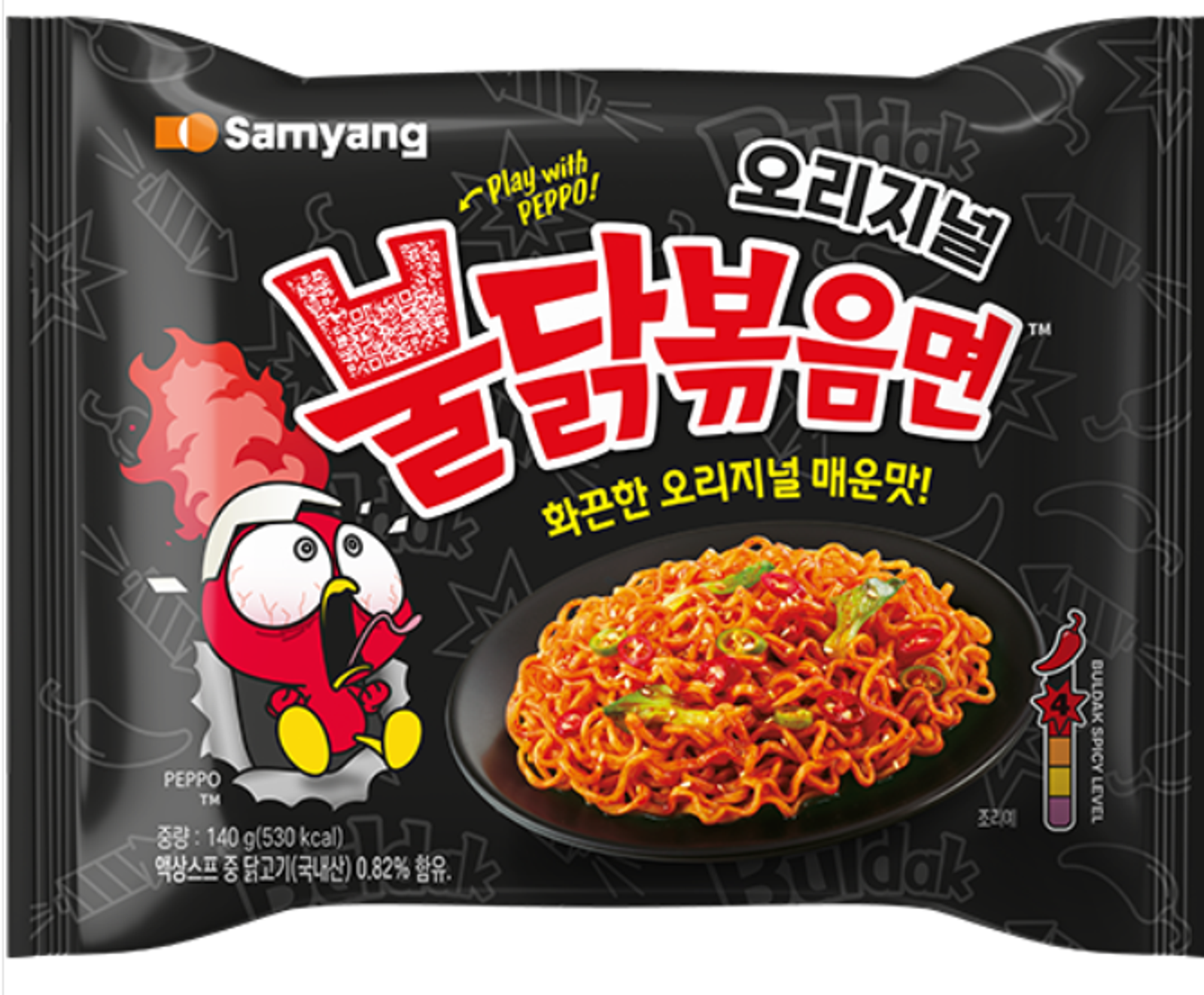
Several risks deserve attention. The trajectory of US tariff policy towards both China and South Korea remains uncertain, and the unpredictable timing of any tariff refund could cause third-quarter results to swing more sharply than expected. The company's heavy reliance on its single hero product — the Buldak ("Fire Chicken") range of spicy stir-fried noodles — leaves it exposed to shifts in consumer tastes. Finally, if the ramp-up of the new Chinese factory is delayed by several quarters, as was the case with the Miryang plant, fixed costs would be front-loaded before the revenue uplift materialises.