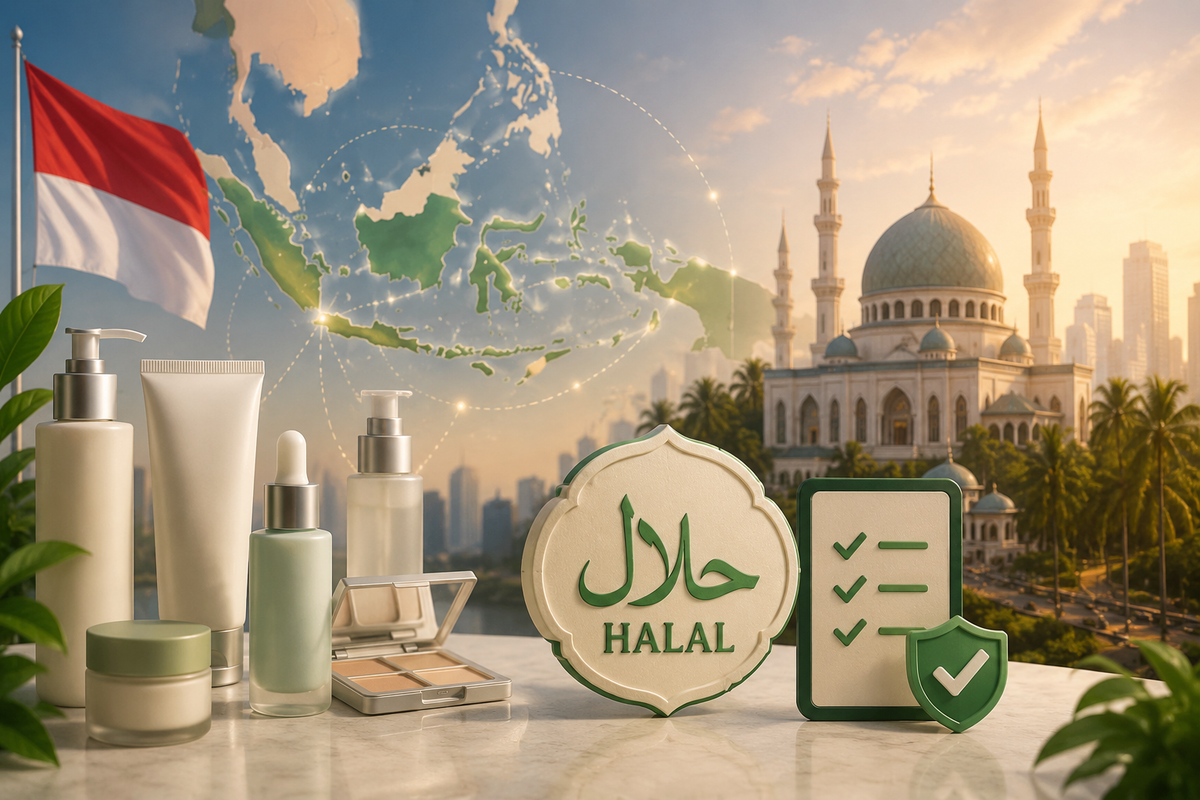
Indonesia's government has adjusted its policy on halal certification requirements for cosmetics, a move that promises to ease the export burden on Korean beauty companies targeting the world's largest Muslim-majority nation. With a population exceeding 270 million, Indonesia sits at the heart of Korean beauty firms' South-East Asian strategy.
Why halal certification became K-beauty's great wall
Under the Halal Product Assurance Law (known by its Indonesian acronym, JPH), enacted in 2019, Indonesia has been phasing in mandatory halal certification across a broad range of consumer goods, including cosmetics. Full enforcement for cosmetics and personal-care products had been scheduled for October 2026—a deadline that was already casting a long shadow over smaller Korean exporters.
Obtaining halal certification is neither quick nor cheap. It requires tracing the origin of every ingredient, auditing the entire manufacturing process, and passing scrutiny by either the Indonesian Ulema Council (MUI) or another government-designated certifying body. Costs can run from tens of millions to hundreds of millions of Korean won, depending on the number of products involved, and the process typically takes several months. For Korea's indie beauty brands—characterised by wide product ranges and short development cycles—this burden was particularly punishing.
According to the Korea Cosmetic Industry Institute, South Korea exported roughly $120m worth of cosmetics to Indonesia in 2023, making it one of Korea's principal South-East Asian markets. Yet industry voices had long warned that full enforcement of the halal mandate could force many uncertified small and medium-sized enterprises (SMEs) off Indonesian shelves entirely.
What has changed, and why
The relief measures centre on either delaying the enforcement timetable for certain product categories, including cosmetics, or broadening exemptions for products aimed primarily at non-Muslim consumers. Since President Prabowo Subianto took office, attracting foreign direct investment and improving the business environment have been declared priorities—and the reforms appear to reflect a recognition that overly stringent rules were deterring global companies from entering the market.
Local economists describe the shift as "an attempt to balance regulatory principle with economic pragmatism," while cautioning that "the durability of the policy will depend on how forcefully Muslim consumer groups and religious organisations push back."
How Korean companies are responding
The Korean cosmetics industry has welcomed the news with qualified optimism. Large conglomerates that had already secured halal certification are largely unaffected; it is the smaller indie brands that stand to benefit most from the breathing room.
Amorepacific and LG H&H (formerly LG Household & Health Care), Korea's two dominant beauty groups, had been building halal-certified product lines through Indonesian subsidiaries for several years. Amorepacific has applied halal certification to Indonesia-specific ranges under brands including Sulwhasoo and Innisfree; LG H&H has done likewise for its premium lines, The History of Whoo and O HUI.
Smaller players tell a different story. Brands defined by trend-driven ingredients and rapid product turnover found the rigidity of halal certification the most disruptive. If the easing of requirements proves durable, the room for these companies to expand in Indonesia should grow considerably.
A crowded global contest
Korea is not alone in coveting this market. Japan's Shiseido, France's L'Oréal and America's Estée Lauder have all launched dedicated halal beauty lines targeting Muslim consumers. L'Oréal has established a halal-dedicated production line in Malaysia; Shiseido has chosen to integrate halal standards throughout its supply chain in Indonesia via local partnerships.
The prize is substantial. According to Statista, the global halal cosmetics market was worth approximately $42bn in 2024 and is forecast to grow at an annual rate of more than 10% through 2030, with Indonesia and Malaysia identified as the fastest-growing segments. Analysts argue that simply obtaining certification will not be enough for K-beauty to maintain its competitive edge: brands must also localise their products to reflect the aesthetic sensibilities and lifestyles of Muslim consumers.
Structural challenges remain
The policy shift is unambiguously positive for Korean exporters, but the underlying challenges have not disappeared. First, Indonesia's halal policy is susceptible to reversal: shifts in the relationship between the government and religious establishment could see requirements tightened again. Second, even where certification is no longer legally compulsory, Muslim millennial and Gen Z consumers—an increasingly powerful cohort—remain sensitive to certification status, making it difficult for uncertified brands to build lasting trust.
Third, Indonesia is simultaneously pursuing industrial policy aimed at nurturing its domestic cosmetics sector, making the longer-term regulatory outlook for foreign brands hard to predict. Home-grown Indonesian halal beauty labels such as Wardah and Sariayu already command loyal followings and position their certified status as a core point of differentiation against foreign competitors.
Outlook
In the near term, the relaxation will lower the barrier to entry for Korean SMEs, allowing them to bring a broader range of products to market more quickly. Over the longer term, however, sustainable success in Indonesia will require a strategic shift: treating halal certification not as a bureaucratic burden to be managed, but as an integral component of brand competitiveness.
At the policy level, the Korean government—through agencies such as KOTRA (Korea's trade and investment promotion body) and the Korea Cosmetic Industry Institute—should consider improving access to existing halal certification consultancy programmes and exploring a shared certification model for SMEs. Indonesia is not a market that simply opens itself once regulatory hurdles are lowered. Only companies that invest in genuinely understanding local values and cultural context are likely to capture the opportunity that its 270 million consumers represent.