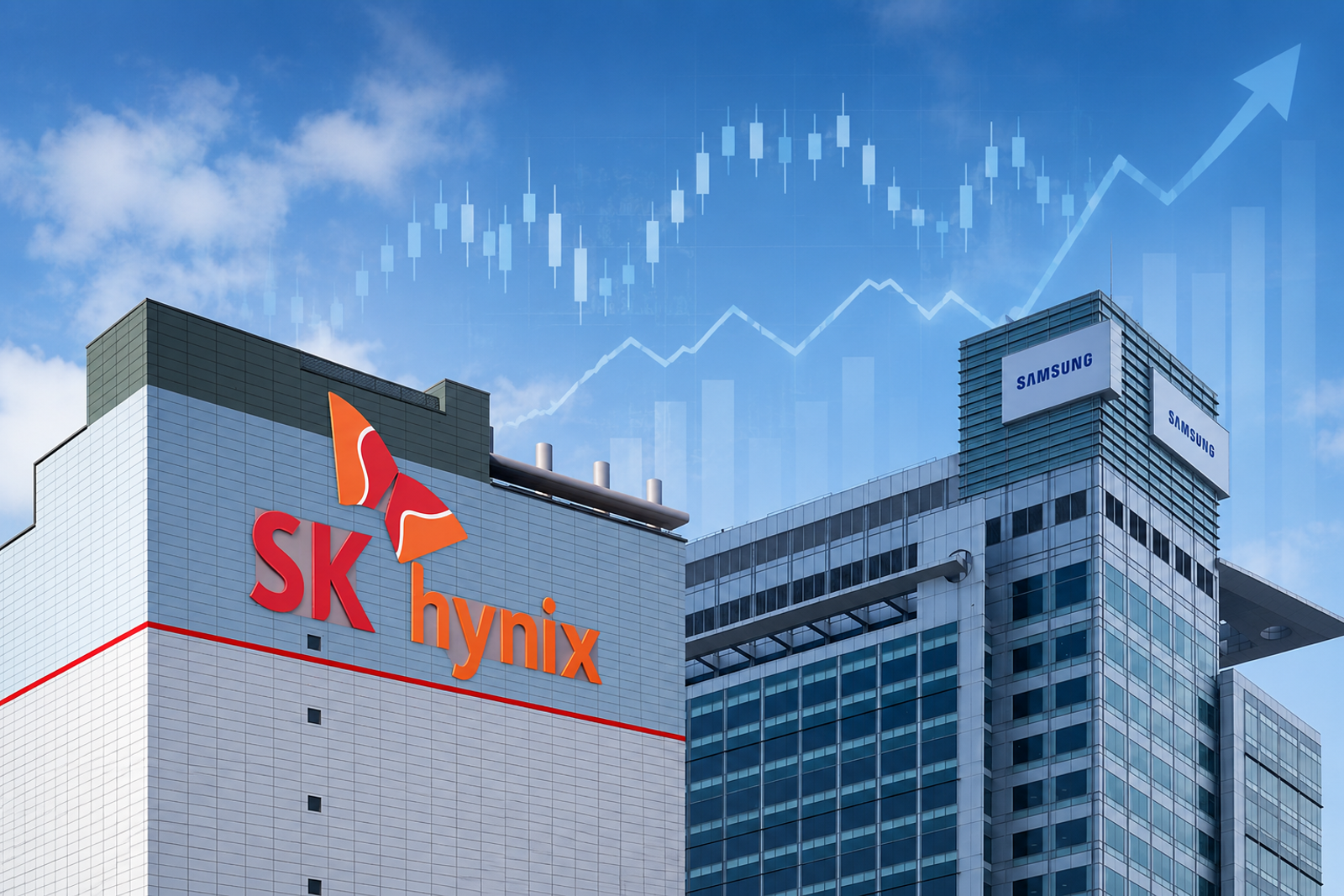
Last week laid bare a striking divergence in how South Korea's two dominant chipmakers plan to return cash to shareholders. On May 19th, SK Hynix announced it would cancel its entire treasury-share holding, worth some 40 trillion won (roughly $29bn). Two days later, Samsung Electronics convened its board and approved a shareholder-return programme of between 90 trillion and 110 trillion won — the largest in the company's history — weighted heavily towards cash dividends, with around 30 trillion won earmarked for payment in the third quarter alone. Both announcements were record-breaking. Yet the methods chosen could hardly be more different.
The standard explanation points to regulation. South Korean fair-trade law requires a listed holding company to own at least 20% of a publicly traded subsidiary. SK Square, SK Hynix's largest shareholder, holds exactly 20.00% — not a single share to spare. On the other side, the Financial Industry Capital Act bars financial companies from collectively holding more than 10% of a non-financial affiliate. Samsung Life Insurance (8.51%) and Samsung Fire & Marine Insurance (1.49%) together are already nudging that ceiling. Taken alone, these constraints make the two companies look like passive victims of regulatory accident, each boxed in by different rules.
But analysts and investors who follow the chaebol — South Korea's family-controlled conglomerates — closely point to something more fundamental: the ownership structures of the controlling families themselves.
Regulation is the stage; ownership is the script
Lee Jae-yong, Samsung's chairman, holds Samsung Electronics shares directly. Every dividend cheque lands in his pocket in proportion to his stake. Share buybacks followed by cancellations, by contrast, carry an awkward side-effect: as the total share count shrinks, the combined stakes of Samsung Life and Samsung Fire automatically rise, pushing them closer to — or over — the 10% ceiling imposed by financial-sector rules. The last time Samsung Electronics cancelled treasury shares, in March this year, both insurers were forced to sell 1.4 trillion won worth of Samsung Electronics stock in an accelerated block trade just to stay within legal limits. Samsung Life is a pillar of the chain through which Mr Lee exercises indirect control over the group; anything that forces it to trim its Samsung Electronics stake weakens that chain. A proposed amendment to insurance regulations — already before the National Assembly and dubbed the "Samsung Life Bill" — would tighten the screws further by capping insurers' holdings of affiliate shares at 3% of total assets, valued at market prices. For Mr Lee, dividends are simply the cleaner option: they deliver cash directly without disturbing the ownership architecture.
Chey Tae-won, SK Group's chairman, faces the mirror-image problem. He holds virtually no SK Hynix shares personally. Last month he bought 3,620 shares (worth roughly 4.8bn won) in his own name as a gesture of managerial accountability — that is essentially the sum total of his direct exposure. His control over SK Hynix runs instead through a chain: SK Inc. owns SK Square, which owns just enough SK Hynix shares to satisfy the legal minimum. In this structure, dividends flowing out of SK Hynix are diluted at each step before any benefit reaches Mr Chey. Cancelling shares, however, lifts SK Square's proportional stake automatically and, by extension, reinforces Mr Chey's grip on the group without requiring him to spend a won of his own money. The maths is straightforward: cancelling the 24.07 million treasury shares announced would push SK Square's holding from 20.00% to approximately 20.68%, creating breathing room for future issuances — including American Depositary Receipts — that might otherwise tip the company below the regulatory floor.
Mr Chey has long spoken of the importance of making all stakeholders "happy together". On this occasion, the cancellation happened to be a rather convenient arrangement in which shareholders and the controlling shareholder could smile simultaneously.
How the market reacted
The market's immediate verdict was unambiguous. SK Hynix's announcement after the close on May 19th sent its shares up 12.73% the following day to 1,691,000 won, touching 1,720,000 won intraday. Samsung Electronics rose a more measured 3.87% on May 21st to 281,500 won. Comparing the two percentage moves directly would be misleading — SK Hynix's surge reflected a full day of pent-up enthusiasm, while Samsung's gain was a same-day reaction — but the divergence in after-hours trading on the 21st is telling. On South Korea's alternative trading platform, Nextrade, which operates until 8pm, Samsung shares slipped back to 270,000 won, below the regular-session close, while SK Hynix climbed further to 1,761,000 won. The pattern suggests that profit-taking set in for Samsung as investors digested the dividend-heavy plan, while SK Hynix continued to attract buyers well into the evening.
The underlying mechanics explain why. A buyback-and-cancellation programme puts the company itself into the market as a buyer, providing a steady, mechanical source of demand. IBK Investment Securities reckoned that the roughly 24 million shares to be acquired over the next three months represents a meaningful improvement in the supply-demand balance. NH Investment Securities noted that the open-ended potential scale of the programme supports a floor under the share price. Hanhwa Investment Securities went further, estimating that SK Hynix's cumulative free cash flow between 2025 and 2027 could reach 491 trillion won; if only half of that were returned to shareholders, total distributions over three years could exceed 245 trillion won.
Dividends work differently. They do not create direct buying pressure but can attract income-oriented investors and support valuation re-ratings. Kim Dong-won, head of research at KB Securities, argued that a sustained high dividend yield could anchor Samsung's shares in the 300,000 won range in the near term, and that a price-to-earnings ratio of around four times is a signal that a genuine re-rating may be beginning. Kim Young-gun at Mirae Asset Securities called the announcement "just the start", estimating that cumulative free cash flow over the next three years could conservatively exceed 600 trillion won — implying a theoretical return capacity ten times the current programme.
In short, SK Hynix's buyback offers more immediate price support through mechanical demand; Samsung's dividend-led approach may take longer to play out but carries greater long-run potential as cash generation compounds.
A convenient alignment — for now
There is an obvious reason to feel uneasy. The "Korea discount" — the persistent gap between Korean blue-chip valuations and those of global peers — has long been attributed to governance structures that prioritise family control over minority shareholders. It would be ironic if the tools deployed to close that discount were themselves designed around the same controlling families' interests.
The cynical reading is available: even these record-breaking returns were shaped first and foremost by each chairman's ownership calculus. But cynicism alone misses something important. The fact that controlling-family interests influenced the choice of method does not mean ordinary shareholders received less. More than 130 trillion won in aggregate is flowing into the market. Both cancellations and dividends are distributed pro-rata; every shareholder benefits in proportion to what they own. This time, the interests of the controlling families and those of minority investors happened to point in the same direction. That is different from past episodes — spin-offs executed at disadvantageous terms, or mergers priced to benefit the family at the expense of outside shareholders — where the two sets of interests plainly diverged.
The Korea discount has been built, in part, by the very ownership structures on display here. On this occasion, those same structures are nudging in the opposite direction. That is progress, even if it arrived for the wrong reasons.
What to watch
The deeper question this episode raises is about durability. The alignment between family and minority interests this time was a result, not a design. There is no structural guarantee that the two will point the same way next time. Resolving the Korea discount requires more than headline-grabbing return programmes; it demands that the interests of controlling families and ordinary shareholders be structurally aligned, not merely accidentally so.
Two specific developments are worth monitoring. First, the fate of the "Samsung Life Bill" in the National Assembly: if passed, it would significantly increase pressure on Samsung Life and Samsung Fire to reduce their Samsung Electronics stakes, potentially forcing the company to reconsider its preference for dividends over buybacks. Second, whether SK Square uses the headroom created by this cancellation — its stake rising to roughly 20.68% — to proceed with additional ADR issuances. How each company responds to these constraints in future capital-allocation decisions will reveal whether this week's announcements represent a genuine shift in governance culture, or simply a fortunate coincidence of interests.