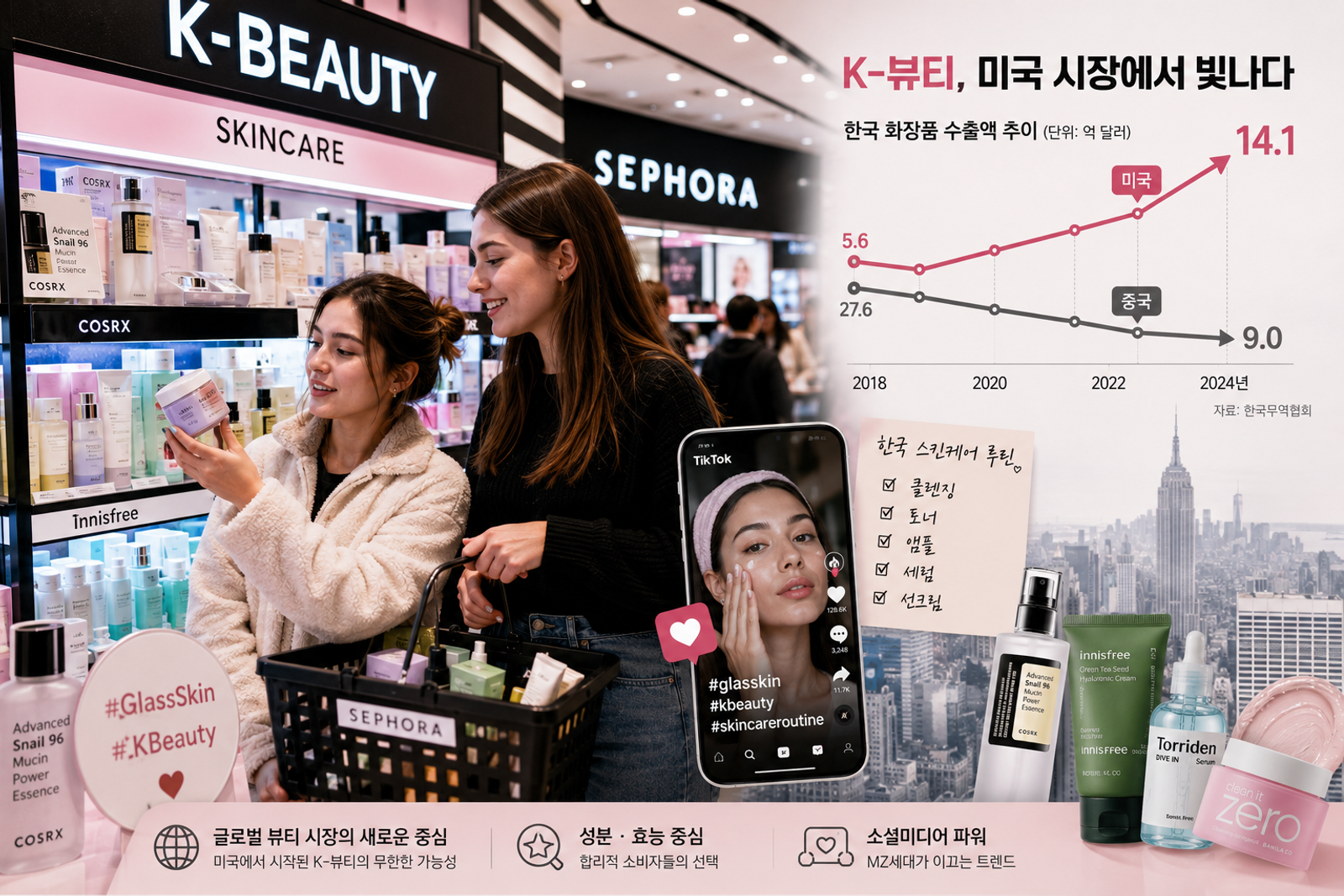
In the autumn of 2024, two women in their twenties paused in front of a shelf of South Korean skincare products at a Sephora store in New York. One of them picked up a cleansing balm and turned to her friend. "I saw this on TikTok. It's Korean." Her friend was already reaching for a basket.
Not so long ago, China was the undisputed heartland of K-beauty. Korean cosmetics brands courted Chinese influencers—known as wanghong—and poured hundreds of millions of won into Singles' Day (Guanggun Jie) promotions. Today, that energy has crossed the Pacific.
According to the Korea International Trade Association, South Korean cosmetics exports to the United States exceeded roughly $1.4 billion in 2024, a record high. Exports to China, once the industry's largest market, have been falling steadily since the early 2020s. Executives across the sector describe the shift as "structural."
The reasons are layered. The damage inflicted by China's informal cultural embargo—imposed in retaliation for South Korea's deployment of the American THAAD missile-defence system—had barely faded when a new threat emerged from within: a surge of nationalist pride in homegrown Chinese beauty brands, known as guochao. As Chinese consumers turned to domestic products, Korean brands found themselves squeezed out.
A senior executive overseeing international operations at Amorepacific, South Korea's largest cosmetics group, put it bluntly: "China taught us a painful lesson. If you are too dependent on a single market, one external shock can bring everything down. America is not merely an alternative—it is a core market we must pursue seriously."
The door to the American market was opened by product quality; social media made it wider. As Korean "glass skin" routines went viral on TikTok and YouTube, younger American consumers began embracing the multi-step Korean skincare regimen—toner, ampoule, sunscreen and more. Brand-name recognition hardly mattered. Hundreds of thousands of glowing reviews were proof enough.
Smaller brands rode the same wave. COSRX, Innisfree and Torriden are now reaching American consumers directly through Amazon and Sephora. COSRX's snail mucin essence, in particular, has held a top spot in Amazon's skincare bestseller rankings for several years running. The unusual provenance of its key ingredient—secretions from snails—proved no obstacle once shoppers understood its reputation for promoting skin regeneration.
The appeal of K-beauty in America goes beyond trend-chasing. Its emphasis on ingredients and efficacy resonates with a culture of rational consumption. Sarah Chen, a 32-year-old beauty blogger based in New York, explains: "Korean products feel honest about what's in them, rather than hiding behind marketing. The value for money is excellent, and you actually see results—so you keep coming back."
Yet the outlook is not without complications. The American market is far more complex and competitive than China ever was. Global giants such as L'Oréal and Estée Lauder are firmly entrenched, and homegrown American brands built around active ingredients such as retinol and vitamin C are formidable rivals. Distribution costs are steep, and for smaller Korean brands without the resources of the large conglomerates, the barriers to entry remain daunting.
Even so, the Korean beauty industry shows no sign of reversing course. Industry insiders speak of America not as a market to be raided quickly, but as a long-term strategic base. Success there, they reason, builds the global credibility needed to unlock Europe, the Middle East and South-East Asia.
Back at the Sephora store in New York, the woman who picked up the cleansing balm ultimately placed two products in her basket. Walking towards the till, she offered a final verdict: "Korean people are genuinely obsessed with skincare."
That single sentence, in many ways, is what South Korean beauty brands have spent decades earning. And now, that trust is taking root in new soil.