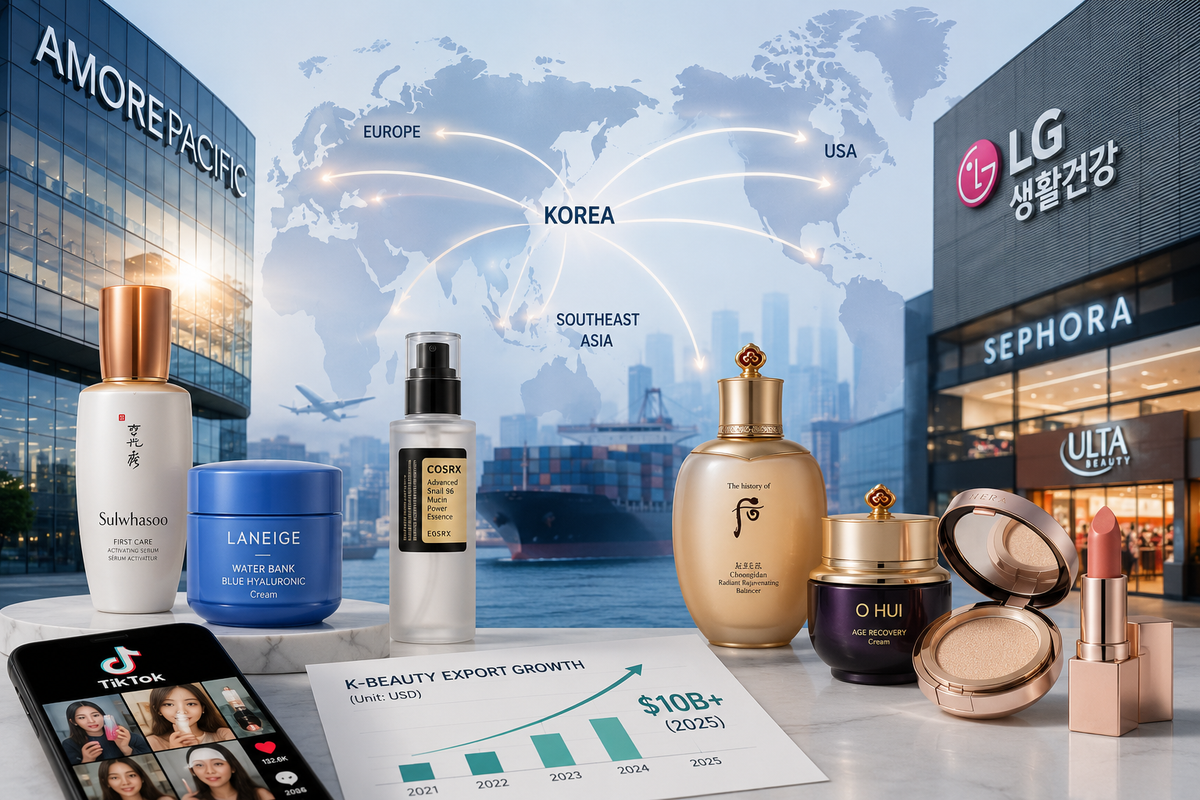
South Korea's cosmetics industry is reasserting itself on the world stage. Amorepacific and LG Household & Health Care (LG H&H) both posted strong overseas revenues in the second quarter of 2026, leading what many in the industry are calling a "K-beauty renaissance." The driving force behind both recoveries is the same: a deliberate and largely successful effort to reduce dependence on China and diversify into the United States, Europe and South-East Asia.
Amorepacific's North American sales are understood to have grown by more than 40% year on year in the second quarter. Its brands—Laneige, Sulwhasoo and CosRX—are rapidly expanding their customer base through Sephora and Amazon. CosRX's snail mucin skincare range has proved particularly explosive, generating a feverish response among Generation Z consumers via TikTok and YouTube. LG H&H, meanwhile, has won plaudits for rehabilitating its overseas business through its premium lines: The History of Whoo and O HUI have performed well in South-East Asia and Japan.
This turnaround is the fruit of years of painful restructuring. Both companies endured a severe slump between 2021 and 2023, when their Chinese revenues collapsed. The causes were well-documented: lingering restrictions on Korean cultural exports following the diplomatic row over the deployment of America's THAAD missile-defence system, combined with the rapid rise of homegrown Chinese beauty brands—so-called C-beauty—had rendered the premium positioning that Korean firms had long relied upon in China largely ineffective. In response, both groups dispersed their export efforts across the United States, Europe, Japan and South-East Asia, and invested aggressively in acquiring independent ("indie") brands and building local influencer-marketing operations.
The recovery extends well beyond these two firms. According to the Korea Cosmetic Industry Institute, South Korean cosmetics exports surpassed $10 billion in 2025, with the United States overtaking China as the largest export market for the first time. The Korea Health Industry Development Institute attributes this growing global confidence in Korean beauty products to a marketing strategy centred on ingredients and dermatological science.
International observers are taking notice. Mintel, the American market research group, has concluded that "Korean skincare has moved beyond a mere trend and is redefining the standard of the American beauty market." Major American retail chains—Target and Ulta Beauty among them—are expanding dedicated K-beauty sections. In Europe, rising demand for ingredient-focused skincare in Germany and France is opening further doors for Korean brands.
Yet formidable challenges remain. Industry analysts point to intensifying competition from smaller indie brands, tough margin negotiations with global retail partners, and the burden of navigating divergent regulatory regimes across multiple markets. Some question the sustainability of a marketing model so heavily reliant on TikTok: should American regulators succeed in curbing or banning the platform, Korean beauty companies would lose one of their most powerful promotional channels. A sustained appreciation of the Korean won poses an additional risk, potentially eroding the price competitiveness of Korean exports.
The trajectory of Japanese beauty offers a cautionary tale. Shiseido, Kanebo and their peers once dominated global cosmetics in the 1990s and 2000s, only to cede ground steadily as they failed to localise effectively in China and Western markets, and became ever more reliant on domestic demand. Experts broadly agree that avoiding the same fate will require Korean companies to pursue a dual strategy: reducing dependence on any single market or channel, while remaining nimble enough to respond to local consumer preferences without diluting their brand identity.
The second-quarter rebound at Amorepacific and LG H&H should not be read as a seasonal blip. It looks more like the first tangible payoff from years of strategic reinvention—a two-track approach that pitches premium branding in the United States and Europe while competing on value and technical sophistication in South-East Asia and the Middle East. Whether K-beauty can establish itself as a durable global industry, rather than a passing fashion, will ultimately depend on technological innovation, supply-chain resilience and the patient, long-term stewardship of brand equity.