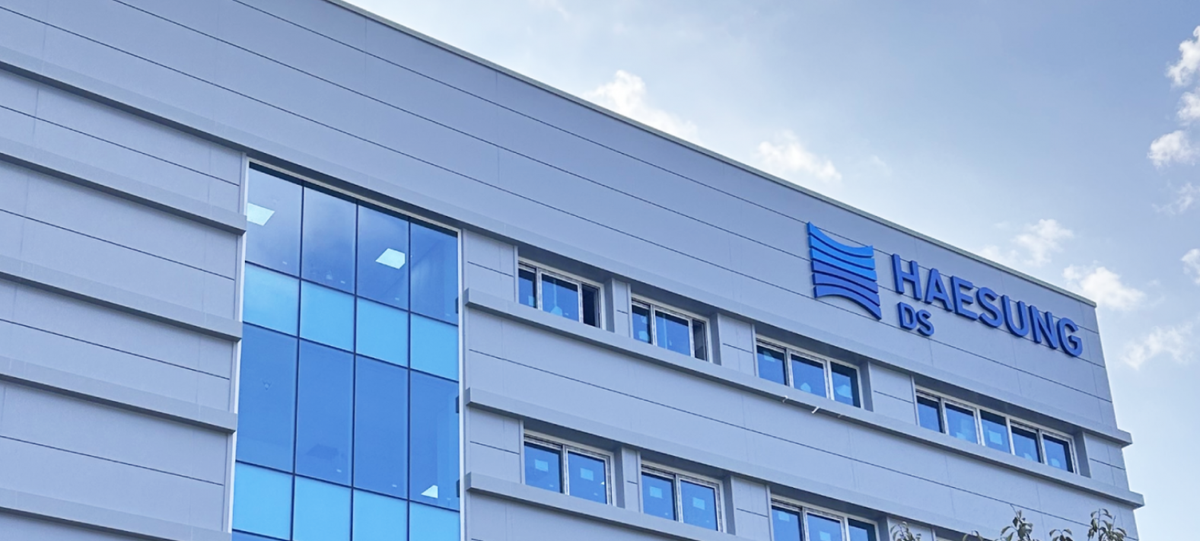
Kiwoom Securities maintained its "Buy" rating on Haesung DS (KOSPI: 195870) on 30th July but cut its target price sharply, from 120,000 won to 80,000 won.
Analyst Kwon Min-gyu, writing in a company note published the same day, attributed the reduction to falling peer-group valuation multiples triggered by the broader global equity sell-off. Haesung DS shares closed at 40,150 won on 29th July, down 61% from their 52-week high of 102,400 won.
The revised target is derived by applying a price-to-earnings multiple of 12.2 times — a 20% discount to the 2027 forecast P/E of global lead-frame peers — to the company's projected 2027 earnings per share of 6,924 won, yielding an intrinsic value of 84,334 won. At the current price, the stock trades at 8.1 times forecast 2026 earnings, well below Haesung DS's own five-year historical average P/E of 11.9 times. The gap between the current share price and the target stands at 99%.
A blowout quarter
Haesung DS reported revenues of 211.1bn won for the second quarter of 2026 (April–June), with operating profit of 24.9bn won — a 202% jump year-on-year and an operating margin of 12%. The result beat the market consensus of 22.5bn won by 2.4bn won. Sequentially, operating profit surged 127% from the 11bn won recorded in the first quarter. In a single quarter, the company earned more than half of its entire 2025 annual operating profit of 46.5bn won.
Two factors drove the strong performance. First, demand for lead frames — thin metal components used in semiconductor packaging — rose across the board. In the IT segment, volumes destined for data centres increased. In the automotive segment, a recovery in electric-vehicle shipments combined with customers restocking depleted inventories provided a further lift. Margins also benefited from a lag effect: the spike in London Metal Exchange (LME) copper prices seen in the first quarter had been passed on to customers during that period, and when those elevated selling prices fed through to the second quarter under the company's lagged pricing mechanism, margins expanded accordingly. A persistently weak Korean won, favourable for an export-oriented business, added to the tailwind.
The packaging-substrate division told a more mixed story. Although the company secured higher selling prices after completing contract negotiations in the second quarter, volumes fell as customers ran down inventories ahead of a process migration. As a result, divisional revenues edged down 2% from the previous quarter.
The outlook: capacity ramp and new businesses
Kiwoom Securities expects the packaging-substrate business to pick up meaningfully from the third quarter onwards. New factory qualifications — supplying D1b Prime to one customer (referred to as "S"), D1c technology to another ("H"), and an expansion of volumes for a third ("C") — are expected to raise the division's utilisation rates and push it back into profit.
The lead-frame business is also running at maximum utilisation, with newly added production capacity beginning to flow through to results from the third quarter.
Haesung DS is additionally developing a heat-slug product — a thermal-management component used in advanced chip packaging — as a new business line. The company plans to begin supplying heat slugs for smartphone application processors in the second half of this year, using that as a reference to pursue entry into the higher-value server FC-BGA market. Meanwhile, its power-semiconductor lead-frame business has already surpassed the whole of its 2025 revenue within the first half of 2026 alone.
Kiwoom Securities forecasts full-year 2026 revenues of 881.7bn won, up 35% year-on-year, with operating profit of 104.7bn won, up 125%, implying an operating margin of 11.9% against 7.1% in 2025. By 2027, revenues are projected to reach 1.03tn won, with operating profit of 153.8bn won and a margin of 15%.
Risks to watch
Several risks warrant attention. A fresh spike in LME copper prices could temporarily squeeze margins, given the lag between spot prices and the selling prices the company can charge customers. A slowdown in either data-centre investment or electric-vehicle demand would directly dent lead-frame volumes, as both sectors account for a substantial share of orders. The ramp-up in packaging-substrate shipments depends on customers' own process-transition schedules, which could slip. And if the broad de-rating of semiconductor stocks continues, it may cap any near-term share-price recovery, however compelling the fundamental case appears.