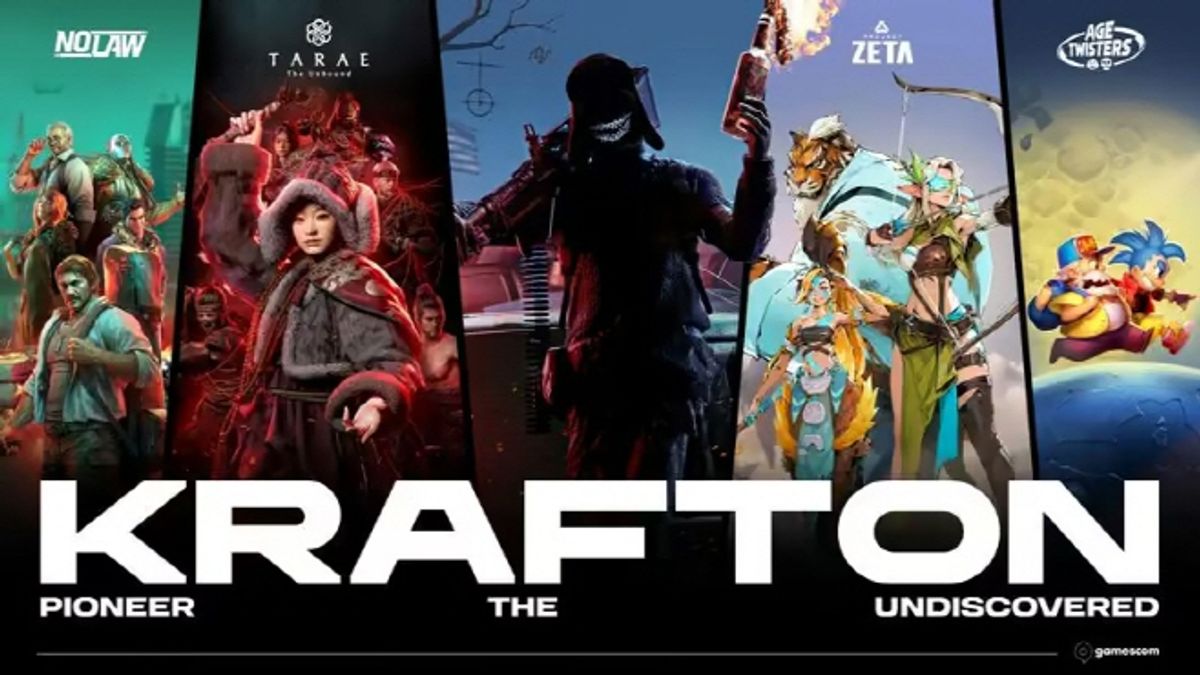
Krafton has seized the attention of the global games industry by generating, in the first half of 2025 alone, 92% of its full-year operating profit for 2024. The result reflects two converging forces: the enduring profitability of the PUBG (Battlegrounds) intellectual property and rapid user growth in emerging markets, particularly India and South-East Asia. Yet opinion is divided on whether the performance can be sustained. User-generated content (UGC) and artificial intelligence are emerging as new strategic pillars, but the company still faces the most fundamental test in the games business — proving it can produce another hit.
Six months, 92% of a year's profit: the power of the PUBG franchise
The headline figures are striking on their own terms. The primary engine is Battlegrounds Mobile. Market-share gains in India and an expanding user base across the Middle East and Latin America drove the results. Krafton India, the company's local subsidiary, is credited with simultaneously lifting player numbers and payment-conversion rates through a disciplined localisation strategy.
According to Newzoo, a games-industry research firm, India's mobile gaming market is forecast to reach roughly $3.2bn in 2025. Krafton is considered one of its principal beneficiaries. Battlegrounds Mobile India (BGMI) has held a top position in local download rankings for several months running, and investment in an esports ecosystem has deepened fan loyalty.
UGC strategy: from game publisher to platform operator
User-generated content is central to Krafton's medium- and long-term growth plan. Through its proprietary UGC platform, Creators Lab, the company is building an ecosystem that allows players to design maps, modes and other content and to monetise their work. The model follows a path already validated by Roblox and Fortnite's Creative mode — the transition from content provider to platform operator.
By 2024, Roblox had paid its UGC creators a cumulative total exceeding $1bn; that ecosystem now underpins the platform's 88 million monthly active users. Epic Games is likewise using Fortnite's Creative 2.0 (UEFN) to harness a developer community as the engine of platform expansion. Industry analysts broadly agree that, if Krafton travels the same road successfully, the PUBG franchise has considerable life left in it.
"If the UGC strategy takes root, Krafton can reduce its dependence on a single title while continuously expanding the IP ecosystem — a virtuous circle," said one South Korean games analyst. Sceptics exist, however. They argue that without rigorous quality controls, a sound revenue-sharing structure, and well-designed incentives to encourage spontaneous creative participation, the push towards platformisation will come to nothing.
AI integration: opportunity or hype?
Krafton is integrating artificial intelligence into its actual development pipeline rather than deploying it merely as a marketing slogan. The company is applying generative AI to NPC behaviour, procedural content generation and anti-cheat systems, and is exploring the commercialisation of in-game AI services through a dedicated research unit.
Collaborations with AI start-ups in which Krafton has invested could give rise to next-generation interaction models — natural-language conversations with AI-driven NPCs, for instance — that would alter the very paradigm of the gaming experience rather than merely improving existing features. Yet monetising AI investment meaningfully will take considerable time and carries real uncertainty. Some market participants worry that the current valuation premium already prices in an overly optimistic future.
The new-title problem
For all the brilliance of the first-half numbers, the most fundamental challenge before Krafton is demonstrating what comes after Battlegrounds. The company is rolling out a succession of new titles: Dark and Darker Mobile, an RPG; the interactive story game Dinkum Together; and its most closely watched project, inZOI, a life-simulation game.
InZOI attracted the attention of The Sims fan community worldwide before its release and delivered impressive results even in early access — a strategy that appears to have exploited EA's reluctance to invest heavily in a new Sims instalment. Early-access success and durable long-term retention after a full commercial launch are, however, entirely different things. Numerous developers, both in South Korea and abroad, have seen promising early-access titles haemorrhage users once a game enters full service.
It is also unclear whether console and PC-focused new releases can replace the mobile-centric revenue structure that has underpinned Krafton's profits. With several titles simultaneously consuming development and marketing budgets, a string of commercial disappointments could rapidly worsen the company's cost structure.
The single-IP trap: lessons from elsewhere
Krafton's dilemma is familiar in a global context. Supercell maximised returns from Clash of Clans for years, but subsequent titles — Clash Royale and Boom Beach among them — failed to replicate its success, leaving the company in a prolonged plateau. Blizzard spent years searching for a new mega-franchise after the peak of World of Warcraft.
Riot Games, by contrast, parlayed the League of Legends IP into multiple genres and platforms — Legends of Runeterra, Valorant, Teamfight Tactics — dramatically extending the franchise's commercial life. Krafton's strategy of broadening the Battlegrounds IP through UGC, esports and derivative titles is structurally similar to Riot's approach. The critical variable is the precision and pace of execution.
At an inflection point
A closer look at the quality of the first-half results makes clear that Krafton's growth is not a one-off. The headroom for expansion in India and other emerging markets, the potential to evolve into a platform through UGC, and efficiency gains from AI in development all support a constructive structural outlook over the medium term.
Yet this is also a moment of proof. Three things must become visible simultaneously before the "single-IP company" label can be convincingly shed: a new hit title that meaningfully reduces revenue dependence on Battlegrounds; a sustainable monetisation model for the UGC ecosystem; and tangible returns from AI investment.
The second half of 2025 is shaping up as the opening act of that test. Markets are watching closely for inZOI's full-launch performance and for greater clarity on the new-title pipeline. The central question facing Krafton is whether dazzling financial results can be converted into evidence of genuine structural transformation.