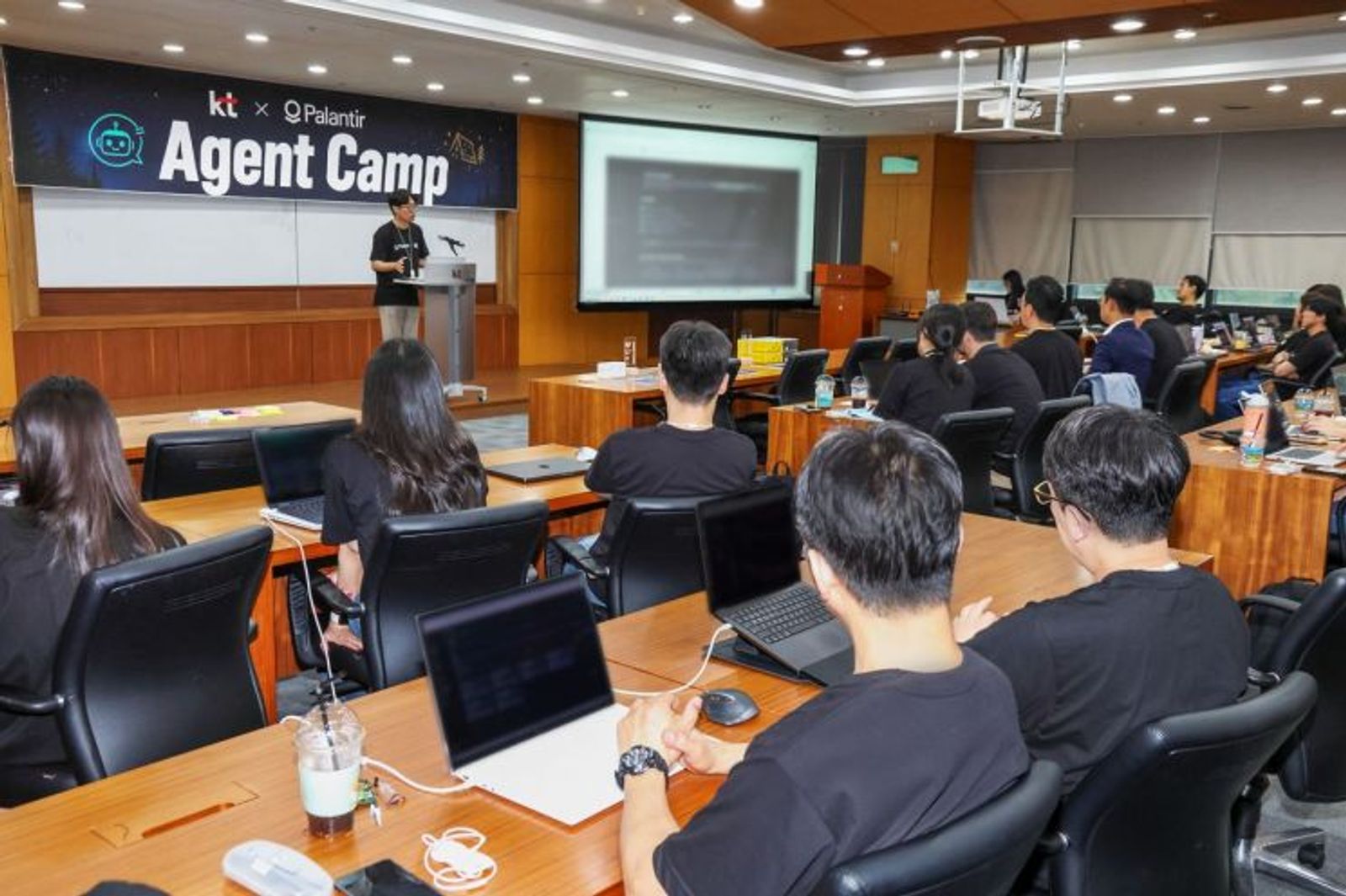
KT, one of South Korea's largest telecommunications groups, has struck a partnership with Palantir Technologies, the American data-analytics and artificial-intelligence firm, to develop homegrown specialists in AI agent technology. Industry observers say the collaboration goes far beyond a standard technology-licensing arrangement: it reflects a deliberate strategy to construct an AI workforce ecosystem from the ground up.
What makes the Palantir partnership distinctive
Palantir built its reputation supplying data-analysis tools to American intelligence agencies, including the CIA. It has since leveraged that expertise through its Artificial Intelligence Platform (AIP), rapidly expanding into the market for enterprise AI agents — software capable of autonomously analysing and executing complex workflows. The company has been broadening its commercial reach beyond defence and government into finance, manufacturing and telecommunications, drawing the attention of major corporations worldwide.
Under the terms of the KT partnership, Palantir's AI platform will serve as the foundation for a structured, practical training programme designed to produce job-ready AI agent professionals in South Korea. AI agents are widely regarded as the next frontier beyond generative AI tools: rather than merely responding to prompts, they autonomously manage intricate business processes end-to-end. Industry practitioners consider 2025 to 2027 a critical window — a "golden period" — during which demand for such specialists will surge, intensifying competition to secure talent.
South Korea's AI talent shortage: a structural problem
The scale of the challenge is daunting. According to data from South Korea's Ministry of Science and ICT and the Korea Institute of Science and Technology Evaluation and Planning (KISTEP), the country faced a shortfall of roughly 12,000 AI professionals in 2023; that gap is projected to exceed 20,000 by 2027. The scarcity is sharpest at the intermediate and senior levels — engineers who can handle MLOps (the operational management of machine-learning systems) and design autonomous AI agents.
"There is no shortage of people who know how to use AI services like ChatGPT," said one IT industry executive. "But professionals who can connect a company's internal data and business processes to build and operate a genuinely autonomous AI agent are extremely rare." This gap is prompting both large conglomerates and foreign technology platforms to intervene directly in talent development.
Precedents from abroad: how Big Tech builds talent ecosystems
The structure of the KT-Palantir tie-up mirrors a model already pioneered by global technology giants. Google's "AI Skills for Africa" programme cultivated local specialists around its cloud and AI products, simultaneously expanding its customer ecosystem. Microsoft similarly used its "AI for Good" initiative and Copilot certification courses to accelerate enterprise AI adoption.
Palantir itself has previously employed intensive bootcamp-style training programmes with American and British government clients to build a rapid base of AIP platform users. The KT deal is, in many respects, an adaptation of that playbook for the South Korean market. For Palantir, the arrangement carries a dual benefit: a foothold in the Korean corporate market and a set of local reference clients to bolster future sales.
KT's strategic calculus: a bridgehead for AI transformation
KT has formally declared its ambition to reinvent itself as a "digital and AI company," restructuring its business portfolio accordingly. With AI infrastructure, cloud services and AI-driven products designated as the group's core growth engines, the partnership with Palantir is less a standalone training initiative than a means of building competitive capability from within. It is best understood as a long-term investment in KT's AI solutions business.
KT is reportedly considering extending the programme's reach beyond its own employees — encompassing partner companies and corporate clients as well. The logic is straightforward: by making talent development the mechanism for deepening relationships with business customers, KT can simultaneously stimulate domestic demand for Palantir AIP-based solutions, creating a self-reinforcing cycle of adoption and expertise.
Risks: dependency and long-term sustainability
Not everyone is sanguine. Some critics warn that anchoring South Korea's AI agent capabilities around a foreign platform risks creating structural dependence. If the country's AI workforce is trained primarily on Palantir's proprietary tools, South Korean companies may find themselves at a disadvantage in future licensing negotiations and may gradually cede technological sovereignty.
AI policy researchers caution that while talent development is inherently positive, "a talent pool that is locked into a single platform could, over time, weaken South Korea's capacity for independent AI development." Several voices in the industry argue that any collaboration between large conglomerates and foreign platforms must be designed to coexist with — rather than crowd out — the domestic AI start-up ecosystem.
Outlook: the telecoms-AI alliance spreads
The KT-Palantir partnership is likely to set a precedent for how South Korean telecoms groups engage with global AI platform companies. The country's three major carriers are all moving quickly to sharpen their AI strategies: SK Telecom has invested in Anthropic, the American AI safety company, while LG Uplus is building its own proprietary AI agent platform. Competition over talent is set to intensify in parallel.
Experts stress that the real measure of this partnership's success will not be the volume of training courses delivered, but the number of verified professionals it produces — people capable of designing and operating AI agents in real corporate environments. Whether KT and Palantir can together lay the genuine foundations for a Korean AI agent ecosystem remains the question the market is watching most closely.