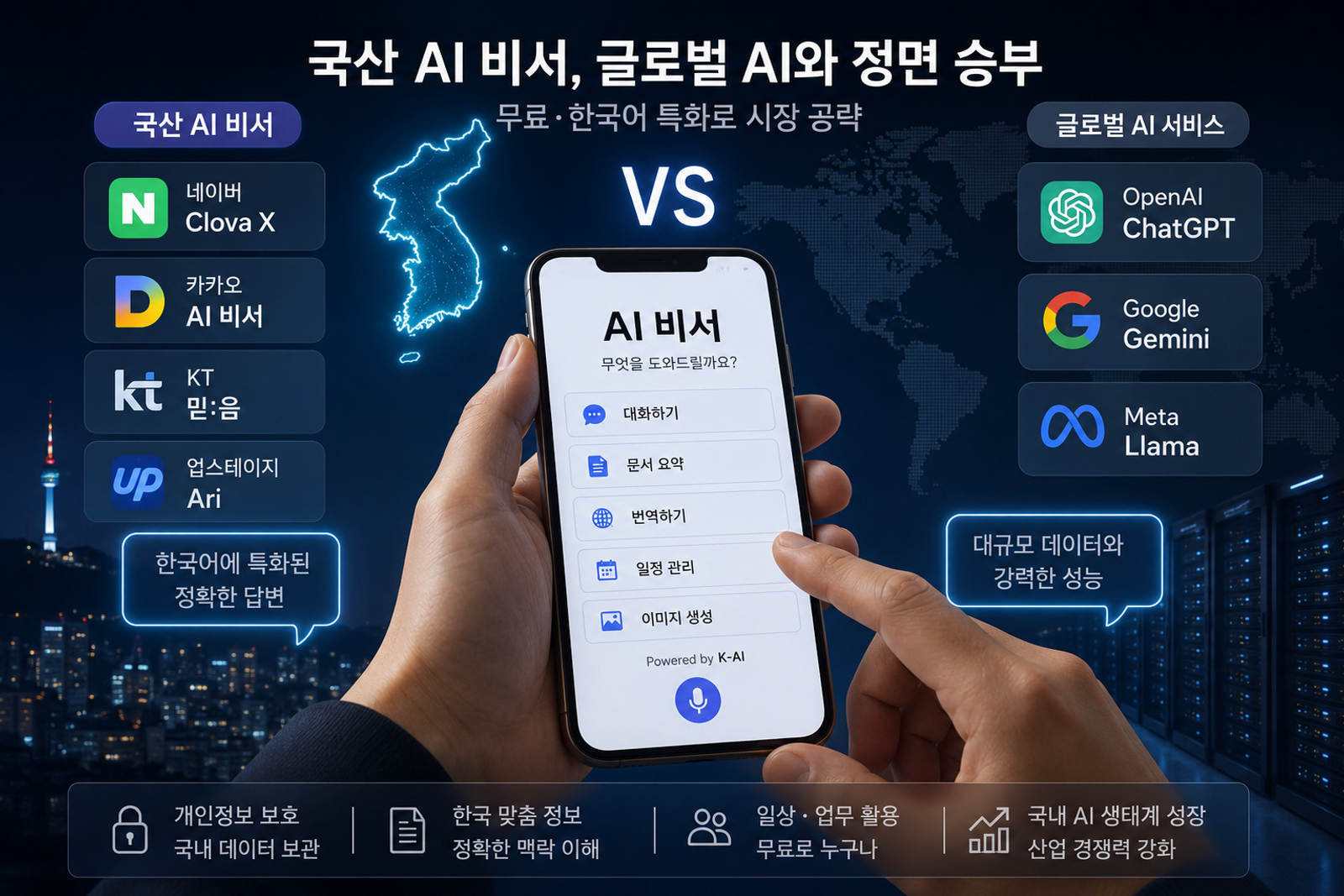
South Korea's leading technology companies are rolling out free AI assistant services in rapid succession, entering direct competition with global generative-AI platforms such as ChatGPT and Google Gemini. Their strategy rests on superior Korean-language performance and locally tailored features as weapons to reclaim ground in the domestic market.
Free-to-use: lowering the drawbridge
The decision to offer core features at no charge is a calculated move to reduce the barriers to adoption. Using ChatGPT's higher-performance models — GPT-4o and above — requires a paid subscription of at least $20 a month (roughly 28,000 won); Google Gemini Advanced costs a similar amount. By contrast, the Korean entrants are making their primary functions freely available, aiming first to capture everyday consumers and small-business customers.
The tactic echoes the way domestic portal companies once built their user base against Google in the search market. The analogy has limits, however: AI services demand enormous computing resources for both model training and inference, so designing a viable long-term revenue model remains an unsolved problem.
Korean fluency as a competitive edge
Because the leading global AI models are trained predominantly on English-language data, analysts argue that Korean-built systems could hold a meaningful advantage in processing accuracy and cultural comprehension. In domains with distinctly Korean institutional contexts — legal, administrative and medical queries, for instance — specialised domestic models may well deliver more practical answers than general-purpose global ones.
Domestic AI benchmark results have occasionally borne this out: Korean models have matched, or in some categories surpassed, their global rivals on Korean-language generation and comprehension tests. That gap, if it holds, translates into a tangible difference in the quality of experience for Korean users — something beyond mere translation.
The gap with global big tech remains formidable
Optimism should be tempered, however. OpenAI, Google and Meta continue to pour trillions of won into AI infrastructure, and the pace at which they improve their models is relentless. On sheer parameter counts and the absolute volume of training data, Korean models face structural constraints that cannot easily be overcome in the short term.
Global services are also closing in on Korean-language quality. ChatGPT has steadily improved its Korean-language responses; Google Gemini is expanding its Korean-language multimodal capabilities. Over time, the linguistic edge that Korean AI firms claim could erode.
Lessons from abroad
Comparable competitive dynamics have played out elsewhere. In China, domestic models such as Baidu's ERNIE Bot and Alibaba's Tongyi Qianwen have effectively displaced global services in the home market, bolstered by government backing and a regulatory environment that restricts foreign competition. France's Mistral AI carved out a distinctive position through a focus on European languages and an open-source strategy, winning enterprise clients in the process.
The picture is not uniformly encouraging. Japan's LY Corporation (formerly Line Yahoo) and several German AI start-ups have struggled to establish a clear market position against global models, remaining confined to niche segments. Their experience suggests that linguistic specialisation alone is insufficient; expanding the surrounding ecosystem and linking AI capabilities to compelling "killer" applications are what ultimately determine success or failure.
Policy and industry implications
The launch of these domestic AI assistants amounts to more than a product release — it is a test of whether South Korea's AI industry can sustain itself on its own terms. Industry voices have consistently called on the government to provide commensurate support: broader access to public data, subsidised computing resources and the operation of regulatory sandboxes that allow experimentation without undue legal risk.
Winning user trust is equally critical. Clear standards on the handling of personal data, domestic storage of user information, and transparency in how the systems generate responses will determine whether Korean AI assistants can build lasting loyalty. Whether they can transcend the role of a localised ChatGPT substitute and prove themselves as genuinely independent platforms is a question the market will begin to answer in the second half of 2026.