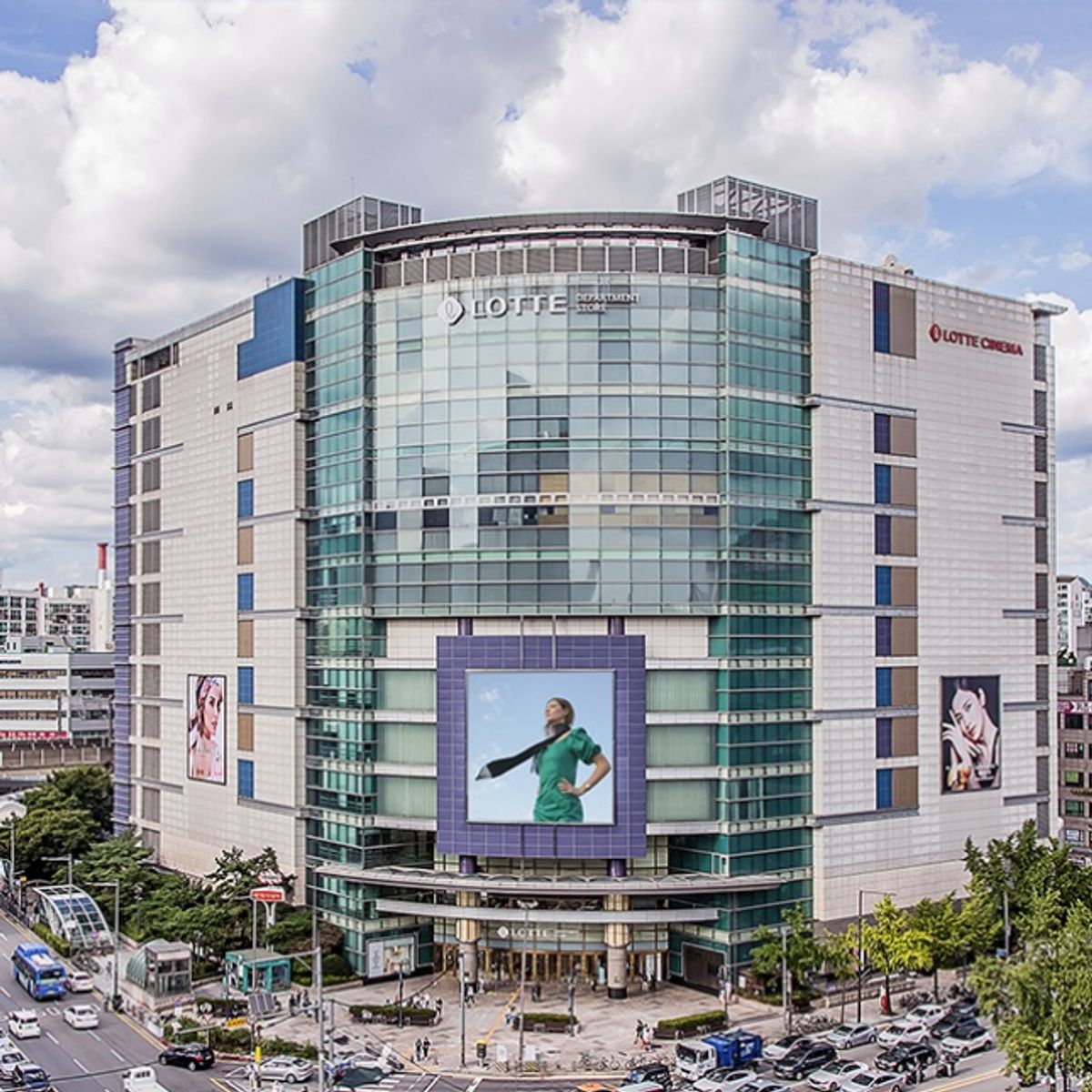
When Lotte Department Store launched its first-ever voluntary redundancy scheme in 2021, the industry chalked it up to the pandemic. Some called it a temporary crisis. Now, barely four years later, South Korea's largest department-store operator has reached for the same instrument again — and this time, the excuses are harder to sustain.
The move has reignited a fundamental debate about whether the offline retail model in South Korea can survive, and on what terms.
What has changed the second time around
The 2021 scheme shocked an industry accustomed to regarding Lotte as a retail behemoth, a "distribution dinosaur" in the Korean vernacular. The stated culprit then was pandemic-era consumer retrenchment. But the recurrence so soon after suggests that the post-pandemic recovery never delivered what management had hoped.
Data from the Ministry of Trade, Industry and Energy bear this out. Department-store sales growth staged a brief rebound in 2022 before decelerating again from 2023 onwards. The luxury-goods boom that had briefly flattered the sector faded as global economic conditions deteriorated and interest rates stayed high. Mid-market brands, which dominate the offering at smaller and regional stores, were hit hardest.
Lotte's particular vulnerability reflects its strategic positioning. Compared with its two main rivals — Hyundai Department Store and Shinsegae — Lotte carries a lower proportion of luxury-brand concessions and relies more heavily on provincial locations. In an environment where consumer spending is polarising sharply between the affluent and the budget-conscious, that combination is punishing.
The e-commerce vice and the fixed-cost trap
Accelerating all of this is the relentless growth of online retail. According to Statistics Korea, online shopping transactions exceeded 260 trillion won (roughly $190 billion) in 2024, and their share of total retail sales continues to climb. Platforms such as Coupang, Naver Shopping, and Kurly have expanded from groceries and fashion into territory — including luxury goods — that department stores once considered their exclusive domain.
The structural problem for department stores is that their cost base does not shrink when revenue does. Rent, staffing, and facilities maintenance are largely fixed. "E-commerce players can flex their cost structures with demand," one industry executive noted. "An offline department store, as long as it keeps its doors open, is stuck with almost the same costs regardless of how much it sells. Workforce restructuring is the fastest lever available."
That lever, however, is also a blunt one.
A Lotte problem, or an industry problem?
Opinion is divided on whether this is a company-specific failure or a systemic crisis.
The optimists point to Hyundai and Shinsegae, which have sustained relatively stable growth through premium repositioning and the expansion of mixed-use retail complexes. Shinsegae's Starfield properties have successfully repositioned themselves as destinations for experiential consumption, maintaining footfall in a way that conventional department stores struggle to replicate. Hyundai's The Hyundai Seoul, meanwhile, has drawn younger shoppers — the so-called MZ generation — through a deliberate aesthetic and tenant overhaul.
The pessimists retort that Lotte is simply "the first to catch the wave that others will face in turn." A researcher at the Korea Distribution Industry Institute put it bluntly: "The collapse of provincial commercial districts, demographic decline, and the polarisation of consumer spending are converging to shrink the space available for mid-to-upper-tier department stores." It is an open secret in the industry that many of Lotte's provincial stores have been loss-making for years.
Lessons from the retail apocalypse abroad
This trajectory is familiar to observers of Western retail. In the United States, Sears, JC Penney, and Neiman Marcus — once titans of the department-store format — filed for bankruptcy or undertook sweeping store closures. The term "retail apocalypse" entered the lexicon around this period. In Japan, venerable chains such as Seibu and Sogo shrank their store networks and reinvented their formats to survive.
What distinguished the survivors in each market was a consistent strategy: shrink to strength, and go upmarket. Harrods in London and Saks Fifth Avenue in New York navigated the crisis through rigorous premiumisation and a redesign around experiential retail. The implication for Lotte is uncomfortable but clear.
The human cost of a second restructuring
Voluntary redundancy is, in law, a resignation. In practice, it rarely feels that way. Employees who lived through Lotte's first round are reportedly unsettled by the repetition. Beyond the immediate human toll, there is a strategic risk: when job security erodes visibly, the first to leave are often those with the most options — precisely the skilled staff a company needs to execute a transformation.
Research by the Korea Labour Institute suggests that companies that undergo repeated restructuring rounds tend to suffer a dual burden of falling productivity and weakening organisational loyalty. The short-term cost savings can undermine the long-term capabilities needed to recover.
Beyond the redundancies: Lotte's strategic choices
Experts are broadly agreed that cutting headcount is not, by itself, a strategy. For Lotte to secure its medium-term future, they argue, workforce reduction must be accompanied by store-by-store format reinvention, the development of data-driven personalised services, and a rethink of how Lotte's various retail subsidiaries — department stores, supermarkets, and others — can generate genuine synergies within the group.
Some analysts advocate a clear "choose and concentrate" approach: exit unprofitable provincial stores decisively, and redevelop flagship urban locations as mixed cultural and retail spaces. Lotte has already experimented with pop-up retail and experiential content in selected stores, but whether the pace and scale of that experimentation is sufficient to match the speed of market change remains an open question.
This second round of voluntary redundancies at Lotte Department Store is not a routine management event. It is a signal that the geography of South Korean consumer culture has shifted in ways that may be irreversible. How Lotte responds will help determine not just its own fate, but the shape of the country's offline retail landscape for years to come.