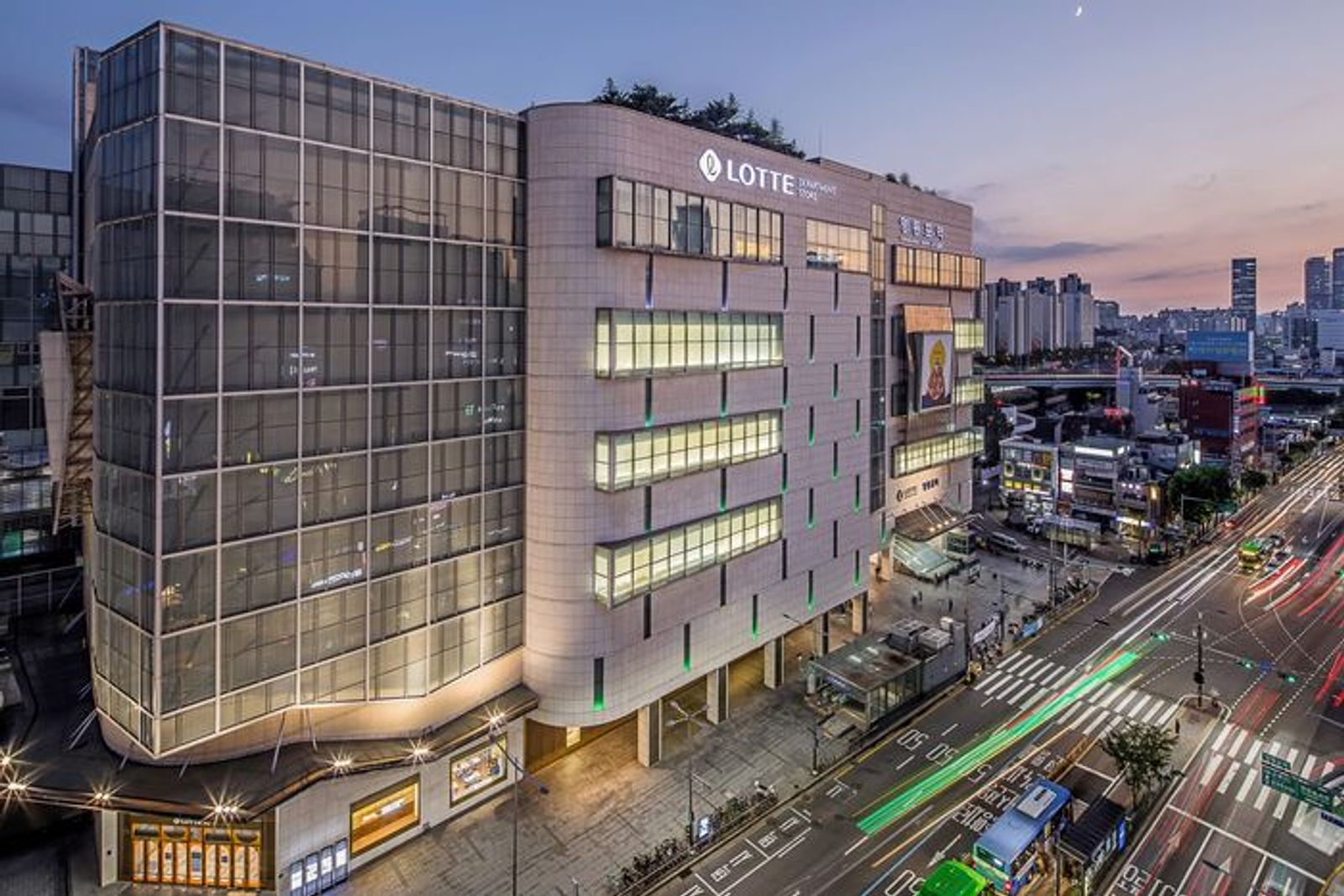
Lotte Shopping has secured the right to operate its Yeongdeungpo department store for a further ten years, after being selected as the new designated tenant of Yeongdeungpo Station's commercial complex. The deal is widely seen as protecting a critical anchor in Seoul's south-western retail corridor — but industry observers read it as something more: a revealing signal of how Korea's established retailers intend to survive the age of e-commerce.
Station retail: the last great battleground for physical space
The Yeongdeungpo Station complex sits on land owned by Korail (Korea's national railway operator) and ranks among the most coveted commercial sites in the greater Seoul area. The station serves more than 100,000 passengers a day, functioning as the principal transit hub for south-western Seoul with connections to Seoul Metro Line 1, the Airport Railway, and a dense network of regional bus routes. Its catchment area is correspondingly vast.
Lotte's department store has occupied the site since 1991, weathering more than three decades of competitive upheaval — including the rise of neighbouring rivals such as Times Square and Shinsegae — without losing its footing. The reason is largely structural. "A department store directly connected to a railway station captures footfall regardless of weather or season," notes one retail industry executive. "That gives it a structurally lower risk profile than any ordinary high-street location."
Why Lotte won the bid
The tender, run by Korail Distribution, attracted interest from several retailers. Evaluation criteria extended well beyond headline rent, encompassing planned capital investment, operational track record, and brand drawing power. Most analysts believe Lotte's three decades of on-site experience, combined with credible commitments to refurbishment, proved decisive.
Lotte Department Store has in recent years undertaken substantial renovations of its older properties — most notably the transformation of its Jamsil store into "The Avenuele World Tower" and its involvement in the redevelopment of the Incheon Terminal site. A significant spatial overhaul of the Yeongdeungpo store within the ten-year contract period is widely anticipated. "Korail needed a partner that could simultaneously raise the station's image and maximise rental income," says one retail analyst. "Lotte's investment commitments were almost certainly the deciding factor."
The paradox of offline retail's transit-hub land grab
The timing of the deal carries an irony that is hard to ignore. South Korea's department store sector enjoyed a brief surge in 2022 and 2023, driven by concentrated spending on luxury and premium goods. Since 2024, however, growth momentum has weakened amid a deepening polarisation of consumer spending and a broader economic slowdown. Online shopping transactions surpassed 240 trillion won annually in 2024, placing mounting pressure on physical retail across the board.
Yet department store groups continue to pursue transport-node locations aggressively, and the logic is straightforward. "Experience consumption" and impulse purchasing — the two categories most resistant to online substitution — are disproportionately concentrated at transit hubs. Research by the Korea Distribution Science Association finds that the purchase conversion rate at station- and airport-adjacent retail facilities is 20–30% higher on average than at conventional commercial districts. The structural advantage of turning passing footfall into spending remains very much alive.
Global precedents: the station-retail model refined
The commercial potential of station-integrated retail is well established internationally. Japan's JR Group has built proprietary retail brands — Lumine, Atré, and GranSta, among others — into major terminals such as Tokyo, Shinjuku, and Osaka stations, turning station commercial space into a core profit centre. Takashimaya Times Square at Shinjuku is perhaps the most complete expression of this model, drawing tens of millions of visitors a year by fully merging department store and station into a single destination.
London's King's Cross redevelopment offers another instructive example. Coal Drops Yard, which layers premium retail and food and beverage onto the station's function as a Eurostar interchange hub, is credited with transforming the surrounding neighbourhood. The common thread in these cases is the formula of transport plus shopping plus experience: it is the combination, not any single element, that sustains station retail's competitive advantage.
Yeongdeungpo in flux: threat and opportunity
Lotte's ten-year commitment will reverberate across the wider Yeongdeungpo retail landscape. The district is in the midst of substantial change: the development of Yeouido's international financial zone and large-scale residential regeneration schemes such as the Singil New Town project are set to materially alter the area's population base and purchasing power over the coming decade.
The most immediate competitive challenge comes from The Hyundai Seoul in Yeouido. Since opening, it has drawn explosive interest — particularly among younger consumers of the so-called MZ generation (millennials and Generation Z) — and has demonstrably shifted the gravitational centre of the Yeongdeungpo-Yeouido retail corridor. If Lotte's Yeongdeungpo store cannot differentiate itself through content and experience while retaining its transit-access advantage, the ten-year contract risks amounting to little more than defensive survival.
Industry specialists are unequivocal about what is needed. "To remain competitive over the contract period, Lotte will have to pursue fundamental change — not merely a refresh of its merchandise mix, but the development of specialist food and beverage offerings, expanded cultural and experiential spaces, and stronger integration with digital services," says one retail consultant.
The weight of ten years: Lotte's strategic calculus
Within the broader context of Lotte Shopping's portfolio, the Yeongdeungpo renewal carries a dual logic: defence of a key Seoul foothold, and an offensive claim on the south-western consumer market. Lotte Department Store operates roughly 30 stores nationwide and has in recent years pursued a twin-track strategy of pruning less profitable locations while reinforcing its grip on prime sites.
The ten-year Yeongdeungpo contract reads, above all, as a bet on long-term positional advantage over near-term returns. The rental obligations to Korail Distribution are expected to be substantial, meaning Lotte must demonstrate within the contract period that aggressive investment in footfall-driving content can generate the required returns.
The next ten years will determine how — or whether — physical retail redraws its boundaries with the online world. Whether Lotte's Yeongdeungpo store turns out to be merely another lease extension or the starting point for a genuine reinvention of station-based retail will depend on the quality of investment and execution that follows. The 100,000 passengers who pass through Yeongdeungpo Station every day will ultimately deliver the verdict.