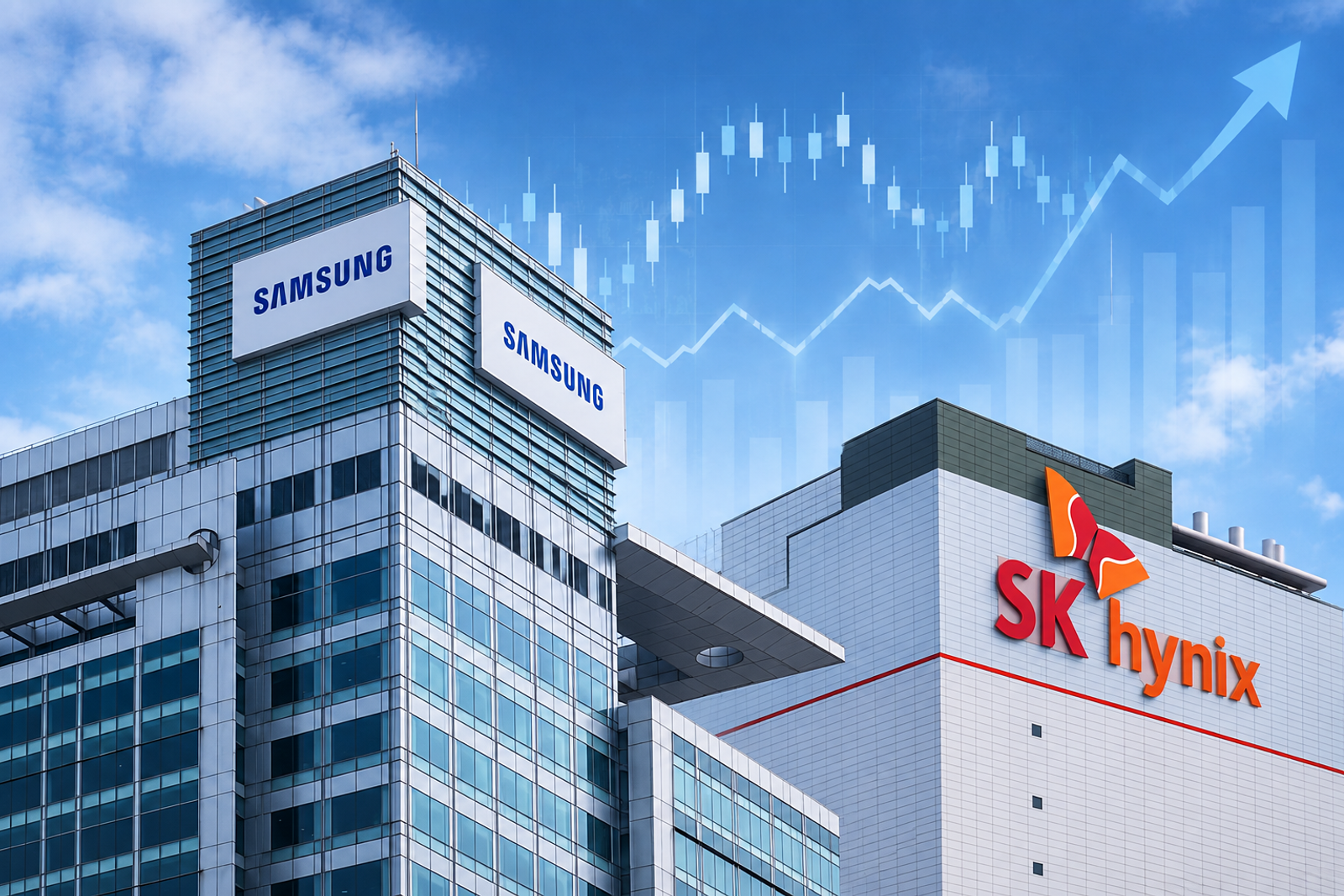
In a semiconductor industry report published on the 16th, SK Securities maintained its overweight recommendation and buy ratings on Korean memory chipmakers, arguing that the share prices of Samsung Electronics and SK Hynix already reflect an extreme industry downturn that the underlying fundamentals do not support.
Valuations below the historical floor
According to SK Securities, Samsung and SK Hynix are trading at 12-month forward price-to-earnings ratios of 3.3x and 3.0x respectively. Both figures sit below the companies' all-time lows since 2010—recorded at 5.5x and 3.0x—suggesting that investors have already priced in a severe deterioration in the industry outlook. SK Securities contends that this pessimism is detached from reality.
Two pillars of the bull case
The brokerage identifies two reasons why memory fundamentals remain robust.
The first is rising earnings estimates. Despite a weakening Korean won against the dollar, a sharper-than-expected tightening of memory supply and anticipated price increases for HBM (high-bandwidth memory) in 2027 are together pushing earnings forecasts higher once again. Spot-price premiums for DDR5 RDIMM modules have widened markedly: the 64GB variant now commands a spot premium of around 115% over contract prices, while the 32GB product is approaching 150%. SK Securities notes that this expansion in spot premiums for high-density DDR5 modules began in earnest in September 2025, coinciding with the acceleration of AI scale-out demand. HBM4 12H, due for release in 2027, is expected to be priced in the mid-to-high $4 range per gigabit—absent specific contractual constraints—and SK Securities believes even this may prove conservative.
The second pillar is improved earnings visibility from the proliferation of long-term supply agreements (LTAs). SK Securities characterises these contracts not as caps on prices but as mechanisms that raise price floors, lock in capacity, and dampen the amplitude of the memory cycle. Micron has publicly stated that its LTAs include provisions allowing it to negotiate appropriate price premiums for next-generation products at the point of transition. SK Securities argues that even where existing contracts cap prices on legacy products, the overall average selling price can still rise through a mix of new contracts and uncontracted volumes.
Shareholder returns on the horizon
The brokerage also forecasts that the combination of deepening supply shortages and capacity lock-in from LTAs will drive price increases beyond the server segment beginning in the first quarter of 2027, significantly expanding the pool of capital available for shareholder returns.
For Samsung, SK Securities estimates free cash flow (FCF) of roughly 211.6 trillion won in 2026; distributing 50% of that figure would imply shareholder returns of approximately 105.8 trillion won, equivalent to around 6% of the company's current market capitalisation. For SK Hynix, estimated 2026 FCF of roughly 170.7 trillion won implies potential returns of approximately 85.3 trillion won at a 50% payout ratio—about 6.8% of its current market cap.
Risks the bulls must reckon with
SK Securities' thesis rests on the assumption that macroeconomic tail risks do not materialise, and investors would be wise to keep that caveat in mind. Global recession fears and uncertainty over interest-rate policy remain critical variables for memory demand. Scepticism about the durability of AI capital spending has not gone away, and while SK Securities notes that the correlation between the ISM manufacturing PMI and memory chipmakers' operating profits has weakened since the AI cycle began, a contraction in demand from traditional consumer electronics could still undermine the broader memory demand base.
The earnings season as the key test
The most important near-term indicator will be the results season that begins at the end of this month. SK Securities expects that earnings releases from memory chipmakers and large technology companies in late October and November will reaffirm the resilience of AI demand and restore confidence in memory sector valuations. The logic is straightforward: as reported results refute the market's downturn fears, a re-rating of the sector should follow.
Historically, depressed P/E multiples in the memory industry have appeared late in the cycle and have been read by the market as a signal to sell. SK Securities' contrarian argument is that this cycle is different—that the spread of LTAs and the structural shift in AI-driven demand mean the old playbook no longer applies. Whether that argument is borne out by actual earnings will be the decisive factor in determining which direction these stocks move next.