Mirae Asset Securities raised its target price for Sanil Electric (KOSPI: 062040) on 15 October 2026 from 250,000 won to 270,000 won — an 8% increase — while reaffirming its "Buy" recommendation.
At the time of the note, Sanil Electric's shares stood at 212,000 won, implying upside of 27.4% to the revised target. Mirae Asset derived the new target by shifting its valuation reference year forward to 2030 and applying a price-to-earnings multiple of 16.6 times, in line with the 30-month forward average for global power-equipment peers.
Third-quarter results expected to fall short of consensus
Mirae Asset forecasts third-quarter revenue of 165.1 billion won, up 24.4% year on year, and operating profit of 63.2 billion won, up 48.0%, implying an operating margin of 38.3%. Both figures come in below consensus — by 6.6% and 4.3% respectively.
Two factors explain the shortfall. First, typhoon disruptions during the quarter delayed shipments, leaving an estimated 10 billion won of revenue unrecognised compared with a typical quarter. Second, with overseas sales accounting for nearly 90% of total revenue, the 12% quarter-on-quarter decline in the won-dollar exchange rate weighed materially on reported results.
Medium-term growth trajectory intact
Despite the near-term miss, Mirae Asset argues that Sanil Electric's structural growth story remains compelling. The company's factory in Ansan, south-west of Seoul, had originally targeted revenues of 1 trillion won by 2030, but actual growth has outpaced that conservative assumption by a wide margin. Mirae Asset now projects that the Ansan facility alone could generate revenues of 1.2 trillion won in 2030, should the current trajectory hold.
A further tailwind emerged in August 2026, when the United States government announced restrictions on Chinese-made inverters and power equipment used in the American electricity grid. The measures are prompting non-Chinese original-equipment manufacturers to restructure their supply chains, and Sanil Electric has since fielded a surge of production-allocation requests from non-Chinese inverter customers seeking alternative suppliers.
Annual forecasts and order book
Mirae Asset projects full-year 2026 revenue of 652.7 billion won, up 30.0% on the prior year, with operating profit of 248.0 billion won, up 38.5%, yielding a margin of 38.0%. Growth is expected to continue: 2027 revenue is forecast at 837.1 billion won with operating profit of 336.9 billion won (margin: 40.3%), rising to revenue of 1.0649 trillion won and operating profit of 431.7 billion won (margin: 40.5%) in 2028.
The order book reinforces this outlook. Quarterly new orders climbed from 112.7 billion won in the first quarter of 2025 to 243.5 billion won in the second quarter of 2026, while the order backlog grew from 414.4 billion won to 556.7 billion won over the same period. The book-to-bill ratio — a measure of orders received relative to revenue recognised — stands at approximately 1.2 times.
Risks to monitor
Investors should keep a close eye on the currency. With foreign sales making up 90% of total revenue, a strengthening won directly compresses both top- and bottom-line figures, as the third quarter demonstrated. Valuation is also a consideration. Sanil Electric trades at 30.6 times 2026 earnings — below GE Vernova (43.6 times) and LS Electric (49.2 times), suggesting relative undervaluation against global peers, yet above South Korean rivals HD Hyundai Electric (20.9 times) and Hyosung Heavy Industries (25.7 times).
Mirae Asset acknowledged that on 2028 estimates the stock trades close to the sector average, but maintained that Sanil Electric remains undervalued relative to its 2030 earnings potential once the full impact of capacity expansion is reflected. The broker reiterated its long-term Buy case on that basis.
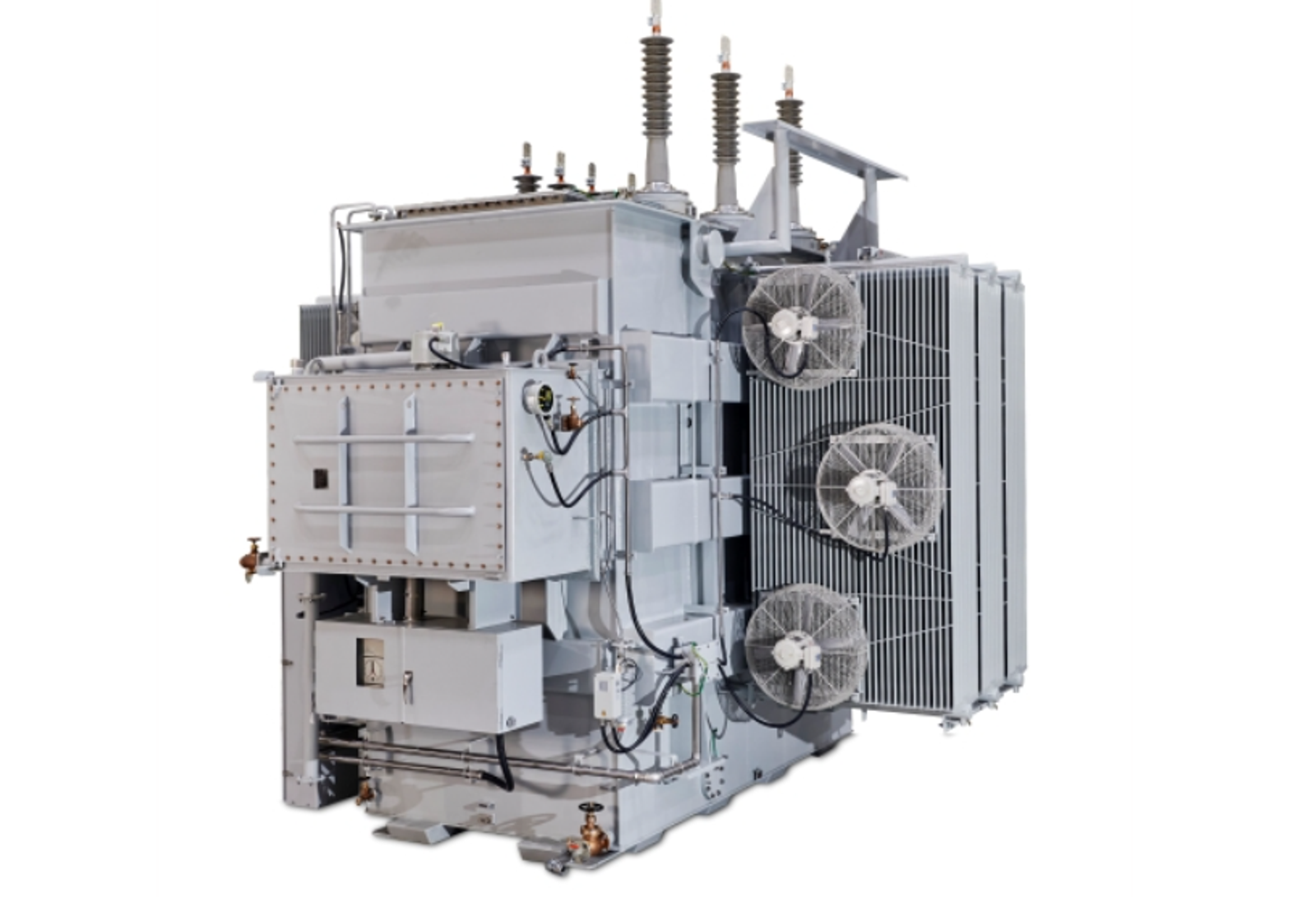
*Sanil Electric is a power-solutions company headquartered in Ansan, Gyeonggi province, whose principal product is transformers supplied primarily to the North American market. Growing demand for power infrastructure — driven by the expansion of data centres and renewable-energy installations in the United States — is the chief engine of its earnings growth.*