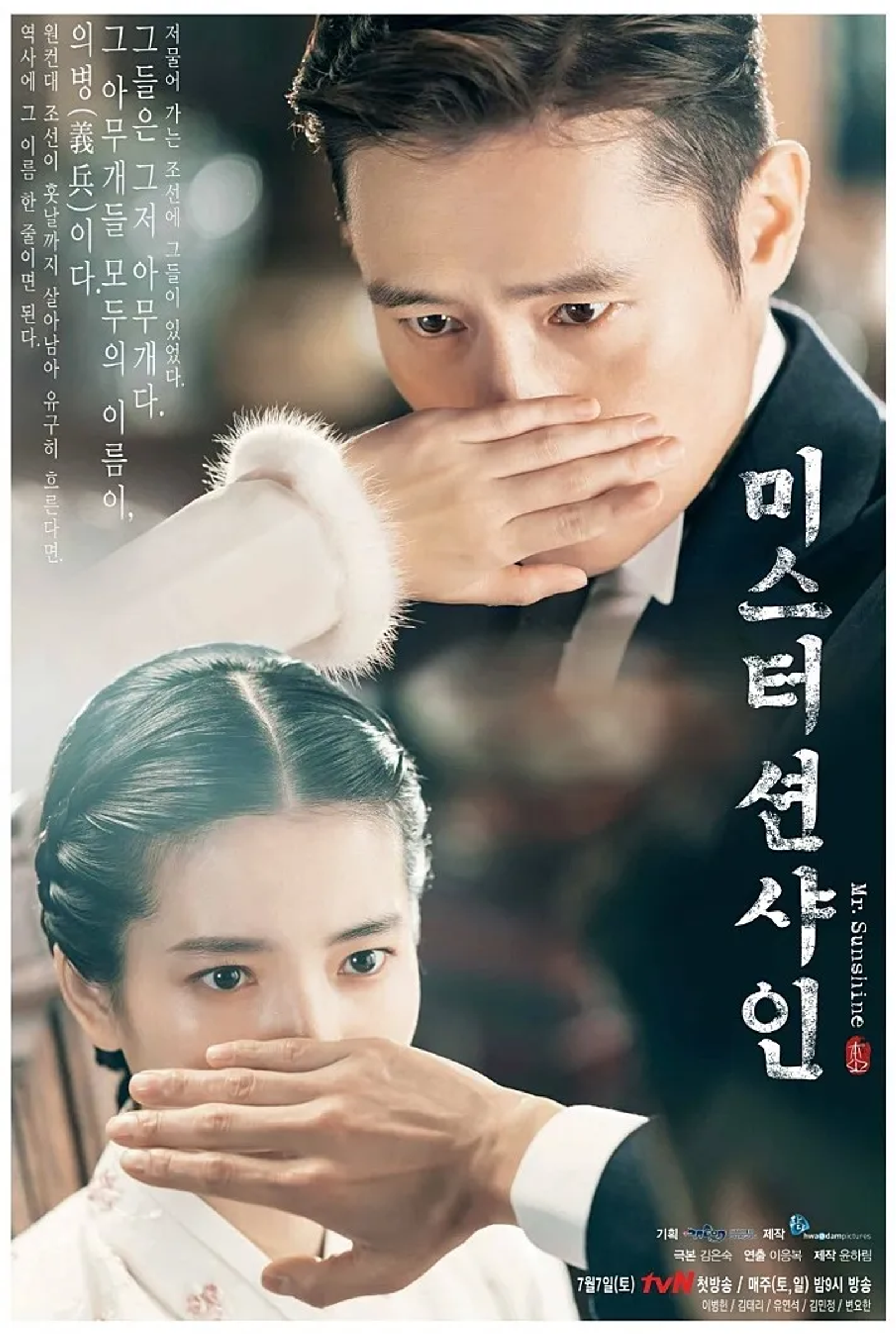
*Editor's note: This is the eighth instalment of our Behind the Scenes series. It covers Mr Sunshine, broadcast on tvN in 2018, and is based on previously published reporting and statements made by the production team and cast.*
Mr Sunshine premiered on tvN on 7th July 2018. Set in the early 1900s, the 24-episode series tells the story of Korea's righteous army — irregular guerrilla fighters, known as uibyeong, who resisted foreign encroachment on the Joseon dynasty and the subsequent Japanese colonial occupation. The final episode, broadcast on 30th September, drew an average nationwide paid-household rating of 18.1%. The drama's recreation of Hanseong — the historical name for Seoul — presented an immediate logistical problem: not a single remnant of that era's cityscape survives in South Korea today. Everything had to be built from nothing.
Building Hanseong in Nonsan, and a Hotel in Daejeon
Filming began in September 2017 and continued across all four seasons. The total set footprint came to roughly 8,000 pyeong (approximately 26,400 square metres). On an outdoor lot in Nonsan, South Chungcheong Province, the production team reconstructed the architecture, trams, stone bridges, and city walls of the Korean Empire and early Japanese colonial period. The Nonsan Sunshine Studio — an open-air set covering around 6,000 pyeong — recreated Hanseong as it appeared during the late 19th-century Enlightenment period. A further 2,000-pyeong indoor stage in Daejeon housed the interior of the fictional Glory Hotel and the American legation offices.
Period-accurate costumes were made from scratch. The wardrobe budget was reported to be among the largest ever for a Korean drama. Across the entire shoot, approximately 10,000 actors and extras appeared on screen. The production company stated that "because the historical period Mr Sunshine sought to portray had never been tackled by a Korean drama before, we prepared with exceptional thoroughness." Total production costs came to roughly 40 billion won (approximately $30 million at the time). Several structures from the Nonsan set — the Glory Hotel, a French bakery, a traditional herbal medicine shop, and a Hanseong tram — remain standing today.
"A Subject I Had Always Wanted to Tackle"
The story came before the sets. In a report published by the sports daily Ilgan Sports on 29th May 2017, screenwriter Kim Eun-sook revealed that her next project would be a story about uibyeong fighters set between 1900 and 1905. "It was a subject I had always wanted to tackle," she said, making a point of distinguishing uibyeong — informal patriotic militia — from the more formally celebrated independence movement figures of later decades. The drama's central premise was also already in place: a Korean boy who boards an American gunship during the 1871 Sinmi yangyo incident (a US naval expedition against Korea), eventually reaches America, and returns to Joseon as a US Marine officer.
The show's title carried its own historical logic. Kim explained that she had written "Sunshine" in the Korean transliteration used at the turn of the 20th century — rendered as Shyonshaing in the romanisation of the period — rather than in the modern form. She also noted that because the sets did not yet exist and would have to be built before filming, she was under pressure to complete scripts quickly. In effect, the physical world of the drama had to be constructed before the story that would inhabit it was fully written.
"My Home" Came First
The score was overseen by music director Nam Hye-seung. The production team described "My Home", performed by Savina & Drones, as "the theme song that best represents the drama", and confirmed that it was the first piece of original soundtrack music to be completed — even though it was released sixth among the OST tracks, at noon on 6th August. The ballad "Good Day" by MeloMance had preceded it on air, first appearing in episode eight on 29th July before its digital release the following evening. The production team noted that the melody of Greensleeves — woven through the score — was used to express love, hope, sacrifice, and passion.
Singer Shin Seung-hun's "Beautiful Like Flames", the twelfth OST track, was released on 9th September. It is said that music director Nam conceived the song with Shin's voice already in mind before writing a single note. The music team reportedly declared after his recording session: "Irreplaceable, as expected."
Finding an Actor Who Could Handle Both Korean Drama and English Dialogue — and One Cast Change
On 24th June 2017, production company Hwa & Dam Pictures announced that Lee Byung-hun would play the male lead. It was his first television drama in roughly nine years, since KBS's Iris in 2009. Producer Yoon Ha-rim explained the early casting decision: "This isn't a pre-produced drama in the conventional sense, but it requires a long and painstaking shoot to achieve the quality we're aiming for, so we felt it was important to lock in the cast quickly." He added that Kim Eun-sook had wanted an actor who excelled at both acting and English — a clear reference to the demands of playing Choi Yu-jin, an officer in the United States Marine Corps who must credibly operate in English.
The female lead, Go Ae-shin, went to Kim Tae-ri, who took on her first television drama role after making her name in film. After being cast, Kim trained at a private shooting range. For a firearms scene filmed in Changnyeong, South Gyeongsang Province, she dressed as a man. A rooftop chase sequence shot in Yongin, Gyeonggi Province, reportedly required her to run repeatedly across the roof while carrying heavy props.
There was one significant casting change. Kim Sa-rang was originally announced for the role of Kudo Hina, a Japanese woman entangled in the drama's political intrigues. On 12th February 2018, her departure was announced. The production initially cited health reasons; her agency corrected this the same evening, attributing the exit to scheduling conflicts and apologising for the miscommunication. Kim Min-jung took over the role.
Smaller parts also came with backstories. Yoon Ju-man, who played Yoo-jo — the right-hand man of antagonist Gu Dong-mae — recalled that his character had originally been listed in the script simply as "Ronin No. 1", without even a name. Director Lee Eung-bok had noticed his professionalism on the set of Goblin (2016) and brought him back. Actor Byun Yo-han, reflecting on the drama's conclusion, said he had spent approximately eight months living as his character, Kim Hee-sung.
Ratings, a Rewrite, and Awards
The broadcast was not without controversy. Critics raised concerns that the Heukryonghoe — the shadowy organisation to which Gu Dong-mae belongs — was based on a real historical group with pro-Japanese associations, and that its portrayal risked glorifying collaboration. On 16th July, a petition on the presidential Blue House website calling for greater historical accuracy in period dramas gathered more than 20,000 signatures within days. The production team reportedly agreed to redesignate the Heukryonghoe as a fictional organisation and to revise footage that had already been shot accordingly.
Ratings climbed steadily from an opening episode figure of 8.852% to a final-episode average of 18.1%, with a peak of 20.0%. Among viewers aged 20 to 49 — the demographic most prized by advertisers — the average rating of 11.5% and peak of 13.1% both set new records for tvN. In the final episode, a foreign journalist visits the uibyeong camp, photographs the fighters, and is asked: "Tell the whole world who we are." At the 55th Baeksang Arts Awards on 1st May 2019 — South Korea's most prestigious television and film prize — Lee Byung-hun won the Grand Prize for acting in television. In his acceptance speech, he said: "Considerable time has passed since the drama ended, and I am grateful for the affection that has not diminished."
*One-line verdict: A drama that used an enormous set not for spectacle, but to preserve the faces of people history never recorded.*