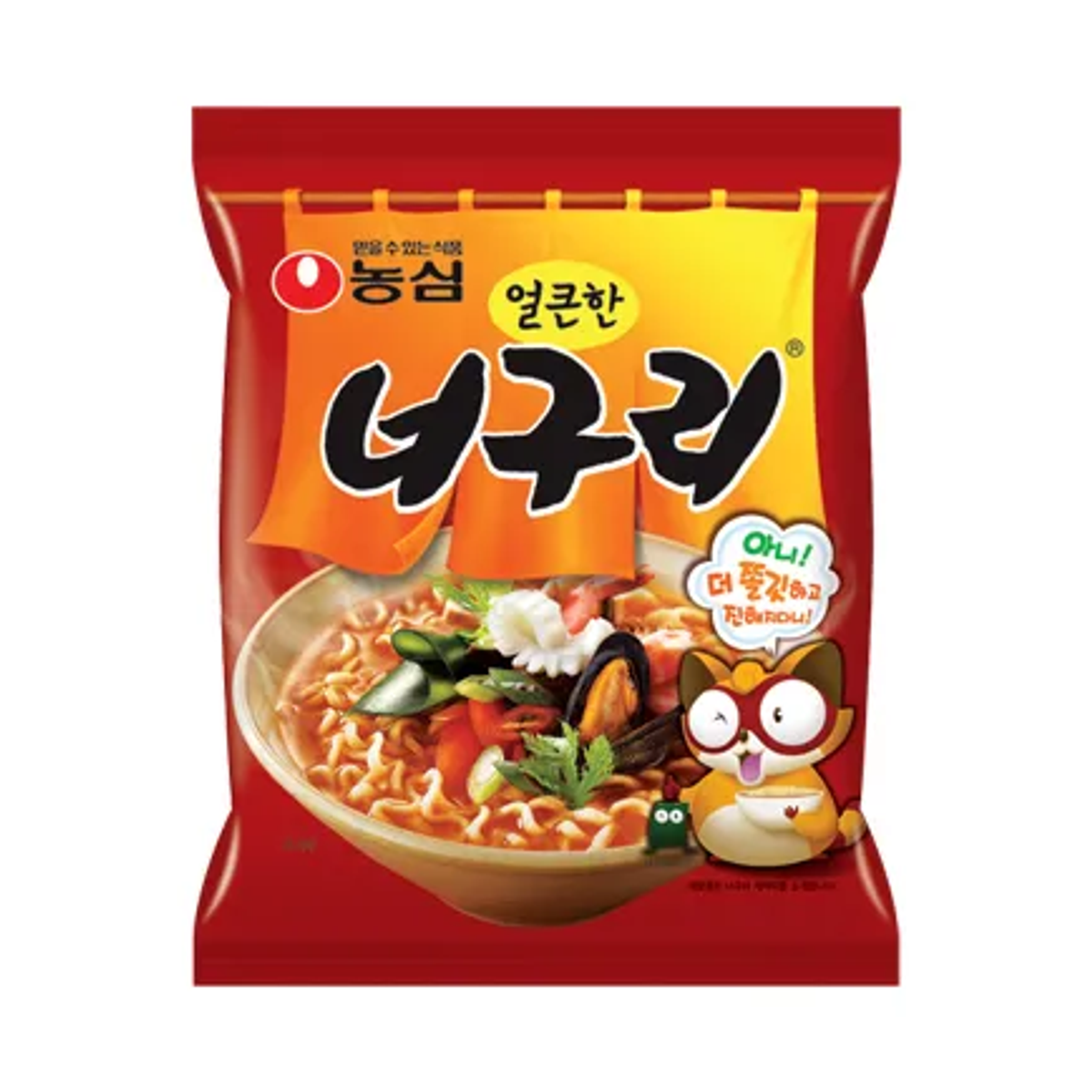
Born in 1982 and now in its 43rd year, Nongshim's Neoguri has sold well over five billion packets — a figure that places it among the most enduring products in South Korea's fiercely competitive instant-noodle market. Over the past 37 years, Nongshim has purchased more than 15,000 tonnes of dried kelp harvested from the pristine waters off Geumil Island, on the southern coast of Wando, and that single ingredient has defined the product ever since. Conceived as Korea's first "udon-style" ramen — combining the spicy broth familiar to Korean palates with the thick, yielding noodles of Japanese udon — Neoguri has held its place as a market stalwart for nearly half a century.
The story
When Neoguri launched, its central proposition was an unfamiliar one: a ramen that borrowed from udon. The idea was to marry Korea's beloved spicy broth with the comforting warmth of thick, soft noodles. From the outset, Nongshim decided to include a whole piece of dried kelp sourced from Geumil Island — a choice that has since become the product's defining identity.
The scale of that commitment is striking. Nongshim purchases an average of 400 tonnes of Geumil Island kelp each year, making it the single largest buyer of the ingredient in Korea's food industry. That volume represents roughly 15% of the island's entire annual dried-kelp output, and the three-decade purchasing relationship has become a meaningful source of stable income for local fishermen — an unexpected industrial ripple effect from a bowl of instant noodles.
Neoguri also inspires an unusual degree of culinary debate for a convenience food. Enthusiasts argue passionately about whether to add the kelp at the start or end of cooking, whether to include an egg, and precisely how long to let the noodles sit. The recommended cooking time of five minutes is longer than the three to four minutes typical of most instant ramen, a direct consequence of the noodles' thickness. Amusingly, older packaging once claimed the opposite — that the thick noodles actually required less time to cook.
In South Korea's mandatory military service, soldiers discovered a now-celebrated combination: mixing Neoguri with Chapagetti, a black-bean-sauce noodle also made by Nongshim, to create a dish dubbed "Jjapaghetti-Neoguri," or Jjapaguri. The combination gained global recognition when it appeared in Bong Joon-ho's 2019 film *Parasite*, prompting Nongshim to launch a dedicated cup-noodle version, "Angry Jjapaguri," in 2020.
Taste assessment
Neoguri's character is, above all, one of abundance. The plump, substantial noodles offer a firm, satisfying chew, while generous garnishes — dried kelp, shrimp, and vegetables — lend the broth genuine depth. The soup itself leans towards clean, savoury umami rather than aggressive heat, which makes it a reliably comfortable choice amid a market increasingly dominated by extreme spice. That said, the very richness that defines Neoguri also raises the bar for preparation. The thick noodles are unforgiving: misjudge the water volume or cooking time, and they emerge either underdone or bloated and soft. The timing of the kelp addition meaningfully affects both the colour and flavour of the broth. This is not, in short, a ramen for the inattentive cook.
Verdict
In a market that churns out novel products every season, Neoguri has survived by doing the opposite — by not changing. While competitors chase fleeting trends, Nongshim's offering has spent 43 years defending the same identity: thick noodles and a piece of kelp. That constancy has earned it a permanence few instant foods achieve. The trade-off is effort. For those who prize above all else the speed and simplicity of instant noodles, Neoguri makes demands that others do not.
★★★☆☆ (3.5/5.0)
In a line "Not flashy — but it has stood its ground, stubbornly and substantially, for 43 years."