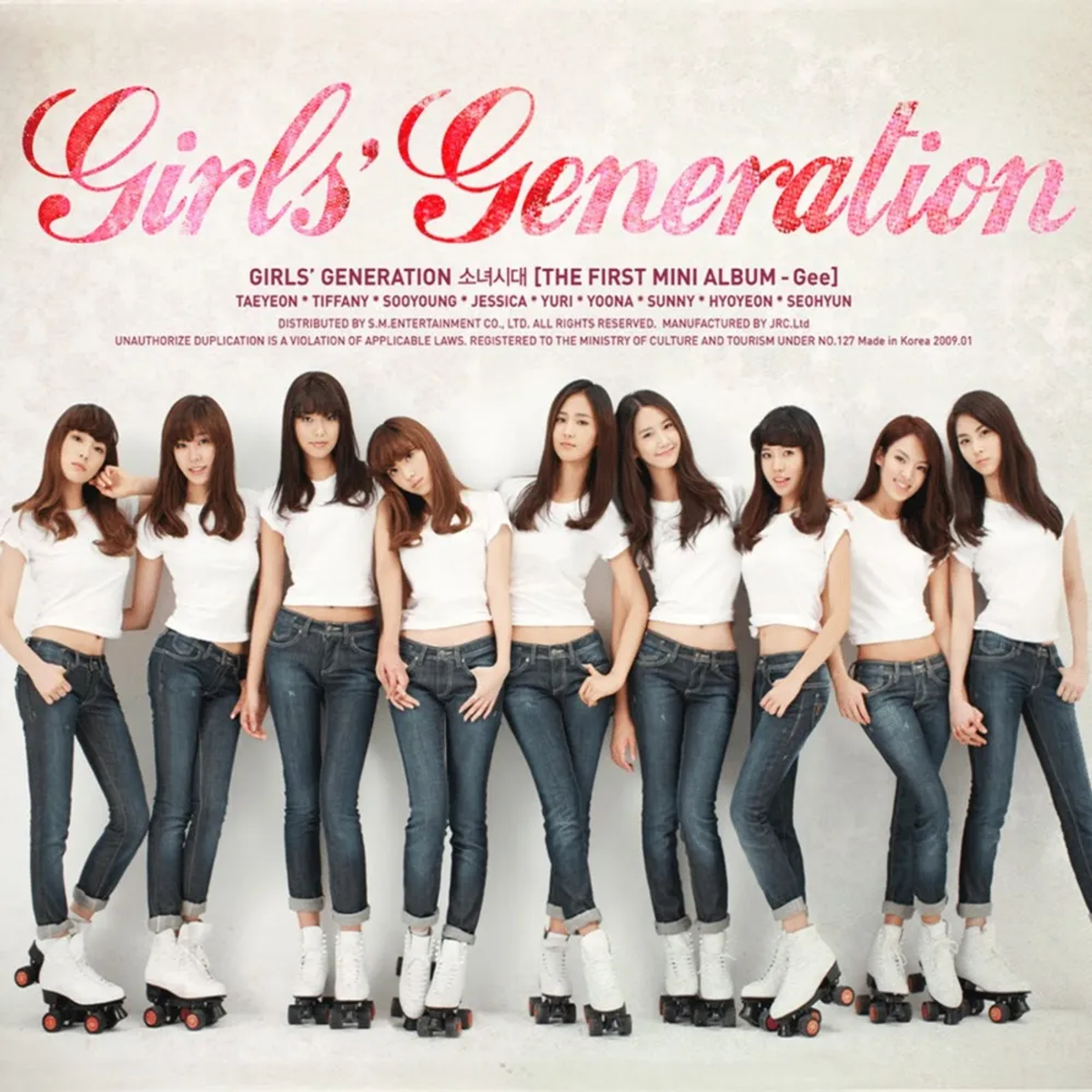
*Editor's note: "One Track" is a series that uses a single song to trace the broader currents of the K-pop industry. This fifth instalment examines "Gee" by Girls' Generation — the record that created the template for girl groups over the decade that followed.*
Released on 5th January 2009, "Gee" was the title track of Girls' Generation's first mini-album of the same name. The nine-member group — Taeyeon, Sunny, Tiffany, Hyoyeon, Yuri, Sooyoung, Yoona, Seohyun, and Jessica — had debuted on 5th August 2007 under SM Entertainment, one of South Korea's dominant talent agencies. With a single song, just eighteen months into their career, they permanently altered the landscape of the domestic girl-group scene.
Origins — Inheriting two rivals' legacies
"Gee" was composed by the songwriting duo E-Tribe: a bright, buoyant dance-pop track capturing the flutter and bashfulness of first love. Critics have characterised the song's identity as a deft synthesis of two earlier girl-group archetypes — the ethereal, polished glamour of S.E.S., SM's own pioneering girl group, and the warm, approachable "girl next door" image cultivated by Fin.K.L, who were signed to rival agency DSP Entertainment. The music video, directed by Jo Su-hyeon, was filmed in December 2008 at a studio in Yangsu-ri, Gyeonggi Province, using a mannequin-and-clothing-boutique concept. Notably, Minho of SHINee — another SM act — makes a cameo appearance in both the Korean and Japanese versions of the video.
Records — Rewriting girl-group history
"Gee" swept real-time streaming charts the moment it dropped. On KBS's *Music Bank*, it held the number-one position for nine consecutive weeks — at the time, the second-longest chart reign in the programme's history. It also claimed a triple crown on SBS's *Inkigayo*.
Its haul at year-end awards ceremonies was still more emphatic. At the 2009 Melon Music Awards, the group took home six prizes, including Song of the Year and Artist of the Year. In February 2010, it won the Digital Single Award and Main Prize at the Seoul Music Awards, and was named the year's top digital track at the inaugural Gaon Chart ceremony. In March, it received the Korean Music Award for Song of the Year; in December, it claimed the Japan Record Award for Best New Artist. To this day, many critics and publications regard "Gee" as the defining song of Girls' Generation's career.
Industrial significance — Making a girl group a national phenomenon
The true measure of "Gee"'s impact lies beyond chart positions. Following its success, Girls' Generation rapidly expanded into dramas, variety shows, and advertising. In 2009 alone, the group filmed fifteen commercial campaigns; one widely cited statistic holds that they appeared in broadcasts an average of roughly 39 times per day. Equally significant was what happened at the individual level: it was during this period that the practice of members pursuing separate careers in parallel — fronting cosmetics brands, anchoring variety programmes — became a standard feature of how K-pop girl groups operated.
This model became the industry grammar that subsequent generations of K-pop girl groups absorbed wholesale. The formula runs as follows: secure mass public recognition through a single, dominant title track, then leverage that attention to launch individual members across broadcasting, endorsements, and beyond. Girl groups existed before "Gee," but none had achieved dominance at this scale across South Korean popular culture as a whole — claiming, in effect, the status of the nation's girl group.
Legacy — A tribute that crosses generations
More than a decade after its release, "Gee" continues to be invoked in popular culture. In 2020, a special ensemble of K-pop idols born in the Year of the Rat — drawn from groups including CLC, APRIL, WJSN, and MOMOLAND — staged a joint cover of the song, a tribute that itself spanned generations of the industry. The fact that a song released over ten years ago still commands this kind of reverent homage from younger artists speaks plainly to its symbolic standing within K-pop.
Why it matters
The significance of "Gee" is different in kind from the four songs examined previously in this series. Where "Dynamite," "Gangnam Style," "Hype Boy," and "Spring Day" each illustrated how K-pop crossed borders, "Gee" shows how a single record reorganised an entire domestic scene. The success formula that countless K-pop girl groups have since adapted and reinvented in their own ways — that template began here, in three minutes of dance-pop about a teenage crush.
*In short: before K-pop conquered the world, "Gee" first redrew the map at home.*