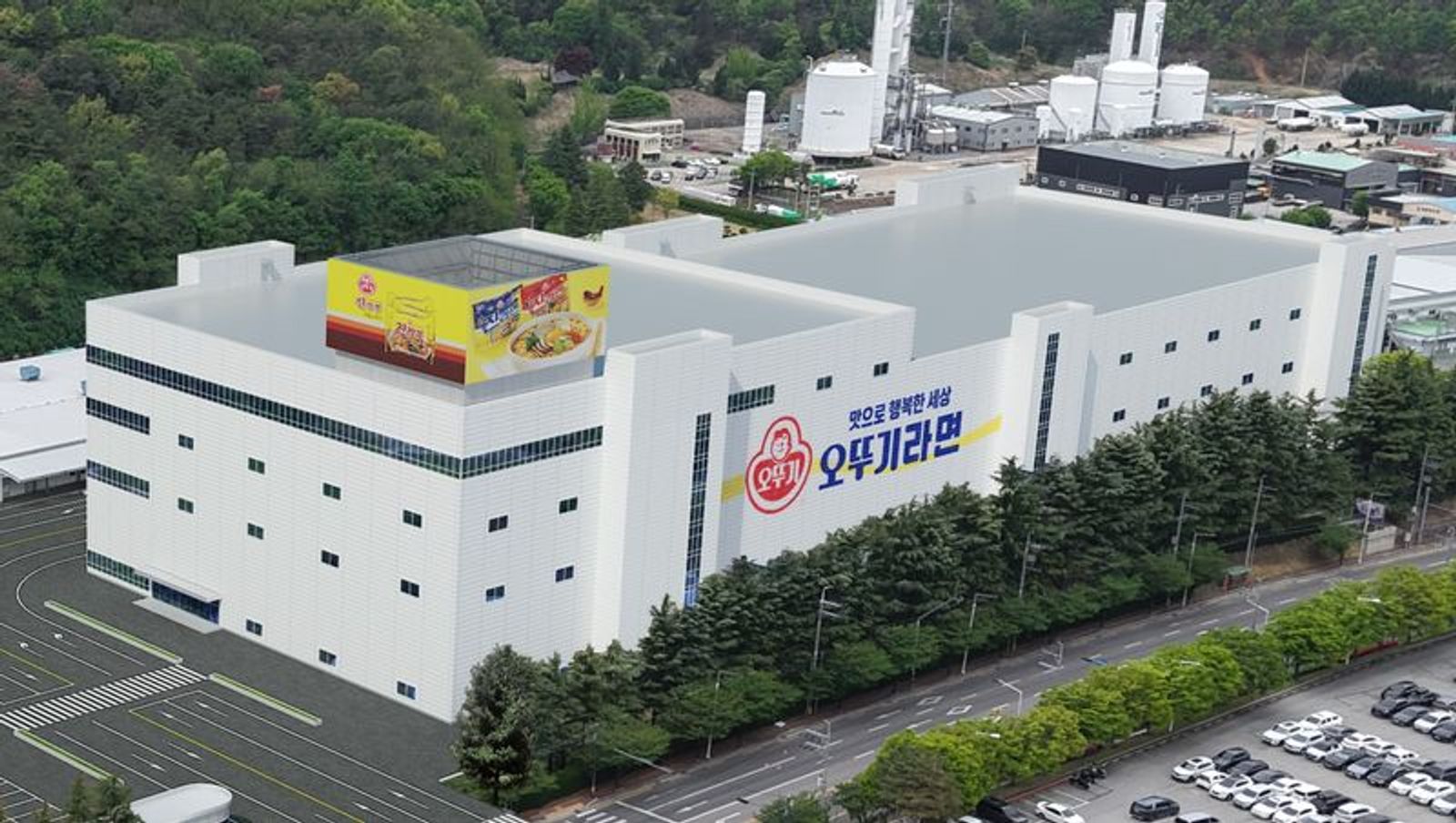
Ottogi, South Korea's second-largest ramen maker, has committed roughly 200bn won (approximately $145m) to build a dedicated export production facility in Gumi, a city in the North Gyeongsang province. The investment marks the company's most aggressive push yet into overseas markets and comes as the domestic ramen market reaches maturity, leaving exports as the primary engine of future growth.
A factory built for the world, not for home
The most telling detail of the announcement is the phrase "export only." Until now, most Korean ramen manufacturers have supplied foreign markets by drawing on surplus capacity from lines originally designed for domestic consumption. A dedicated export plant changes the calculus entirely: it allows for product specifications tailored to individual markets, standardised quality control, and systematic compliance with local regulations—halal certification in the Middle East, vegan labelling in Europe, allergen-disclosure requirements in the United States.
Samyang Foods set the template. Riding the global sensation sparked by its Buldak (Fire Chicken) noodles, the company opened a dedicated export plant in Miryang and subsequently watched its overseas revenue soar to more than 70% of total sales. Ottogi's decision follows that logic, though it aims to forge an independent export portfolio built around its own brand identity rather than a single viral product.
How big has the K-ramen market become?
The numbers justify the ambition. According to the Korea Agro-Fisheries and Food Trade Corporation (aT), Korean ramen exports rose from roughly $600m in 2020 to more than $1.1bn in 2024—nearly doubling in four years. The structural drivers are well understood: the global spread of Korean drama and film through Netflix and other streaming platforms, and the viral K-food challenges that have proliferated on YouTube and TikTok, have converted curiosity into habitual consumption.
Growth has been particularly sharp in the United States, Europe, and South-East Asia. American imports of Korean ramen have grown at an average annual rate of more than 20% over the past three years, and Korean brands are now stocked in mainstream retailers such as Walmart and Costco rather than being confined to Asian grocery stores. A deliberate diversification away from dependence on China has also made the export base more resilient.
Where Ottogi stands—and where it falls short
For all its strength at home, Ottogi has struggled to translate domestic popularity into global recognition. Its flagship products—Jin Ramen and Sesame Ramen—command loyal followings in South Korea but remain far less visible abroad than rivals' offerings. In the export rankings, Ottogi trails not only market leader Nongshim, which operates a manufacturing plant in Los Angeles to serve North America, but also Samyang Foods and Paldo.
The Gumi investment is accordingly conceived as something broader than a capacity expansion. Industry analysts describe it as the opening shot of a comprehensive export drive, one that will need to encompass new product development and marketing investment alongside the physical plant. "Installing export-dedicated equipment signals an intention to tackle the full complexity of international compliance—halal, vegan, allergen labelling," said one food-industry consultant. "If that infrastructure is paired with a premium product line, it could significantly sharpen Ottogi's ability to penetrate new markets."
Why Gumi?
The choice of location carries its own significance. Gumi was once the beating heart of South Korea's consumer-electronics industry, home to major manufacturing operations for Samsung and LG. As smartphone production migrated overseas, the city's economy hollowed out. Local and provincial authorities have since worked hard to attract new industries—food processing, battery manufacturing, and defence among them—and Ottogi's 200bn-won commitment represents precisely the kind of anchor investment that can revive a local economy through job creation and tax revenue.
Gumi also makes logistical sense. The city sits on the Gyeongbu Expressway corridor and is served by a KTX high-speed rail station, while road connections to the ports of Busan and Gwangyang—South Korea's principal export gateways—are reasonably direct. Government incentives offered by the provincial and municipal authorities are understood to have sweetened the deal.
A market in motion
Ottogi's announcement will not go unnoticed by competitors. Nongshim continues to expand its North American footprint through its Los Angeles plant. Samyang Foods is simultaneously broadening its global OEM partnerships and adding domestic capacity. Paldo, which has long held a strong position in Russia and Eastern Europe, is pushing into new markets to diversify its own export base.
Not everyone is convinced that building factories automatically translates into export gains. The costs of marketing globally are rising, currency volatility can erode margins quickly, and local competition is intensifying across key markets. Perhaps most immediately, uncertainty over American tariff policy complicates the strategic planning of any company betting heavily on the US market.
What it all means
Ottogi's Gumi plant is a symbol of something larger: the globalisation of K-ramen is no longer the story of one or two companies with a viral product, but a structural shift reshaping an entire industry. South Korea's ageing and shrinking domestic population leaves food companies with little alternative—exports have become a matter of survival, not merely opportunity.
Governments at both national and local level face growing pressure to support that shift through subsidies for overseas certification, help with distribution networks, and investment in local marketing infrastructure. For Ottogi itself, the 200bn-won wager will ultimately be judged not by the ribbon-cutting at the new factory but by how deftly the company manages the three disciplines that determine success in any foreign market: localising its brand, differentiating its products, and broadening the channels through which it reaches consumers.