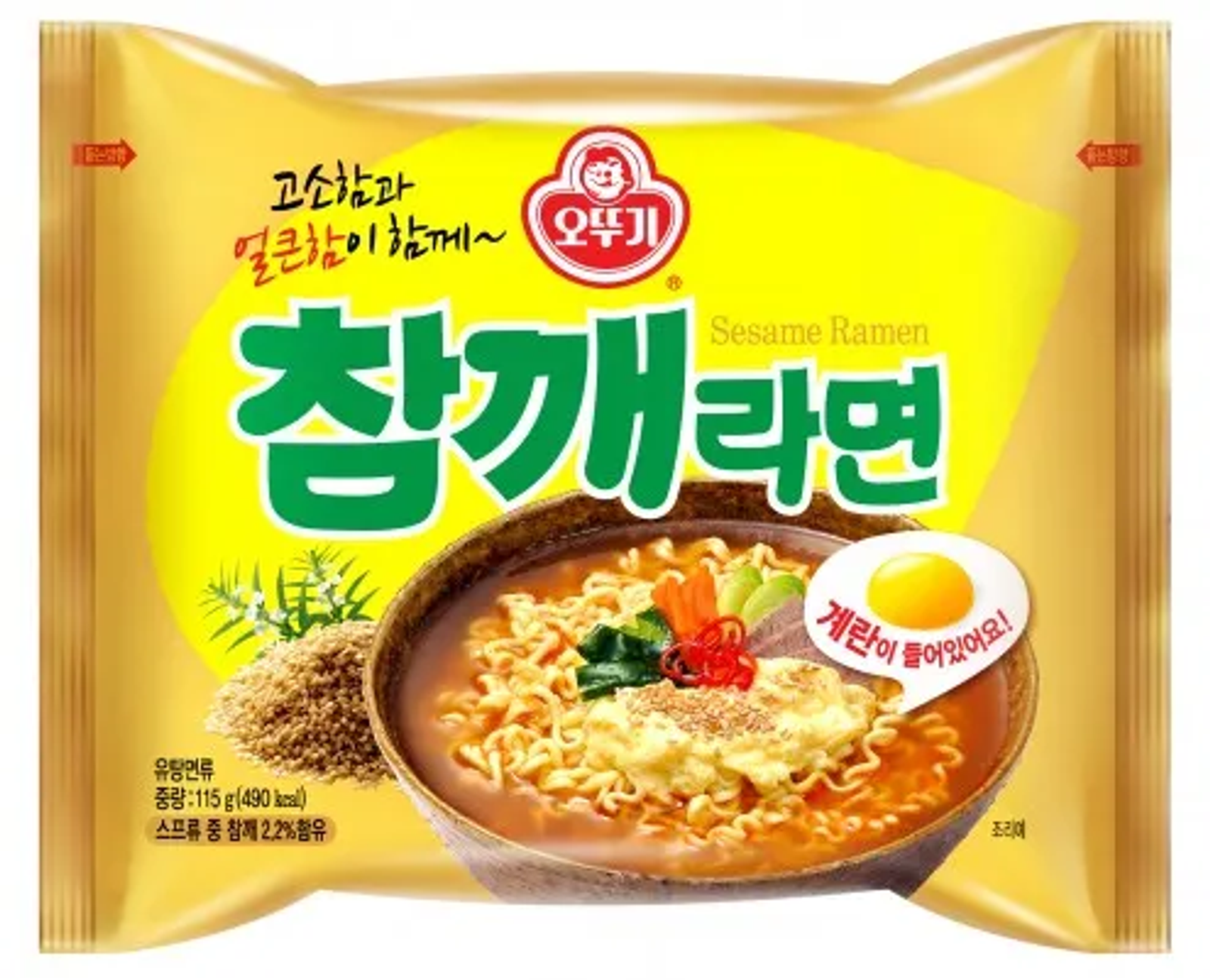
This article is part of our ongoing series, Ramen Wars, reviewing South Korea's most enduring instant noodles.
In 1994, South Korea's instant-noodle market was a spice arms race. Ottogi, one of the country's largest food conglomerates, chose to go in the opposite direction — reaching instead for sesame seeds, sesame oil, and egg. The result was Sesame Ramen (참깨라면), launched that year as a dried-noodle packet, followed by a cup version the following year. More than three decades on, it remains one of Ottogi's signature products.
Origins
Sesame Ramen was not conceived as a single product. Ottogi's development team originally worked on two separate recipes: a "sesame ramen" built around an oil-based sesame sachet, and an "egg ramen" centred on a freeze-dried egg block. It was only during testing that researchers discovered the two flavours complemented each other well enough to merge into one.
The egg block alone took two years to perfect. Developers began with whole liquid egg, then freeze-dried it so that, when hot water is added, it reconstitutes into something approaching the texture and appearance of a real egg. The formula has continued to be refined: in 2020 the egg content of the block was increased; in 2022 the proportion of sesame oil in the liquid sachet and sesame seeds in the powder sachet were both raised; and potato starch was incorporated into the noodles to improve their elasticity.
The brand has also broadened its range considerably. A cup version appeared in 1995, a mini-cup in 2010, and in 2020 Ottogi released "Open Sesame Ramen" (열려라 참깨라면) — its name a reference to the incantation in *Ali Baba and the Forty Thieves* — which blends the fiery heat of the company's Yeol Ramen with Sesame Ramen's characteristic nuttiness. A stir-fried noodle variant followed in 2023, a cup-noodle version in 2024, and the brand has since extended beyond noodles entirely, into products such as sesame dumplings. Ottogi says sales in the first half of 2026 reached their highest level in five years. "We will continue to offer consumers new pleasures and value through a variety of product lines and brand extensions," a company spokesperson said.
Tasting notes
A single packet weighs 115g and contains 500 kilocalories. The recommended method is to bring 500ml of water to the boil, add the powder sachet, egg block, and noodles, cook for four minutes, then remove from the heat and stir in the oil sachet last. Adding the sesame oil off the heat preserves its fragrance, which rises immediately from the bowl.
The first spoonful is led entirely by the aroma and flavour of sesame. As the egg block dissolves into the broth, it softens the texture noticeably. True to the manufacturer's description, a mild warmth lingers on the finish. The noodles — kneaded with sesame seeds — are springy and absorb the broth well. The nuttiness is persistent but never cloying: even after setting down the spoon, it is difficult to resist returning to the noodles with chopsticks.
The principal drawback is sodium. One packet contains 1,750mg — equivalent to 88% of South Korea's recommended daily intake. Finishing the broth as well adds a meaningful burden for health-conscious eaters. Those seeking sharp, intense heat may also find the overall flavour somewhat mild.
Verdict
Sesame Ramen staked out a different axis in a market defined by chilli heat, and has held that position for over 30 years. Its strength lies not in dramatic stimulation but in a gentle, sustained satisfaction that carries through to the final mouthful. Set aside the sodium load, and this is a dependable choice at virtually any hour.
★★★★☆ (4.0/5.0)
In a line
No heat required — thirty years of staying power on sesame alone.