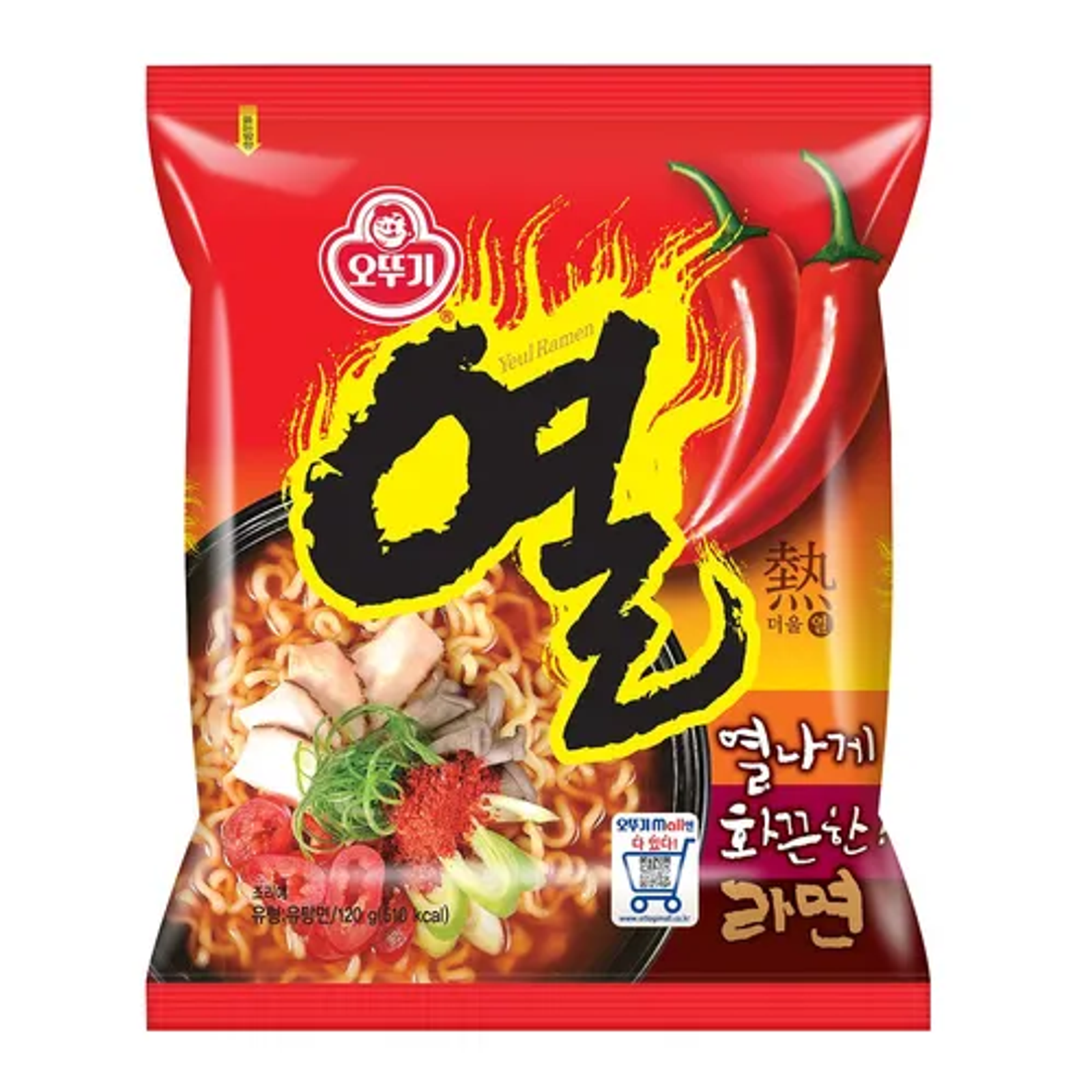
*Ramyeon Wars is a series that goes beyond the packet — exploring the origin stories, brand histories, competitive battles, and honest tasting notes behind South Korea's most iconic instant noodles. Each instalment reviews a single product and awards a star rating. This is the third edition. The subject: Ottogi's Yeol Raymeon.*
Around the same time that whispers began circulating that Shin Ramyun(brand name) had lost some of its edge, Yeol Ramyeon started its quiet ascent. Rather than mounting a frontal assault on South Korea's dominant instant noodle brand, it slipped in from the side. A social-media recipe — add a block of soft tofu and simmer — spread rapidly, and Yeol Ramyeon reinvented itself as the brothy noodle of choice for a new generation of spice lovers. Among ramyeon enthusiasts, the idea that *yeol* (熱, meaning "heat") could supplant *sin* (辛, meaning "spice" — the character that names Shin Ramyeon) is no longer an outlandish claim.
Origins
Yeol Ramyeon did not begin life as an Ottogi product. It was first launched in 1985 by Cheongbo Foods, a now-defunct Korean food company. By the standards of the time it was considered quite spicy, but the public reception was cold: the price was high, the taste widely judged below average. It cultivated a cult following among hardcore spice enthusiasts but never achieved mass appeal. When Cheongbo Foods went bankrupt in 1987, Yeol Ramyeon disappeared with it.
Ottogi subsequently acquired Cheongbo Foods, inheriting the Yeol Ramyeon trademark along with it. Nine years passed. By 1996, the market had shifted. Shin Ramyeon, launched in 1986, had grown into a brand generating 18 billion won in annual sales, and the entire ramyeon industry had piled into the spicy-noodle race. Ottogi joined the rush, reviving the dormant Yeol Ramyeon name. The relaunched version had a notably sweet finish. In 2019 Ottogi reformulated the recipe into its current form.
In academic marketing circles during the 2000s, Yeol Ramyeon became a curious case study. It was cited as a textbook example of the "decoy effect" — the idea that the presence of an inferior alternative makes the market leader look more attractive by comparison. Analysts argued that Yeol Ramyeon's existence made consumers perceive Shin Ramyeon as the more rational choice. The irony is rich: a noodle apparently designed to make its rival shine is, three decades later, quietly encroaching on that rival's territory.
Taste
Yeol Ramyeon's broth occupies a different register from Shin Ramyeon's. Where Shin Ramyeon anchors itself in a heavy beef-stock base with a robust, lingering heat, Yeol Ramyeon is lighter and cleaner. The spice behaves differently too: Shin Ramyeon leaves a deep, slow burn; Yeol Ramyeon hits sharply and retreats. On the Scoville scale, Yeol Ramyoen scores 5,013 SHU against Shin Ramyeon's 2,700 SHU — almost double the measured heat. Yet the overall weight of the broth is paradoxically lighter. The eating experience is less about savoury depth and more about the spice itself.
The noodles share Shin Ramyeon's characteristic firm, springy bite. Portions are generous and the price reasonable. The product's true potential, however, is unlocked by the tofu pairing. When the soft-tofu recipe went viral on social media in 2021, Yeol Ramyeon's sales rose 37%. The tofu tempers the heat while adding creaminess and a nutty richness to the broth — completing a soup that, on its own, can feel slightly one-dimensional. Ottogi's decision to lean heavily into this recipe in its marketing, and to launch a premium "Royal Ramyeon" variant ahead of the brand's 30th anniversary in 2026, reflects a clear-eyed understanding of what makes Yeol Ramyeon work.
Verdict
Yeol Ramyeon is not trying to defeat Shin Ramyeon. It is quietly occupying the space Shin Ramyeon has left behind. The heat is intense yet clean, the format encourages culinary experimentation, and the price is accessible. As Shin Ramyeon has softened its spice profile in pursuit of international markets, Yeol Ramyeon has been absorbing domestic demand for serious heat.
Its weakness, though, is real: eaten straight from the packet, it falls just short of Shin Ramyeon's self-contained satisfaction. Without the tofu, the broth can feel thin. That dependence on a supplementary ingredient is a genuine limitation — Yeol Ramyeon, at its best, is a recipe, not merely a noodle.
Even so, the claim that heat is the new sin is not hyperbole. In the market for fiercely spicy broth-based ramyeon, Yeol Ramyeon has established itself as the most credible alternative to the long-reigning champion.
★★★⯨☆ (3.5/5.0)
In a line: "While Shin Ramyeon chases the world, Yeol Ramyeon is quietly filling the spicy gap it left at home."