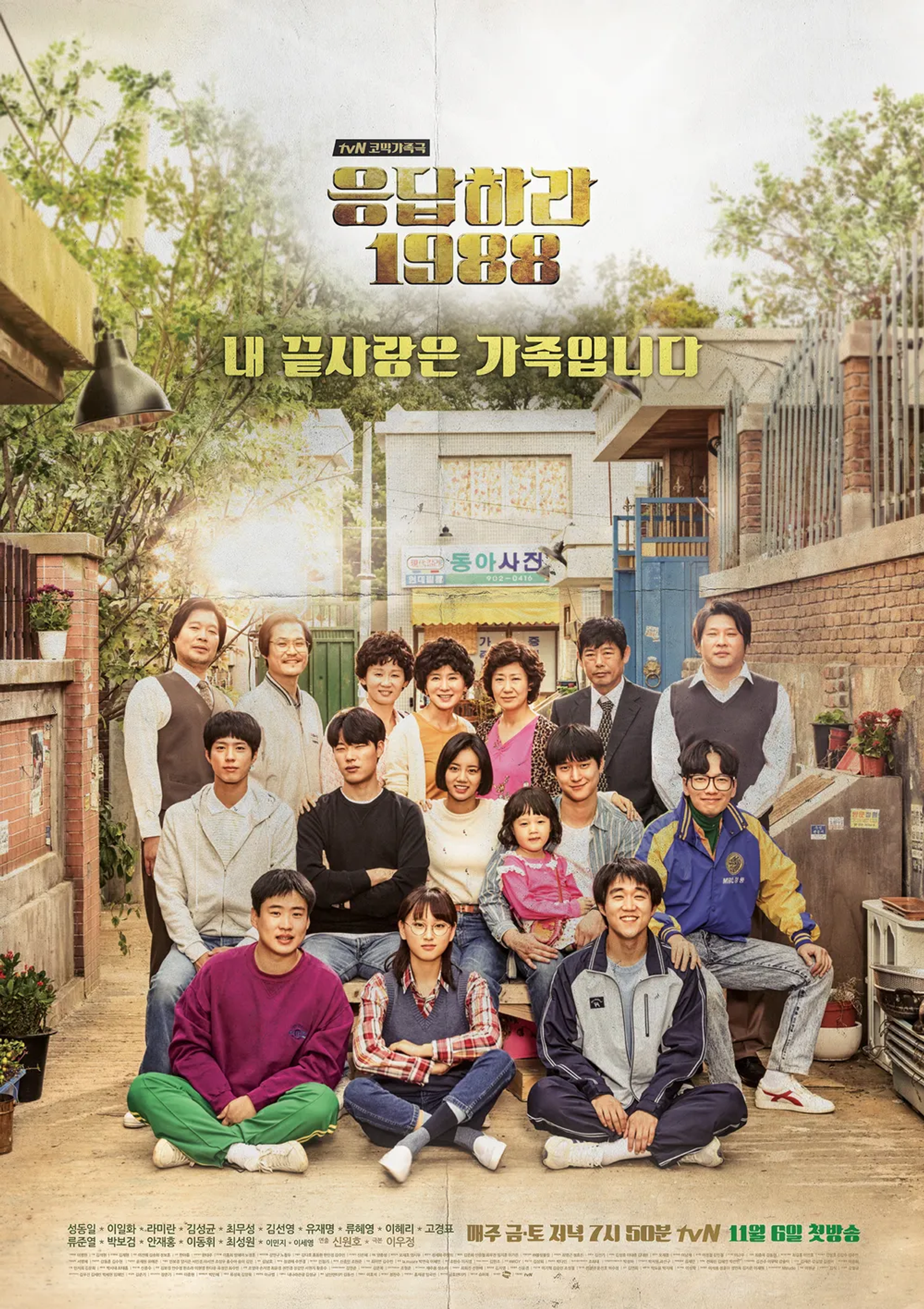
The address given in the drama was Ssangmun-dong, in Seoul's Dobong district. But the narrow alley where five families lived cheek by jowl was never in Seoul at all. It stood on a vacant plot of land in Uijeongbu, a city in Gyeonggi province, north of the capital. The walls, the flowerpots, the telegraph poles — every last detail was fabricated from scratch. When *Reply 1988* premiered on 6th November 2015, it staked everything on that single alley.
The alley that Ssangmun-dong never had
The interiors, the alleyways, and the Bonghwangdang lane were all built as outdoor sets on the Uijeongbu lot. The walls, flowerpots, benches, rubbish bins, telegraph poles, and trees were all production props. South Korean dramas typically secure outdoor sets with support from local governments, but on this occasion CJ E&M — the production company behind the cable network tvN — covered the entire cost itself. A tvN spokesperson described the outlay as "several billion won or more" (tens of millions of US dollars). As filming drew to a close, the prospect of demolition loomed. tvN expressed a wish to preserve the set for public visits, but the Uijeongbu municipal government was reported to have little interest in doing so.
Why Ssangmun-dong?
At a press conference, director Shin Won-ho explained that he chose Ssangmun-dong because he wanted somewhere "average" — a neighbourhood familiar not only to Seoulites but to viewers anywhere in the country, and one where members of his team happened to know people who could help with period research. He was careful to draw a distinction, however: "It is merely a backdrop. This is not a drama about Ssangmun-dong." What he was really after, he said, was "the warm feeling of an alleyway in Ssangmun-dong — the feeling of a place where apartment blocks are nowhere to be seen." He added, almost as an afterthought, that "even the name Ssangmun-dong has a kind of affectionate ring to it."
Sourcing props authentic to 1988 proved a separate challenge. Objects from that era were difficult to track down, and even when found, production staff sometimes had no idea how they were used. Everyday artefacts of 1980s Korean life — coal briquettes, portable gas stoves, rice storage bins, the low wooden platforms that lined neighbourhood alleys — were significant enough to warrant their own section in a viewer's guide released before the series aired.
Shin also admitted to feeling the weight of expectation on the third instalment of the *Reply* franchise. "Based on experience, and on the odds, I began with the assumption that a third series could not possibly succeed," he said. "So I decided we should tell the story we actually wanted to tell. That story was family."
Casting: searching as far as a paediatric obesity clinic
The casting process produced its own share of colourful anecdotes. The role of Jinju — described in the script as a chubby, food-loving younger sister — was filled by Kim Seol only after the production team had gone so far as to inquire at paediatric obesity clinics. Ahn Jae-hong put on more than ten kilograms to play the stay-at-home Jeong-bong; the team had spotted him in the film *Jokgu King*. Choi Sung-won, who plays Noeul, is a trained tenor from a choral background; he had worked with Shin Won-ho on a previous programme and, on hearing about the new project, put himself forward for an audition. Hyeri, a member of the girl group Girl's Day, nearly missed out on her role as rising demand for the band created scheduling complications, but the casting eventually went ahead without difficulty.
When Korean Air said no
The cabin-crew uniform worn by the character Deok-seon was modelled on the Korean Air design used from 1991 for more than fourteen years. Korean Air declined to cooperate with the production, however, citing uncertainty about how the airline might be portrayed on screen. The drama avoided naming the carrier, and the production team sourced the uniform independently while cutting any scenes set inside an aircraft cabin. Product placement elsewhere, by contrast, proved handsomely rewarding: sales of Lotte Confectionery's Ghana Chocolate bar rose by roughly 40% following its appearance in the series, while other snacks featured alongside it saw sales climb by around 20%.
A pink sweater and a Sangam-dong study
The pink knitted sweater worn by Hyeri in episode nine was the same garment that her co-star Park Bo-gum had worn while hosting KBS's *Music Bank*. In the drama, after Park's character compliments the sweater, Hyeri's character shoots back: "This jumper — it's yours, isn't it?" The interview scene featuring actors Lee Mi-yeon and Kim Joo-hyuk was filmed at the Sangam-dong studio of screenwriter Lee Woo-jung. The space had previously been used for several tvN entertainment programmes, including *Grandpas Over Flowers* and *New Journey to the West*, but this was its first appearance in a drama.
A record written in an alleyway
The final episode recorded a nationwide audience rating of 18.803% according to AGB Nielsen — the highest figure ever achieved by a cable drama in South Korea at that time. The first episode had drawn 6.118%. tvN reported revenues of 22.1 billion won (approximately $19 million) from advertising and video-on-demand sales alone.
In short
The alley at the heart of *Reply 1988* was not a slice of real life transplanted onto a screen. It was a space built from nothing for the express purpose of manufacturing *jeong* — the Korean term for a deep, affectionate bond between people. Billions of won in construction costs, a casting search that reached paediatric clinics, a rejected sponsorship request: all of it was in service of the warmth of one single alleyway.