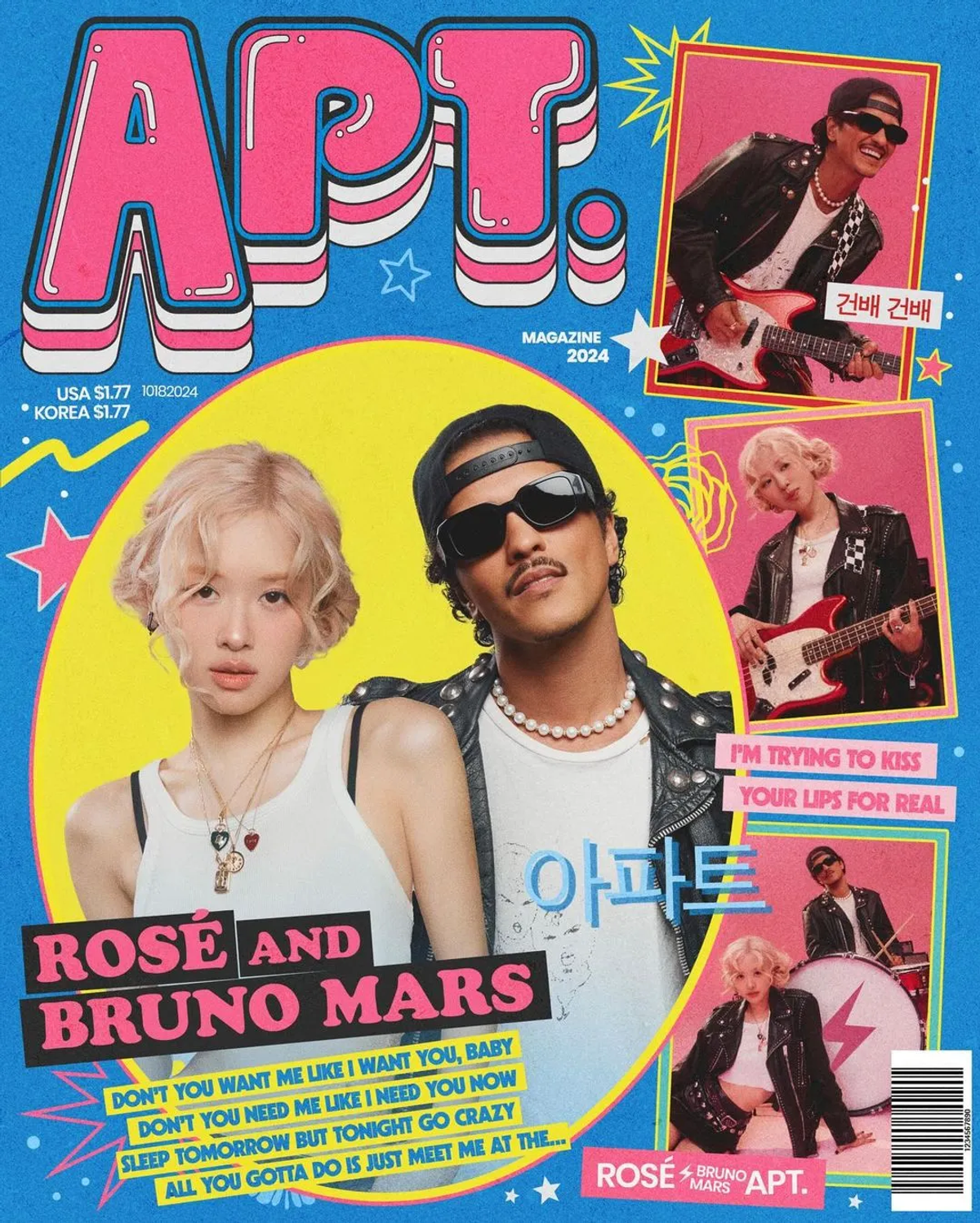
*Editor's note: "One Track" is a recurring series that uses a single song as a lens through which to examine broader trends in the K-pop industry. This seventh instalment examines the most recent case of a solo act eclipsing the group behind it: "APT." by Rosé and Bruno Mars.*
Released on 18th October 2024, "APT." is a duet between Rosé, a member of the South Korean girl group Blackpink, and American pop star Bruno Mars. The track served as the lead single for Rosé's debut studio album *rosie*, released on 6th December 2024, and made an immediate impact on music markets worldwide.
Origin — A party game that sparked a song
The song's concept was drawn from a popular Korean drinking game called the "Apartment Game," in which players chant a rising and falling sequence to the rhythm of the word *a-pa-teu* (the Korean pronunciation of "apartment"). One evening in the studio, Rosé taught the game to the team she was working with; as they played, the songwriting session began to take shape. Bruno Mars later joined the project, and the track was completed. The music video was co-directed by Daniel Ramos and Bruno Mars.
Performance — A phenomenon measured in records
On the day of its release, "APT." achieved a "perfect all-kill" on South Korea's major streaming platforms, simultaneously topping both real-time and daily charts across every major service. The international response was still more dramatic.
Just eleven days after release, the song entered the Billboard Hot 100 — America's definitive singles chart — at number eight. That marked both the highest-ever debut for a female K-pop artist and the first time any such artist had debuted in the chart's single digits. The song subsequently climbed to number five and ultimately peaked at number two, setting a new career high for any female K-pop solo act.
On the Billboard Global charts, the results were even more commanding. "APT." reached number one on both the Global 200 (which includes the United States) and the Global Excl. US chart. On the US-inclusive ranking, it recorded the second-highest streaming figure ever logged for a number-one song in Billboard's history. In Britain, it entered the Official Singles Chart at number four before spending five consecutive weeks at number two. By 30th October 2024, it had simultaneously topped the iTunes chart in 88 countries.
The speed of the song's YouTube milestone was equally exceptional. The music video surpassed 100 million views in five days, 300 million in 22 days, and 500 million in 47 days — breaking the record for the fastest K-pop solo act to reach that threshold in eleven years. On TikTok, it achieved two billion views in the shortest time ever recorded, and topped YouTube's global music video trending chart. The accompanying album *rosie* entered the Billboard 200 — America's main album chart — at number three, the highest position ever reached by a female K-pop artist. Rosé co-wrote every track on the album.
Meme-ification — From university entrance exams to "Gangnam Apartment"
The song's reach extended well beyond streaming statistics, becoming a fully-fledged cultural moment. When South Korea's national university entrance examination, held on 14th November 2024, featured a Korean-language passage in which the word "noise" appeared more than 40 times, students immediately drew comparisons to the song's repetitive hook — a telling sign of how deeply it had embedded itself in the public consciousness. On YouTube, a fan-made mashup with "Gangnam Style" — itself a subject of an earlier instalment in this series — circulated widely under the informal title "Gangnam Apartment," bringing together two defining songs from different eras of Korean pop. The song even found its way into a domestic animated television broadcast, where it was performed with adapted lyrics.
There was an unexpected historical footnote, too. As "APT." swept global charts, a 1982 Korean ballad of the same name — "아파트" (*Apartment*) by singer Yoon Su-il — was rediscovered by a new generation, 42 years after its original release. Two eras of Korean popular music, sharing a title, briefly occupied the same cultural conversation.
In December 2024, Rosé and Bruno Mars performed the song together for the first time on stage at the MAMA Awards, one of South Korea's most prominent music ceremonies.
Significance
What sets "APT." apart from the previous six songs examined in this series is a fundamental shift in the unit of success. Every earlier entry was a triumph of a group; this one belongs to an individual who, while remaining a member of one of the world's most famous pop acts, generated a global reaction that surpassed anything her group had achieved in that format. Rosé had already set a benchmark in 2023 when her debut solo single "On The Ground" entered the Billboard Global 200 at number one — itself a record for a female K-pop artist. "APT." broke that record once more, establishing her as a commercially formidable act entirely in her own right.
There is a broader implication, too. The fact that a Korean drinking game became a global meme suggests that K-pop has entered a new phase — one in which the appeal is no longer anchored solely to the brand power of specific groups, but to Korean cultural content itself. "APT." is evidence that South Korea's entertainment industry can now export not just polished performance, but the texture of everyday Korean life.
In a sentence
Not the weight of a famous group's name, but the competitive strength of one individual — and that was enough to captivate the world.