Introduction
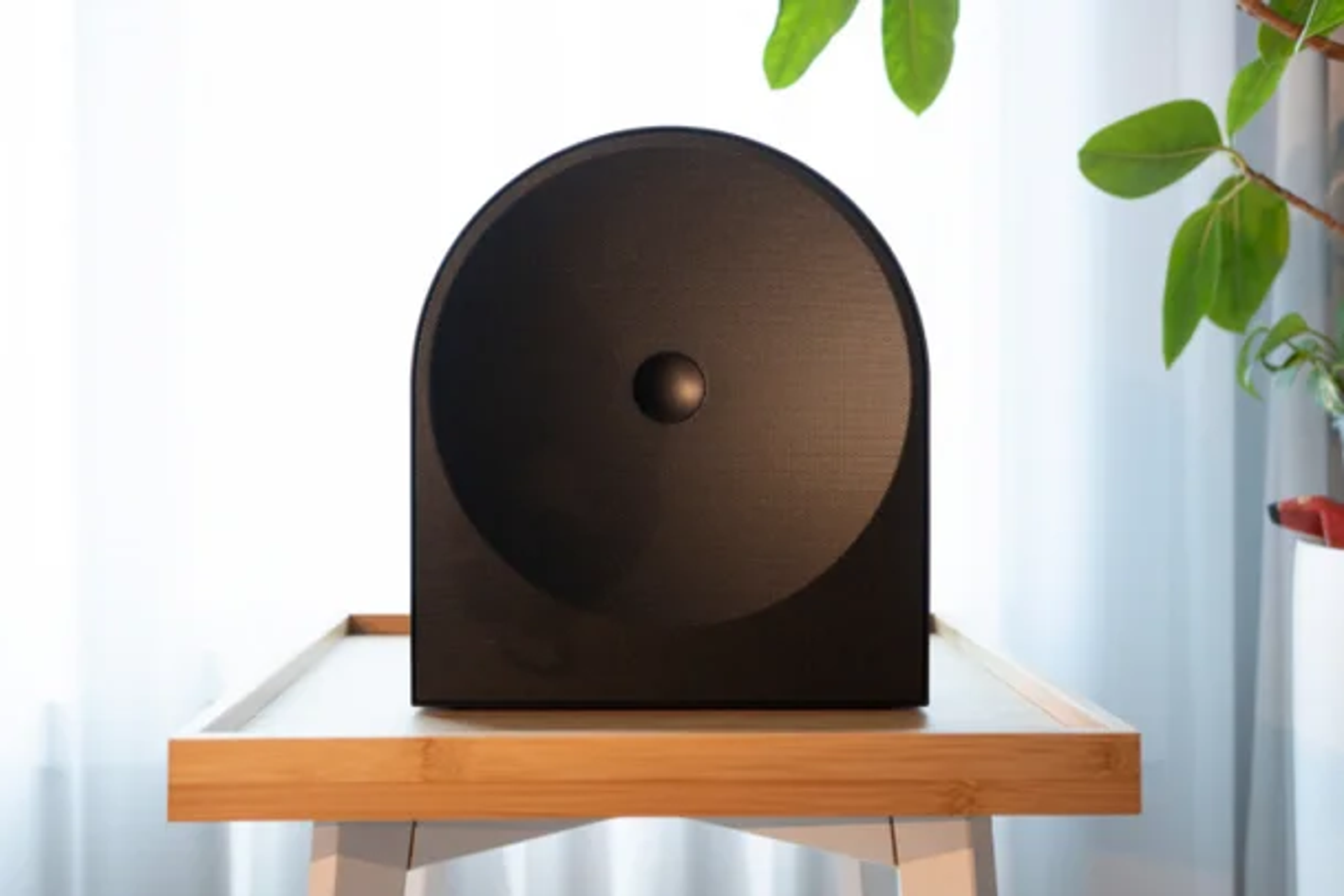
Samsung unveiled two wireless speakers at CES 2025 in January: the Music Studio 5 (LS50H) and Music Studio 7 (LS70H). The design was led by Ronan and Erwan Bouroullec, the French brothers behind Samsung's lifestyle television The Serif, and draws on the visual language of the company's picture-frame speaker, the Music Frame. The result looks more like a decorative object than a conventional loudspeaker — yet conceals an AI engine that analyses and adjusts sound in real time.
Specifications
The feature common to both models is what Samsung calls AI Dynamic Bass Control. The speaker continuously analyses the audio signal it is playing and automatically adjusts low-frequency output whilst preserving signal integrity. In effect, the AI compensates in software for a problem that is inherent in compact speaker hardware: small drivers struggle to reproduce bass cleanly, often producing distortion or a muddy, indistinct thump.
The entry-level Music Studio 5 applies AI Dynamic Bass Control to a 2.0-channel configuration comprising a single four-inch woofer and dual tweeters integrated with a waveguide. The higher-end Music Studio 7 goes further, with a 3.1.1-channel spatial audio architecture — adding left, right, centre, and upward-firing drivers — and supplements the bass-control AI with a second technology Samsung terms Pattern Control. This uses AI to suppress interference between audio signals in real time, improving directional accuracy so that sound is projected more precisely where it is intended. The Music Studio 7 also includes a super tweeter capable of responding up to 35 kHz and supports hi-resolution audio at 96 kHz/24-bit, raising the source quality ceiling for the AI to work with.
AI processing also governs how the speakers integrate with Samsung televisions. Through the Q-Symphony feature on 2026-model Samsung TVs, up to five wireless speakers can be controlled simultaneously, with the system automatically blending their output into a unified spatial soundscape. Dolby Atmos compatibility enables three-dimensional audio reproduction.
Strengths and Limitations
Early user accounts suggest the AI features deliver a meaningfully positive effect in practice. Reviewers note that the AI sound optimisation keeps vocals clear and distinct rather than swallowed by instrumentation, and that bass reproduction exceeds what the physical dimensions of the cabinet would ordinarily suggest. K-pop — a genre characterised by densely layered vocals and complex arrangements — reportedly showcases the AI's balancing capabilities to particularly good effect. Crucially, the system does not simply boost volume; it analyses the signal and targets only the frequency bands that require correction, addressing hardware constraints through software in a way that earlier speaker designs could not.
There are drawbacks. However sophisticated the AI, the absence of a dedicated remote control for basic functions such as volume adjustment is a meaningful inconvenience. Additionally, the degree of improvement the AI delivers will inevitably vary with source quality and listening environment, meaning consistent results cannot be guaranteed across all conditions.
Verdict
The Music Studio 5 and 7 pack AI-driven sound correction into housings that would not look out of place on a gallery shelf. AI Dynamic Bass Control and Pattern Control together compensate in real time for the physical limitations imposed by compact enclosures, making the sophistication of Samsung's signal-processing technology as central to the product's appeal as its distinctive appearance.
★★★★☆ (4.0/5.0)
Summary "The design sits quietly in its surroundings; the AI inside never stops refining the sound."