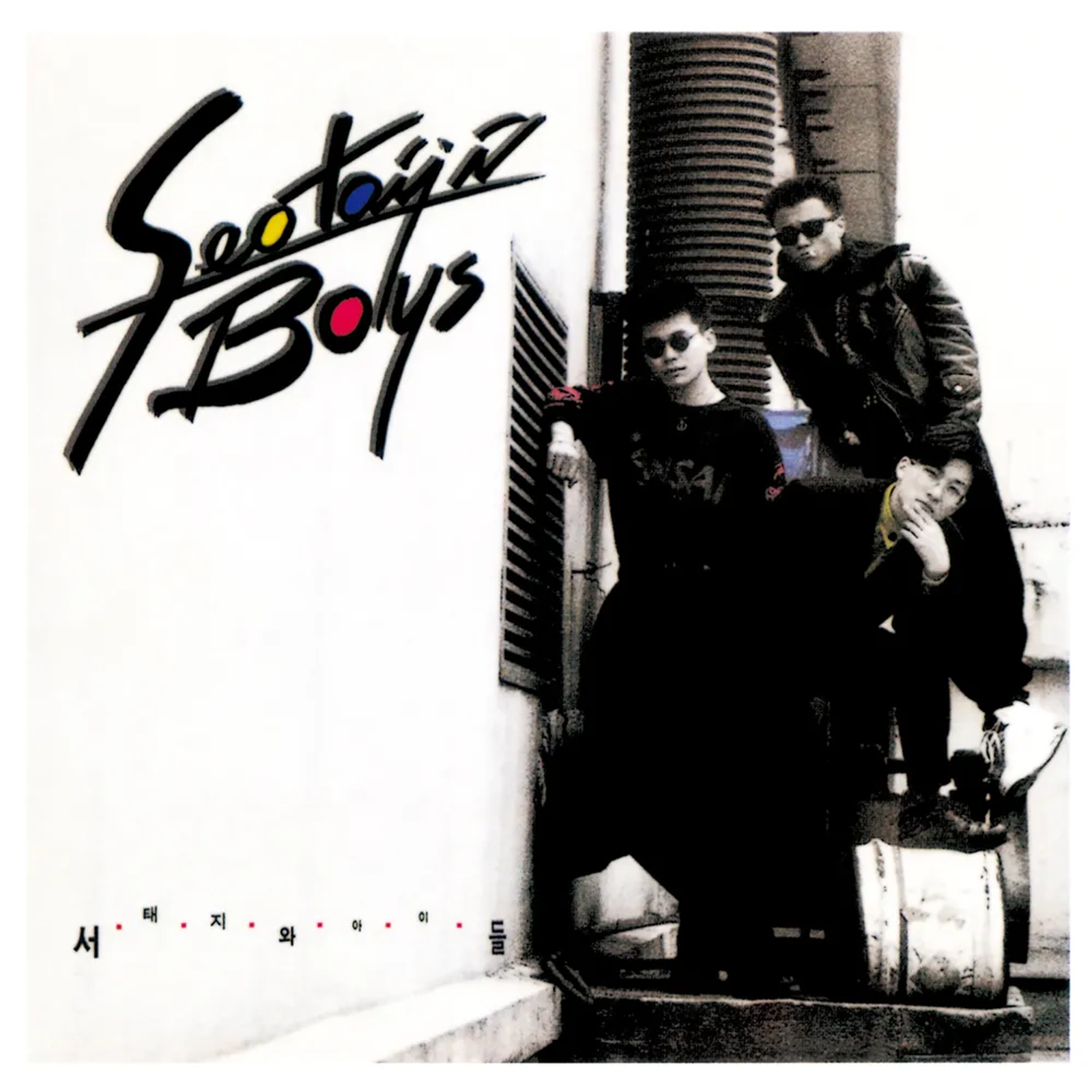
Editor's note: "One Track" is a series that takes a deep dive into landmark K-pop songs. For its seventeenth instalment — and the first to venture back to the 1990s — the series turns to Seo Taiji and Boys' "I Know", widely regarded as the prototype of K-pop.
On 11th April 1992, a newly debuted trio took the stage on MBC's entertainment programme *Special Scoop! TV Entertainment*, which featured a segment introducing emerging acts. The judges scored them 7.8 out of 10 — a near-dismissal. Yet that number has since passed into legend as the "7.8 broadcast", and the very same programme was reporting on the group's record-breaking album sales just one week later. That is how Seo Taiji and Boys' "I Know" turned the Korean pop world upside down.
Origins
Seo Taiji and Boys comprised three members: Seo Taiji (born Jung Hyun-chul), Yang Hyun-suk, and Lee Juno. They made their stage debut on 14th March 1992 and released their first album on 23rd March. The lead single, "I Know", was written, composed, and produced entirely by Seo Taiji. At the time, Korean popular music — known as *gayo* — was dominated by ballads and *trot*, a traditional genre with a distinctly local flavour. A handful of artists had experimented with rap, but it remained firmly on the margins of the mainstream.
Music and performance
The song opens with a solemn introduction before launching into a brisk synthesiser loop layered with rapping, punctuated midway by a heavy-metal-inflected instrumental break that adds raw energy to the track. The rapping, built over a new jack swing beat, was delivered at a measured pace with flexible rhythmic phrasing — critics credited it with establishing a new grammar for Korean-language rap. Yet the song was not wholly unfamiliar: its sung passages carried lyrical, melodic qualities that made it accessible to audiences reared on ballads.
The performance was equally striking. A spinning, whirlwind dance sequence during the instrumental break, street-dance routines by Lee Juno and Yang Hyun-suk, dreadlocked hair, baggy hip-hop trousers, and flamboyant outfits worn with their brand labels prominently displayed gave teenagers a sense of liberation — and promptly set off a nationwide fashion trend.
Results and records
The numbers make plain how badly the 7.8 score misjudged the moment. The debut album sold roughly 1.7m copies in 1992 alone, making it the best-selling album of the year. The momentum carried into the following year: the second album, released on 21st June 1993, sold 2m copies. "I Know" is reported to have held the top spot on the music charts for 17 consecutive weeks, and accumulated 26 first-place trophies on music television programmes that year.
Retrospective assessments have been even more generous. In 2014, the South Korean music channel Mnet ranked "I Know" first on its list of "100 Legend Songs". The American magazine *Spin* placed it fourth on its 2012 list of the "21 Greatest K-pop Songs of All Time". In 2020, *Pitchfork* gave the debut album a score of 8.3 out of 10, and in 2023 *Rolling Stone* ranked the track ninth on its list of the "100 Greatest Songs in Korean Pop Music History".
Significance
What "I Know" changed was not merely chart positions but the architecture of the market itself. The critic Lee Dae-hwa has argued that the popularisation of rap and dance music that followed represents a dividing line in the history of Korean mainstream pop — a before and after. As rap and dance music rose to prominence, fans who had drifted towards Western pop returned to domestic *gayo*, and a large teenage audience entered the market for the first time, driving rapid growth in the industry's overall size. It was also during this period that the centre of gravity in music consumption shifted from radio to video, with television assuming control of the pop market.
The structural transformation of the industry was equally significant. Three months after their debut, Seo Taiji and Boys established their own management company, Yoyo Planning — widely cited as the first instance of a Korean artist founding their own label. The move broke with a convention in which managers held authority over artists, shifting power towards the performers themselves. Yang Hyun-suk, one of the group's members, later founded YG Entertainment, which produced Big Bang — the subject of an earlier instalment in this series. Critics point to Seo Taiji's legacy in the subsequent idol culture exemplified by groups such as H.O.T., in the model of artist self-production, and in the emergence of a politically and socially engaged fan culture. *Pitchfork* has suggested that Seo Taiji can reasonably be regarded as the originator of the lineage that runs all the way through to BTS.
That said, the verdict is not entirely without qualification. Some critics have noted that the song became emblematic of a tendency to imitate foreign hip-hop and dance music rather than to innovate independently. There have also been allegations that it drew too heavily from a track released in 1988 by the international group Milli Vanilli. These are points worth acknowledging alongside the song's undeniable influence on Korean popular music.
Where earlier instalments in this series examined how the Wonder Girls' "Nobody" and Big Bang's "BANG BANG BANG" knocked on the door of global charts, "I Know" tells a different story — one set before that door existed, at the moment when Korean popular music changed its own direction from within.
In a word
The song that began with a score of 7.8 and went on to divide Korean pop history into two eras.