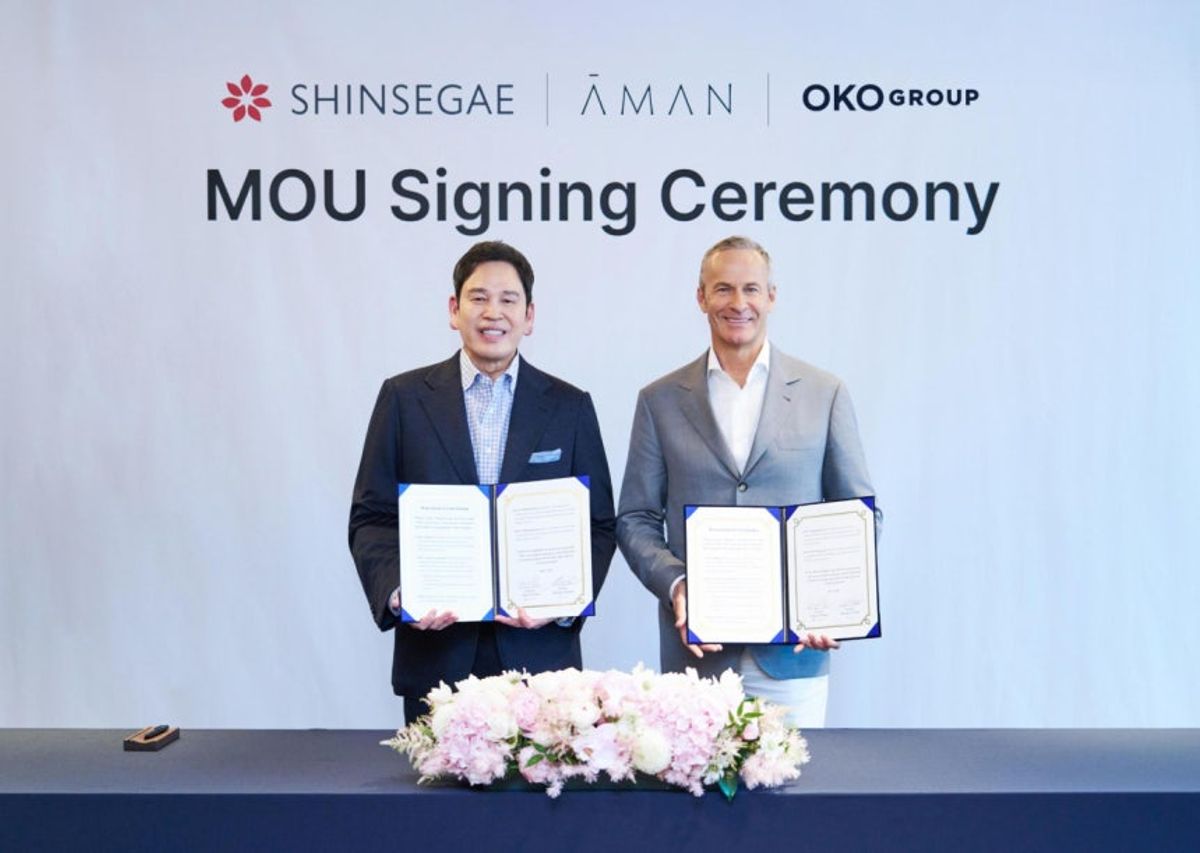
Shinsegae Group, one of South Korea's largest retail and property conglomerates, has joined forces with Aman, among the world's most exclusive hotel brands, to develop ultra-luxury properties on the global stage. The tie-up signals that Shinsegae intends to move well beyond running shops and department stores, positioning itself instead as a serious player in the global premium lifestyle industry.
Aman opened its first resort in Bali, Indonesia in 1988 and now operates more than 35 properties across 34 countries. The brand deliberately limits room counts, charges thousands of dollars per night, and has built its identity around radical exclusivity. Its devoted repeat guests—known in hospitality circles as "Amanjunkies"—have elevated the brand into a cultural icon as much as a hotel chain.
The arrangement between Shinsegae and Aman is understood to be a joint development partnership rather than a straightforward franchise or brand-licensing deal. That structure, analysts note, reflects Shinsegae's ambition to control the full value chain—property development, asset management, and lifestyle content—rather than merely collecting operating fees. The goal is to capture both asset appreciation and brand synergy simultaneously.
The strategic logic is rooted in structural pressures facing traditional Korean retail. Department store revenue growth has slowed steadily since 2022, according to Statistics Korea, as e-commerce platforms and cross-border online shopping erode the market. For Shinsegae, pivoting towards premium experiential businesses is less a choice than a necessity.
Global conditions appear favourable. According to hotel consultancy HVS, the luxury and ultra-luxury hotel segment is forecast to grow at an annual rate of 6–8% through to 2030. The Asia-Pacific region is considered the highest-potential market, driven by expanding wealthy populations in China and India, and rising inbound tourism to South Korea and Japan. That makes an Asia-focused development strategy the most plausible direction for the new partnership.
There are instructive precedents. Japan's Mori Building partnered with Hyatt's Andaz brand, while Hong Kong's CK Group (formerly Cheung Kong) co-developed properties with Four Seasons. In both cases, local capital successfully leveraged global luxury brand expertise and clientele to maximise the value of underlying real estate assets. Mori Building's Andaz Tokyo, embedded within the Roppongi Hills complex, lifted the brand value of the entire mixed-use development.
Yet the risks are substantial. Aman is notoriously demanding of its development partners, insisting on strict conditions regarding building density, the compatibility of surrounding facilities, and operational autonomy. Disputes with partners over these terms have been reported in several markets. If the commercial imperatives typical of Korean property development collide with Aman's "fewer, better" philosophy, both the quality of the finished product and its financial returns could suffer.
The financial profile of ultra-luxury hotels also demands caution. Construction costs per room can run three to five times those of a standard hotel, and payback periods of 15 years or more are not uncommon. In an environment of elevated interest rates and global economic uncertainty, the long-term profitability assumptions underpinning such projects are vulnerable—and large amounts of capital can remain tied up for extended periods.
Industry specialists are broadly agreed that the venture's success will hinge on site selection. Markets such as central Seoul or Jeju island, where luxury hospitality supply is already dense, offer limited upside. Southeast Asia and the Middle East, where demand for ultra-premium accommodation is still expanding rapidly, present more attractive return prospects. Whether Shinsegae treats this partnership as a genuinely global strategy, rather than a domestic one, may prove to be the decisive variable.
Ultimately, the Shinsegae-Aman alliance is the most visible expression yet of a South Korean conglomerate's determination to shed its identity as a retailer and reinvent itself as a global luxury lifestyle group. Whether this strategic wager becomes a new engine of growth—or merely adds a costly and complex burden to an already-pressured balance sheet—will depend on how well the two partners execute on the ground. The Korean hospitality industry, and the investors who watch it, will be paying close attention.