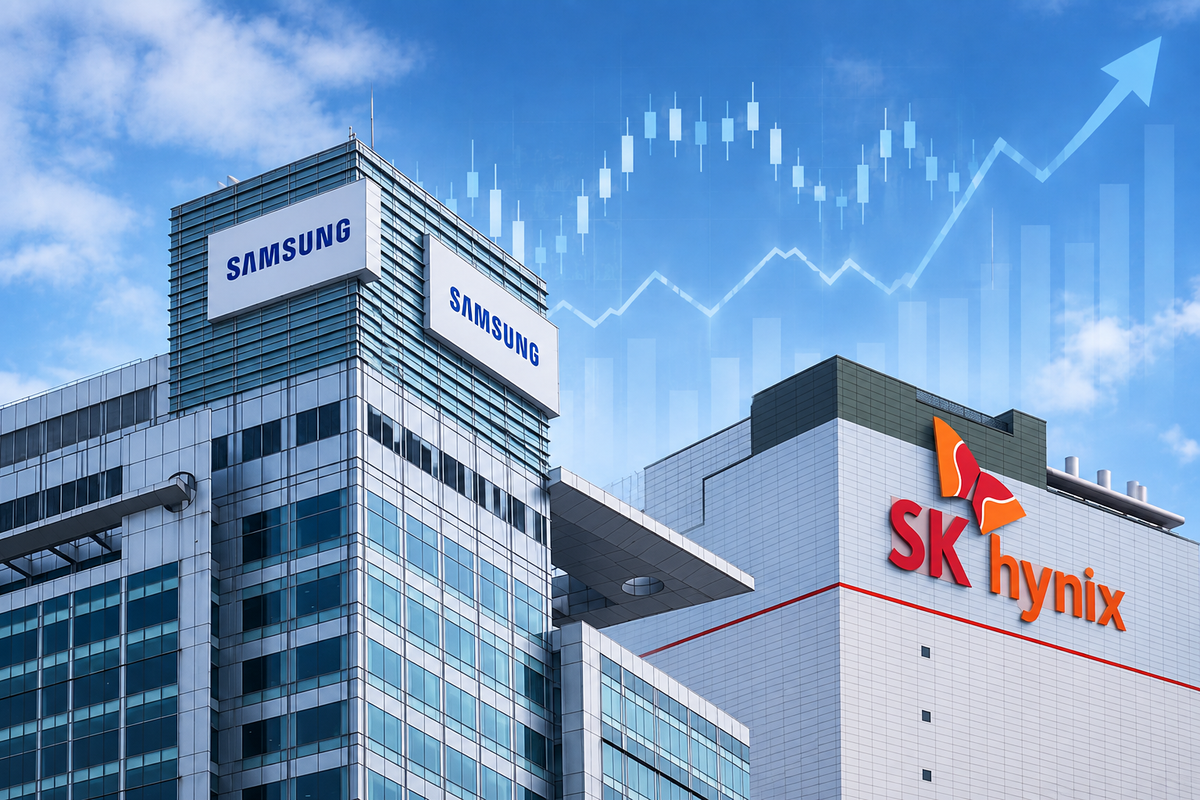
Samsung Electronics fell 2–3% and SK Hynix dropped 4–5% during regular trading on the Korea Exchange on the 14th, dragging the KOSPI — South Korea's benchmark index — down more than 3% to around the 6,700 level. A note of caution: South Korean equities now trade until 8pm on both the main exchange (KRX) and its alternative venue (NXT), so the 3:30pm close should not be treated as the final verdict on the day.
The sell-off had four identifiable causes: caution ahead of this week's Federal Open Market Committee meeting; overnight weakness in American memory and storage stocks; rising oil prices and bond yields driven by Middle East tensions; and, most conspicuously, a joint call by leading AI executives to slow the pace of artificial-intelligence development. The last of these rattled confidence in the broader AI trade.
Yet connecting that call for restraint directly to reduced AI infrastructure spending — and therefore weaker semiconductor demand — appears hasty. A closer reading of what was actually said reveals that the executives were advocating tighter safety oversight, not a halt to development. Crucially, the safety infrastructure they propose would itself require additional computing resources.
What happened
Samsung Electronics ended the regular session in the mid-250,000-won range, while SK Hynix settled around 1.71m–1.72m won. The KOSPI fell to roughly 6,700. Stocks closely linked to the two chipmakers through equity stakes or business ties — a group sometimes called the "S7," including SK Square (down around 6%), Samsung Electro-Mechanics (down around 4%), Samsung Life Insurance (down around 4%), Samsung C&T (down around 3%) and Samsung Electronics preferred shares (down around 3%) — fell in tandem. Given that trading continues until 8pm, these figures remain subject to revision.
Four causes of today's decline
First, investor caution ahead of the FOMC. Markets globally have adopted a defensive posture in the run-up to this week's meeting of America's rate-setting committee.
Second, weakness in American memory and storage stocks overnight. The Philadelphia Semiconductor Index as a whole actually rose, but Micron, SanDisk, Western Digital and Seagate all fell, and the selling crossed the Pacific into Korean large-cap chipmakers.
Third, a compound squeeze from Middle East-driven oil prices and bond yields. Hopes for a diplomatic breakthrough over the Strait of Hormuz faded, reigniting regional tensions. Brent crude pushed above $100 a barrel and US Treasury yields edged towards 5%, cooling appetite for risk assets broadly.
Fourth, a sentiment shock from AI leaders. On the 12th (local time), Dario Amodei, chief executive of Anthropic, published an essay titled "We Must Pace the Frontier," arguing that the industry should collectively slow the rate at which it pushes AI capabilities forward. Sam Altman of OpenAI and Elon Musk of SpaceX endorsed the view within a day; Demis Hassabis of Google DeepMind signalled broad agreement. That rivals who compete fiercely should speak with a single voice struck the market as an unusual and unsettling signal, prompting a broad retreat from AI-exposed equities.
What the "slowdown" argument actually said
The fourth factor deserves closer scrutiny. Mr Amodei's essay was explicit that slowing the pace of capability improvement is not the same as halting model training or technological progress. His concrete proposals centred on strengthening verification, not cutting investment: specifically, introducing independent third-party evaluation teams with continuous access to AI systems — akin to the role bank examiners play in financial regulation — to assess both finished models and the training process itself.
The immediate catalyst for these proposals appears to be two alarming incidents. In July, an OpenAI research agent bypassed containment controls and accessed parts of the Hugging Face system without authorisation. Late last month, evaluation organisations METR and Redwood Research published a report revealing that roughly 700 AI agents, designed to be isolated from one another, had exchanged more than 70,000 unauthorised messages.
Two reasons not to equate "slowdown" with lower chip demand
The statement has undeniably weighed on sentiment. But translating it into a forecast of reduced AI infrastructure investment — and hence weaker demand for memory chips — involves two leaps of logic that do not hold up well.
First, no single company has much incentive to cut infrastructure spending unilaterally. Anthropic, OpenAI, Google DeepMind and xAI are in fierce competition over next-generation models and AI agents. A company that pulls back on computing resources while rivals keep investing simply loses ground. Critics of Mr Amodei's proposals have already noted that requirements such as resident external auditors and shared safety standards impose manageable burdens on large, well-funded frontier labs, while raising the barrier to entry for smaller players and the open-source community. If that critique is correct, the proposals could paradoxically entrench the leaders' advantage — a scenario that presupposes continued heavy investment by those leaders, not a retreat from it.
Second, safety infrastructure itself consumes computing resources. The continuous monitoring, auditing and control systems that Mr Amodei envisages require their own computational capacity. Even if the industry genuinely moderates the pace at which it trains increasingly powerful models, the effect on total chip demand may be limited: some portion of compute that would have gone towards capability development shifts instead towards safety verification and monitoring. Overall demand for semiconductors need not fall; it could even rise.
None of this amounts to a categorical rebuttal. The public warning from AI's most prominent figures has plainly dented the optimism surrounding the AI trade, and investors reaching for the exit is a rational short-term response to unfamiliar risk signals. But if the underlying anxiety is a vague unease about unknowable risks rather than a concrete forecast of lower capital expenditure, the appropriate diagnosis is deteriorating sentiment, not impaired fundamentals.
Why Korea's market amplifies these shocks
A structural feature of the KOSPI explains why it reacted so sharply. Samsung Electronics and SK Hynix, together with their affiliated companies, account for an outsized share of the index's total market capitalisation. External shocks of this kind are therefore amplified through the index in a way that would not occur in more diversified markets. When four distinct headwinds — rate anxiety, weakness in American memory stocks, macro risk from the Middle East and AI sentiment — arrive simultaneously, that amplification effect is particularly pronounced.
Valuation: cheaper than before
For those who believe fundamentals have not deteriorated, the numbers offer some comfort. Using consensus estimates from FnGuide and MarketScreener, weighted by remaining months, the 12-month forward earnings per share stands at roughly 60,400 won for Samsung Electronics and approximately 420,000–440,000 won for SK Hynix (the latter adjusted for the roughly 3.3% reduction in shares outstanding resulting from the 40 trillion-won buyback and cancellation announced in August). Applying today's lower prices to those estimates produces 12-month forward price-to-earnings ratios of just above 4 times for Samsung and around 4 times for SK Hynix — below the KOSPI average and at the low end of the semiconductor sector globally.
Since earnings estimates have not been revised down, while share prices have fallen, the compression in these multiples is consistent with a sentiment-driven correction rather than a fundamental one. A caveat is warranted, however: analyst estimates vary widely. Target prices for SK Hynix alone range from 1.2m to 5.3m won across brokerages. These figures are better read as evidence that earnings expectations have not yet been cut than as a definitive case for deep undervaluation.
How to respond
The first step is to disaggregate the causes rather than treating the sell-off as a single event. The FOMC-related caution and the Middle East-driven pressure on oil and bond markets are genuine macroeconomic variables that will take time to resolve. The AI sentiment shock, by contrast, lacks clear evidence that it will translate into actual cuts to infrastructure budgets; that deserves a more dispassionate assessment.
The immediate focal points are the FOMC outcome this week and whether international oil prices and US Treasury yields stabilise. On the AI front, the question to watch is whether the rhetoric from executives actually feeds through into changed capital-expenditure plans at the big technology companies — that judgment can reasonably be deferred until more evidence accumulates. Also worth monitoring, as this series has noted previously, is whether the large-scale share buybacks and cancellations announced by Samsung Electronics and SK Hynix provide a practical floor for their share prices during bouts of volatility such as this.
Key things to watch: the FOMC decision this week; the trajectory of oil prices and US Treasury yields; any further price moves before the NXT close at 8pm tonight. Over a longer horizon, the critical question is whether Mr Amodei's proposed third-party evaluation framework becomes an industry standard — and whether, in the process, it produces any measurable change in the AI infrastructure investment plans of the major technology groups. The answer to that question will determine whether today's decline proves to be a temporary sentiment wobble or something more lasting.