The essentials
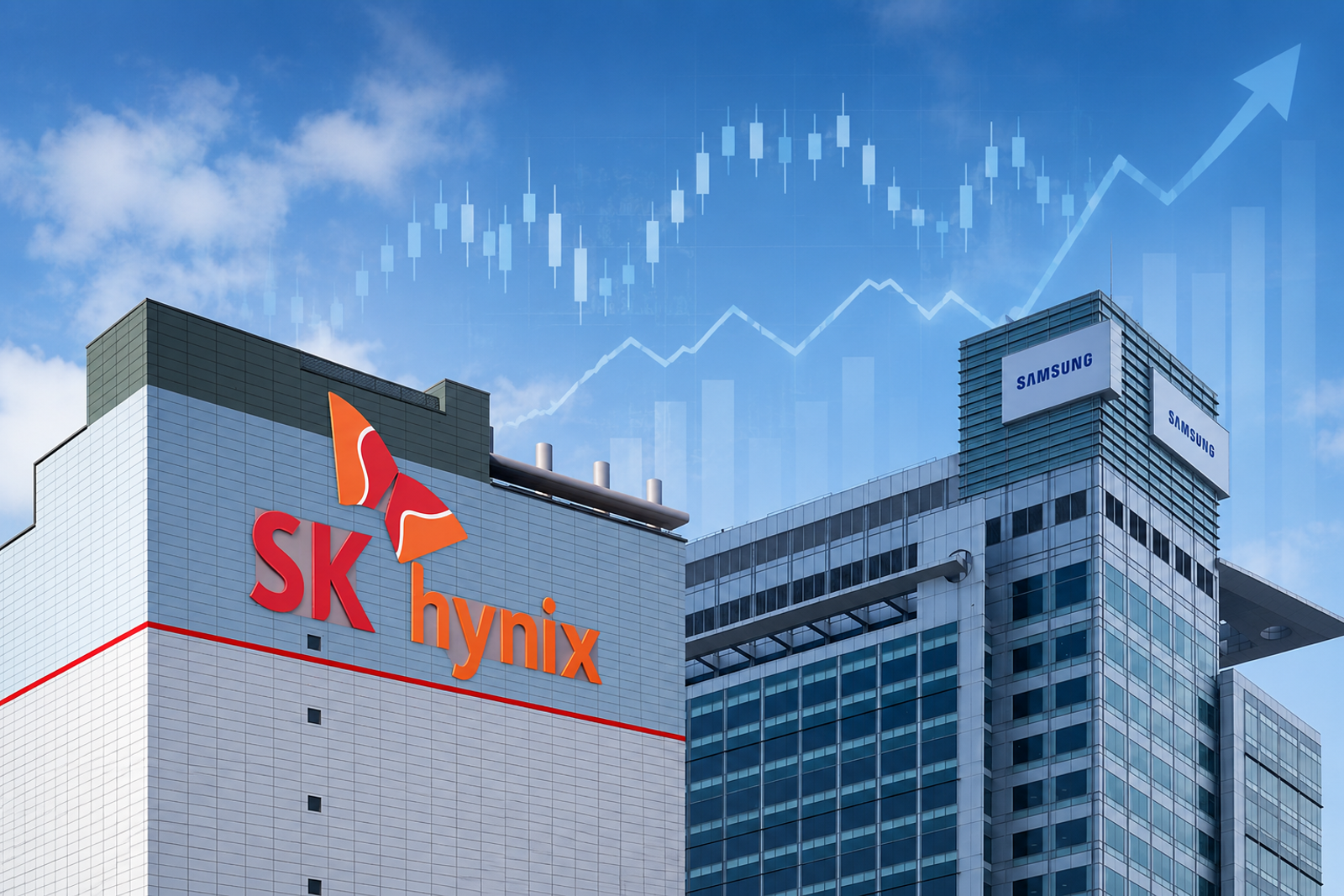
South Korea's KOSPI index plunged as much as 6.8% intraday on the 19th. Samsung Electronics fell 7.82% to 247,500 won and SK Hynix dropped 9.33% to 1,507,000 won, dragging the broader index down with them. It was the 48th circuit-breaker triggered on the Korean market this year. The sell-off was driven by a surge in long-dated American Treasury yields (the 30-year rate topped 5.3%), rising oil prices linked to Middle East tensions, and a report that Washington had asked Seoul to relocate semiconductor manufacturing facilities to the United States.
In the middle of the carnage, SK Hynix announced it would cancel its entire 40 trillion won treasury-share holding. Market purchases begin on the 20th. The decision was made possible by the company's dramatically improved balance sheet: net cash has reached 69.4 trillion won, and the disposal of part of its stake in Kioxia — held via a Bain Capital-led consortium — is estimated to have generated more than 40 trillion won in non-operating income.
All eyes now turn to Samsung Electronics, which has offered only a carefully noncommittal response — "we are aware of the market's keen interest" — without committing to a figure or a timeline. With SK Hynix having moved first and with force, the next inflection point will be determined by what Samsung does, and when.
What happened in the market
The KOSPI opened sharply lower and at one point was down more than 6.8% on the session. Samsung Electronics closed 7.82% lower at 247,500 won; SK Hynix fell 9.33% to 1,507,000 won. As the two largest stocks by market capitalisation on the KOSPI, their combined decline pulled the index down sharply, triggering the year's 48th sidecar — a mechanism that temporarily suspends program trading when futures prices move too far from the underlying index.
Several forces converged to produce the rout. The most significant was the renewed surge in global bond yields. America's 30-year Treasury yield climbed to 5.3% and Japan's equivalent reached its highest level in three decades, reviving fears about the cost of financing the vast artificial-intelligence infrastructure buildout by the big American technology companies. Market participants noted that bond markets are being squeezed from two directions simultaneously: governments issuing more debt to fund widening deficits, and big technology companies selling corporate bonds to finance AI chip purchases and data-centre construction. The aftershocks of overnight falls in American memory stocks — Micron and SanDisk were among those hit — were transmitted directly into Korean markets. Geopolitical uncertainty, particularly tensions between the United States and Iran, pushed oil prices higher and stoked inflation fears. Reports that Washington, as part of a 350 billion dollar investment package, had asked South Korea to build memory chip manufacturing facilities on American soil added to uncertainty for Korean semiconductor exporters; the South Korean government denied the reports, but the denial was insufficient to calm nerves.
A bold bet in the middle of the storm
Against that backdrop, SK Hynix's announcement was striking. The company said it would cancel the entirety of its 40 trillion won treasury-share holding, with open-market purchases beginning on the 20th. The move draws on a markedly stronger balance sheet than the company has historically enjoyed: net cash stands at 69.4 trillion won, and the partial disposal of its Kioxia stake is estimated to contribute more than 40 trillion won in non-operating income.
On SK Hynix's second-quarter earnings call, management had indicated that additional shareholder returns were under active consideration, without specifying either form or scale. Markets had been circulating estimates that an announcement of between 40 trillion and 100 trillion won could arrive this month. The announcement on the 19th was the answer.
It is also the second such move in quick succession. In January, SK Hynix cancelled treasury shares worth 12.24 trillion won. Samsung Electronics made a cancellation of its own at around the same time, worth 14.9 trillion won. Together, the two companies accounted for 63.8% of all treasury-share cancellations in South Korea in the first quarter. The latest 40 trillion won decision is therefore not an isolated gesture but part of an emerging pattern, suggesting that shareholder returns have become a durable commitment rather than a one-off response to market pressure.
Samsung is next
Market attention has shifted squarely to Samsung Electronics. The company has so far offered only a procedural statement — that any buyback and cancellation would proceed in accordance with applicable law and board resolution — without specifying amounts or timing. Securities analysts estimate that Samsung has 131.8 trillion won available under its current capital-return policy, with projections that the next three-year policy, due to take effect next year, could raise the annual return capacity to as much as 200 trillion won.
With SK Hynix having raised the stakes with a concrete figure, the question is whether Samsung matches it in kind — or opts instead for a dividend-oriented approach.
There is, however, a case for caution. Foreign investment banks have pointed out that the market-sentiment benefits of any announcement will depend heavily on the details: how clearly the capital-allocation principles are articulated, whether the size meets expectations, and whether the programme is structured as a recurring commitment rather than a single event. There is also a well-known risk with widely anticipated good news: the more thoroughly it has been priced in, the greater the danger that the actual announcement triggers a "sell on the fact" reaction. As this publication has noted in previous coverage, Samsung has experienced similar dynamics around strong earnings releases. The distinction, though, is that shareholder-return programmes carry more variables than earnings reports — dividend versus cancellation, one-off versus systematic, scale relative to expectations — and those variables can significantly affect how investors respond. The details, not the announcement itself, are likely to determine whether markets rally or sell off.
Dividends versus cancellations
The two methods work differently. A dividend delivers immediate cash to shareholders but has limited power to re-rate a stock. A share cancellation reduces the number of shares in circulation, directly improving earnings per share, and does so without creating a tax liability for shareholders — making it the more powerful tool for driving a durable revaluation.
SK Hynix's insistence on cancelling rather than merely holding its treasury shares signals a deliberate preference for this structural approach. The precedent set by Nvidia and TSMC, both of which have long used aggressive cancellation programmes as a cornerstone of shareholder returns, has not been lost on Korean companies now reassessing their own capital-return frameworks.
A global memory story
Today's sell-off illustrated clearly how tightly the Korean and American memory industries are now coupled. When Micron and SanDisk fell overnight in New York, the losses transferred almost immediately into Samsung Electronics and SK Hynix in Seoul. The pattern has repeated itself over recent weeks: conservative revenue guidance from SanDisk, or a Wall Street Journal report on off-balance-sheet AI commitments by the big technology companies, triggers declines in Micron, SanDisk, and Western Digital that ripple through to Korea within hours. The global memory trade has, in effect, become borderless.
Within that structure, SK Hynix's cancellation announcement creates indirect pressure on Micron. Micron's situation is, however, more constrained. The company has operated a 10 billion dollar buyback programme since 2018 and has continued to make quarterly purchases this year, but under the conditions attached to its US CHIPS Act subsidies, large-scale repurchases are restricted until 9th December. In the meantime, Micron has routed shareholder returns differently — retiring 5.4 billion dollars of high-cost debt early and raising its quarterly dividend by 30%.
Once the restriction lifts, the potential is considerable. UBS projects that Micron could direct its entire free cash flow into buybacks, acquiring more than 40% of its outstanding shares by the end of 2028, with estimated cumulative free cash flow over that period exceeding 400 billion dollars. Bank of America estimates repurchases of up to 31.7 billion dollars in fiscal year 2027 alone. Micron's chief financial officer has already signalled on an earnings call that buybacks, not dividends, will be the primary vehicle for shareholder returns going forward.
The implication is that Micron is currently constrained by regulation, not by capacity. If Samsung follows SK Hynix with a programme of comparable scale, the global memory sector will, at least through to year-end, present an asymmetric picture: the two Korean leaders acting aggressively while Micron is held back by its subsidy conditions. That asymmetry could provide a meaningful incentive for foreign capital to rotate from Micron into Samsung and SK Hynix — or into SK Hynix's American depositary receipts. The caveat is that the asymmetry closes in December, when Micron's restriction expires, and could reverse quickly thereafter.
Kioxia and SanDisk, which co-develop NAND flash technology with both Korean companies, sit in a somewhat different position. Their share prices are less sensitive to valuation-re-rating dynamics and more reactive to memory price cycles, data-centre demand trends, and interest-rate-driven volatility of the kind that roiled markets today.
Beyond semiconductors
SK Hynix's decision carries significance that extends beyond a single company's balance sheet. South Korea has recently seen a cluster of corporate governance reforms: proposed revisions to the Commercial Act that would mandate treasury-share cancellation, moves to eliminate dual-class listing structures at affiliated companies (chaebol subsidiaries holding cross-shareholdings), and legislative debate around inheritance-tax changes framed as a measure to prevent controlling shareholders from suppressing share prices to reduce estate-tax liabilities. Taken together, these constitute what commentators are describing as a second act of Korea's "Value-Up" programme — a sustained effort to dismantle the practices through which controlling shareholders and conglomerate structures have historically disadvantaged minority investors.
When the two largest companies in the country by market capitalisation move decisively toward large-scale shareholder returns, the precedent and the implicit pressure on other large conglomerates that have yet to act becomes difficult to ignore.
What to watch
The pace and scale of SK Hynix's actual open-market purchases, which begin on the 20th. Samsung Electronics' next move — the form (buybacks versus dividends), the structure (one-off versus systematic), and whether the scale meets the market's implicit benchmark of 131.8 trillion to 200 trillion won. Whether the global bond-yield surge that triggered today's sell-off abates: if the rate-driven pressure continues, shareholder-return announcements alone may not be sufficient to restore investor sentiment. And, at a slightly longer horizon, what Micron does once its CHIPS Act buyback restriction expires on 9th December — the point at which the current asymmetry in shareholder-return activity among the world's three largest memory producers may begin to close.