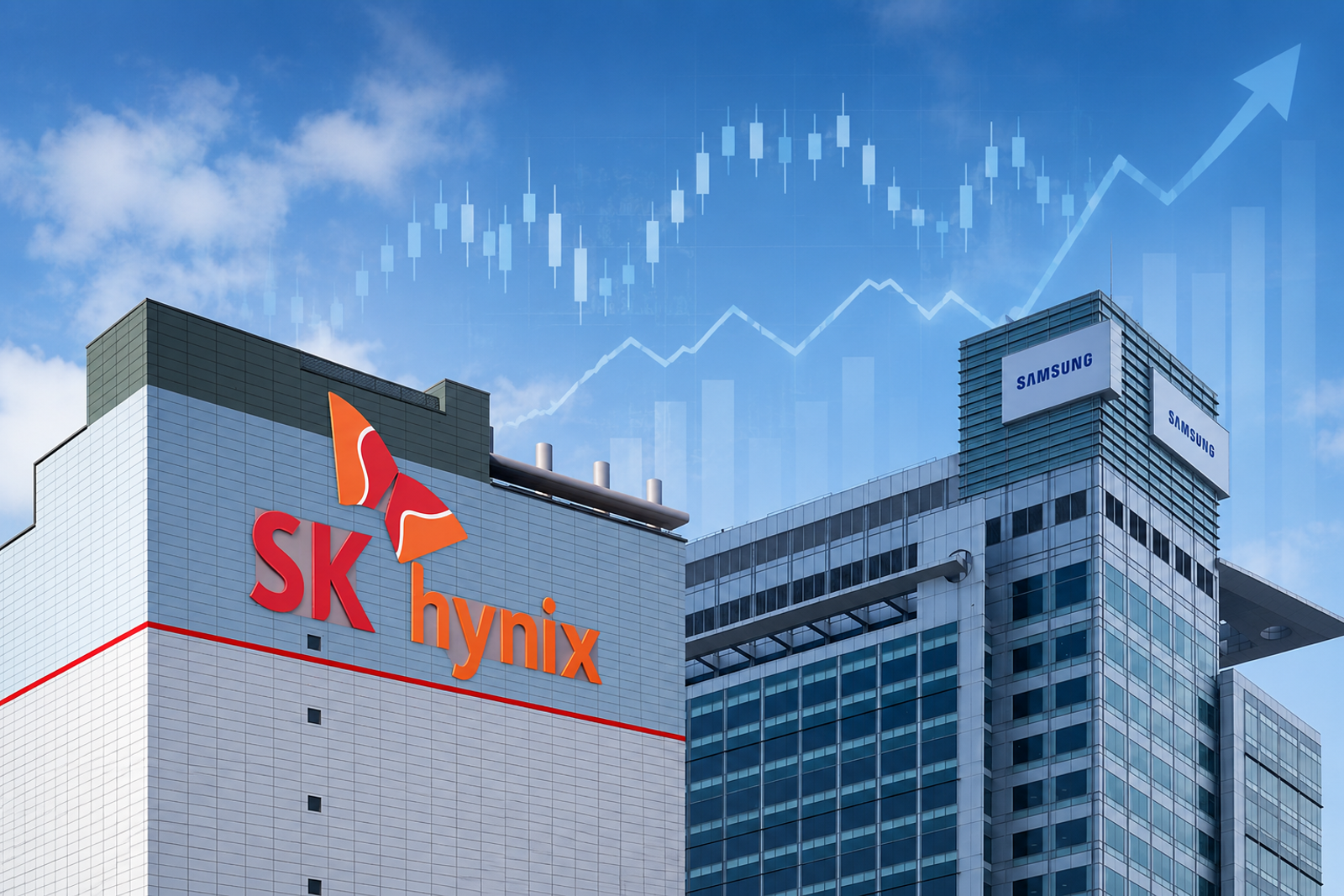
SK Securities published a semiconductor industry report on the 13th arguing that the earnings cycle for memory chips will prove more durable than in previous generations, driven by accelerating investment in artificial intelligence infrastructure. The central thesis rests on a structural reappraisal: AI computing assets are being reclassified from consumable technology goods into financeable infrastructure assets with long economic lives.
The brokerage estimates that Samsung Electronics and SK Hynix will together generate combined operating profits of 641 trillion won in 2026 and 977 trillion won in 2027 — figures that would place them among the most profitable corporate pairings in the world. The implied growth from 2026 to 2027 alone exceeds 52%. On the basis of this earnings durability and visibility, SK Securities maintained its overweight recommendation on the memory semiconductor sector.
The infrastructure argument
The driving insight is a change in how AI accelerators such as GPUs are perceived. Rather than depreciating rapidly after launch — the fate of most consumer electronics — these chips are being redeployed across successive generations, generating recurring cash flows throughout their useful lives. Recent results from CoreWeave, the American cloud computing company, lend weight to this view. The firm has signed long-term contracts through 2029 for servers powered by Nvidia's A100 GPU, a chip first released in 2019, and second-hand A100 prices have held at commercially meaningful levels.
Amazon's public disclosures provided further evidence. The company has stated that its server and networking equipment investments typically reach break-even within three years. SK Securities draws the logical inference: if the economic life of a compute asset extends beyond that break-even point, every subsequent year of utilisation represents pure profit. For chips like the A100, which remain in productive use nine years after launch, the gap between the payback period that markets fret about and the actual economic lifespan represents a sustained high-margin windfall.
Memory as critical infrastructure
The same logic redefines memory chips' role in the AI stack. Because AI demands enormous capital outlays and physical production capacity cannot be expanded at short notice, the leading AI companies have strong incentives to lock in supply. SK Securities argues this explains why major AI firms are signing binding long-term supply agreements (LTAs) with memory manufacturers for periods of five years or more. Memory directly affects the profitability of customers' AI operations, making reliable supply a strategic imperative rather than a procurement convenience.
This structural shift is also altering how memory companies are valued by the market. Historically, elevated fixed costs, the perennial risk of oversupply, and short earnings cycles kept multiples low, with price-to-book ratios (P/B) the dominant yardstick. Now, the proliferation of LTAs with upfront prepayments, capacity reservation by individual customers, and bespoke roadmaps for high-bandwidth memory (HBM) have improved the predictability and persistence of earnings. SK Securities argues this warrants a transition to higher price-to-earnings multiples (P/E), in line with the premium valuations accorded to more stable technology businesses.
Shareholder returns on the horizon
Enhanced shareholder returns are identified as an equally important investment theme. As earnings durability improves, memory companies will be better placed to sustain and grow dividends and share buybacks from stable cash flows. SK Securities also pointed to the narrowing discount at which Samsung's preferred shares trade relative to its ordinary shares as a market signal that expectations of higher payouts are already being priced in.
Risks to the thesis
This report represents the view of a single brokerage operating under an optimistic set of assumptions, and investors should weigh the counterarguments carefully.
The most immediate risk is a slowdown in AI capital expenditure. Should the big technology companies' AI-related spending fall short of market expectations, demand for HBM and high-capacity DRAM could weaken faster than anticipated. Improvements in the efficiency of AI models — requiring fewer memory resources to achieve the same output — could also moderate the pace of demand growth.
A return to oversupply is a structural risk that history cannot be ignored. As previous memory cycles have repeatedly demonstrated, heavy capacity investment during boom years tends to create supply gluts several years later. SK Securities' argument that LTA structures can cushion this dynamic is plausible, but the enforceability of contract terms and the risk of renegotiation are difficult to verify from the outside.
Valuation still depressed
Twelve-month forward P/E ratios for both Samsung and SK Hynix have languished near historical lows for an extended period — the result of earnings estimates rising faster than share prices. SK Securities diagnoses this as a symptom of market scepticism about the durability of the current earnings cycle, and argues that sustained evidence of earnings persistence is the prerequisite for a meaningful re-rating.
Data on GPU rental prices add a further piece of supporting evidence. According to Ornn data, the hourly rental rate for Nvidia's B200 GPU rose from just over one dollar in March 2026 to around seven dollars by August — a sharp recovery that suggests AI compute demand is being driven by genuine end-user requirements rather than speculative stockpiling. Silicon Data figures point to a similarly gradual upward trend since mid-2025. For SK Securities, these rental price dynamics confirm that AI infrastructure spending reflects real economic demand rather than a bubble in corporate capital allocation.