In an industry analysis published on the 28th, iM Securities forecast that global orders for South Korean-designed nuclear reactors will accelerate on the back of a Korea-US nuclear alliance. The report cited three principal drivers: participation in the construction of up to eight large reactors in the United States, a prospective acquisition of a stake in Westinghouse Electric, and the establishment of a joint venture between the two countries' nuclear industries.
The two governments are in discussions—framed as the second major strategic-investment project between Seoul and Washington—over the construction of up to eight large-scale reactors on American soil, at an estimated cost of up to $120 billion (roughly 165 trillion won). The configuration under consideration involves six Westinghouse AP1000 units and two South Korean APR1400 reactors. Were the APR1400 to be built in the United States, it would mark the first time a foreign-designed large commercial reactor had been constructed in the country that pioneered civilian nuclear power.
This follows an earlier agreement—the first such strategic-investment project—to build a $22.3 billion gas-fired combined-cycle power plant in Encinal, Texas. The United States has pressed South Korea to deploy roughly $10 billion of a broader $200 billion investment commitment before the end of this year. That capital is expected to take the form of advance orders for long-lead equipment needed in reactor construction.
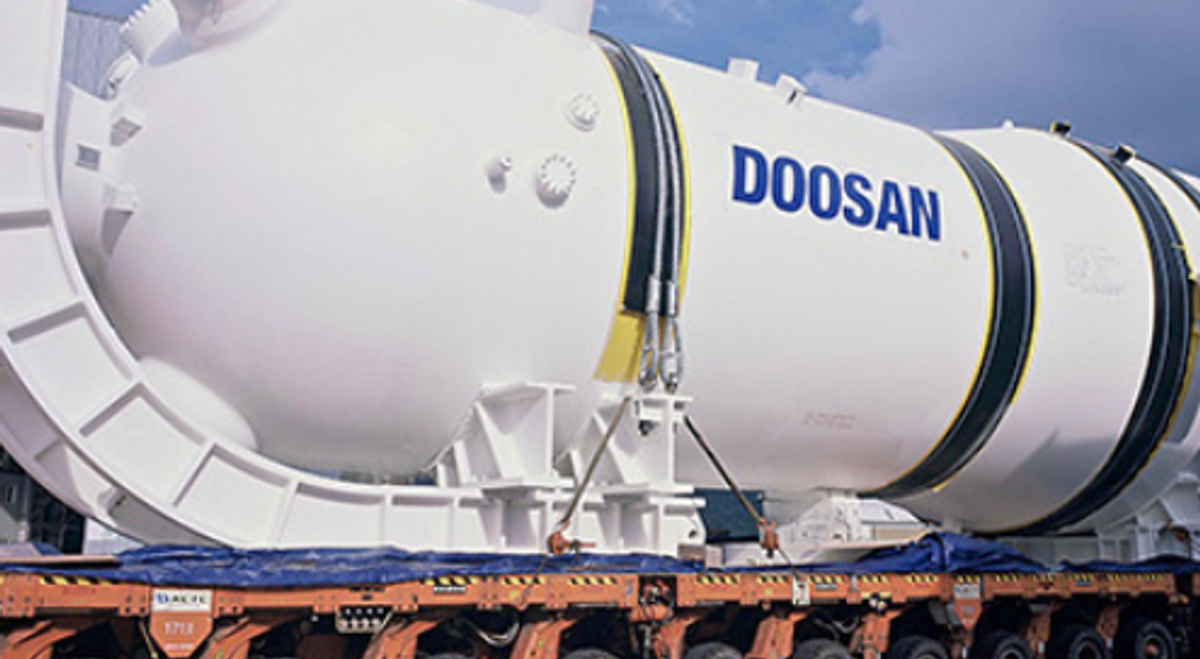
It is precisely this "advance-order effect" that the report finds most significant. Critical nuclear components typically take four to five years from order to delivery. By channelling investment funds into early equipment procurement, South Korea would in effect route dollars back to domestic companies such as Doosan Enerbility and BHI, rather than simply transferring cash to the United States. The arrangement converts an outbound capital commitment into domestic industrial revenue.
Korea's government and Korea Electric Power Corporation (KEPCO) are pursuing a 5–10% stake in Westinghouse at a 10% discount to its anticipated initial public offering price. Westinghouse filed a draft Form S-1 registration statement confidentially with the US Securities and Exchange Commission in July 2026 ahead of a planned IPO. Its current shareholders are Brookfield Renewable Partners, which holds 51%, and Cameco, which holds 49%.
Becoming a strategic shareholder would give South Korea leverage to renegotiate the existing Settlement Agreement between KEPCO, Korea Hydro & Nuclear Power (KHNP), and Westinghouse—the accord that has long blocked the APR1400 from entering the American market. A separate joint venture is also under discussion, under which Westinghouse would handle US licensing and basic engineering while South Korea would be responsible for reactor design, construction, operations, and equipment supply.
America's eagerness for Korean involvement stems from serious gaps in its own supply chain. Thirty years with virtually no new reactor construction have left the United States with badly atrophied manufacturing capacity and construction expertise. The Vogtle 3 and 4 units in Georgia illustrate the problem starkly: they took 14 years to complete—twice the original schedule—and cost 2.5 times the initial budget. The V.C. Summer 2 and 3 project in South Carolina fared even worse, abandoned entirely in 2017 following Westinghouse's bankruptcy. South Korea, by contrast, has earned international recognition for completing all four units of the Barakah nuclear plant in the United Arab Emirates on time and within budget.
Among the companies identified as beneficiaries, Doosan Enerbility (KOSPI: 034020) is forecast to report operating profit of 1.0617 trillion won in 2026, a 39.2% rise from 762.7 billion won in 2025. Even so, that figure remains well below the 1.4673 trillion won the company earned in 2023, a reminder that the lag between securing orders and booking revenues—along with the associated cost burden—is a variable investors should watch closely.
The US Department of Energy announced in June 2026 a $17.5 billion loan programme to fund long-lead equipment purchases for up to five projects being developed by Westinghouse and American utilities. iM Securities believes that if this programme is linked with South Korea's investment commitment, two special-purpose vehicles could be established before year-end, bringing Doosan Enerbility closer to concrete orders for reactor pressure vessels and steam generators.
The brokerage has assigned an Overweight sector view to five stocks: Doosan Enerbility, KEPCO Engineering & Construction, BHI, Taewong, and SNT Energy. All five carry a "Not Rated" designation, meaning no specific price targets have been set. Material uncertainties persist: Korea-US nuclear cooperation remains at the negotiating stage, the outcome of the Settlement Agreement talks is unresolved, the terms of any Westinghouse stake acquisition are undecided, and final investment decisions on individual projects have yet to be taken. These are both the conditions underpinning the forecast and the risks that could unravel it.