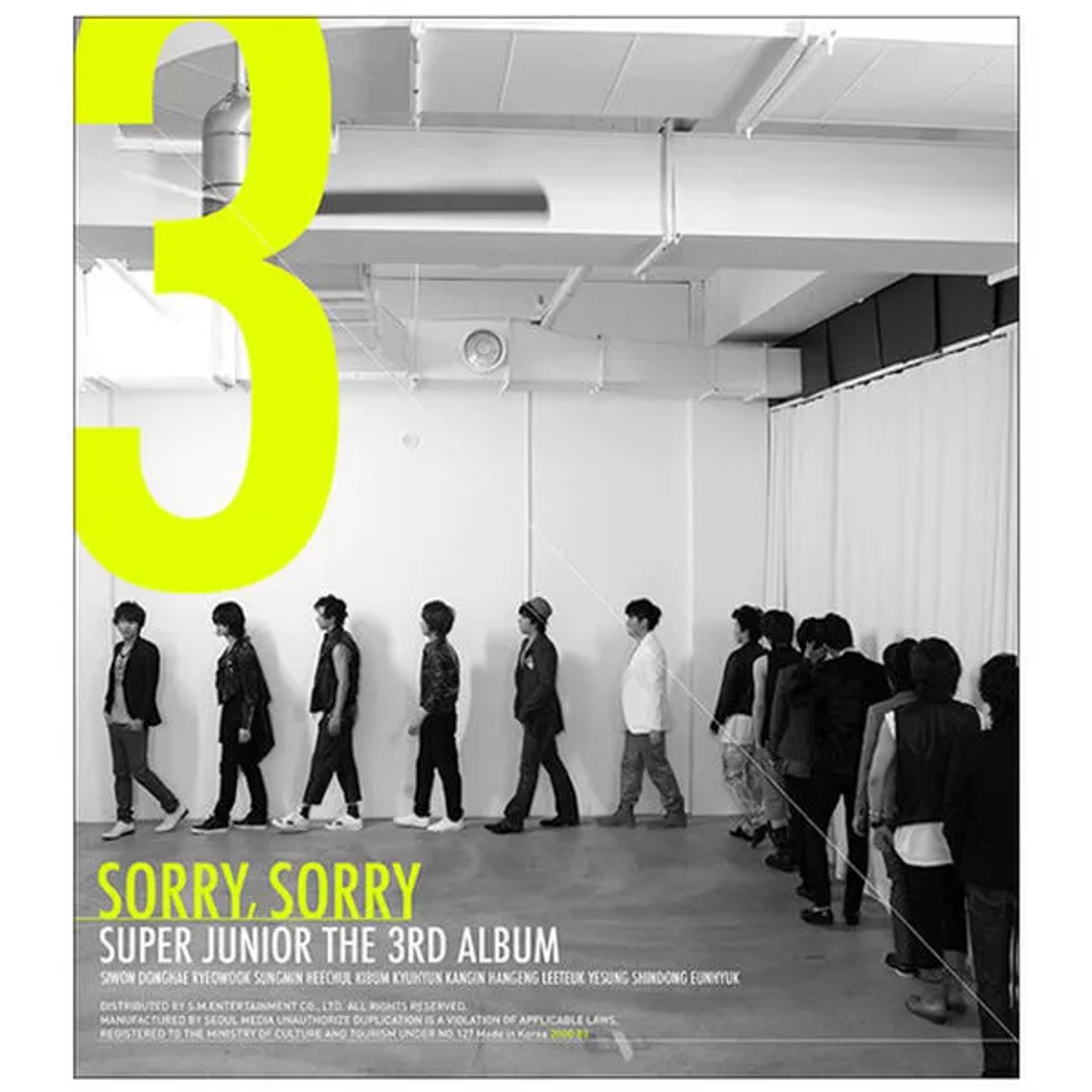
Editor's note: One Track is a series examining the origins, achievements and significance of landmark songs in K-pop history. The nineteenth entry is Super Junior's "Sorry, Sorry."
In the spring of 2009, the same refrain rang out simultaneously from street speakers, television broadcasts and stadium stands. It belonged to Super Junior's "Sorry, Sorry." The thirteen-member boy group, which had debuted in 2005, used a single song to shed their reputation as variety-show performers and plant themselves at the centre of second-generation K-pop. Seventeen years on, the track lives on in cover performances by younger acts.
Origins
"Sorry, Sorry" was the lead single from Super Junior's third studio album, released on 12th March 2009, with the song itself dropping digitally three days earlier, on 9th March. It marked the group's first full-lineup comeback in roughly eighteen months, following their second album in 2007. The track was written, composed and arranged by Yoo Young-jin of SM Entertainment, with Lee Soo-man serving as executive producer; choreography was by Nick Bass. Work on the album began in July 2008, with recording continuing through to February 2009.
The sound can be described in three words: urban, minimal, funky. A sleek club-house groove underpins a rhythmic funk pulse, with a relentlessly repeated chorus as its infectious hook. Eunhyuk, who was just beginning to make his mark at the time, captured the group's mindset: "More than anything, I wanted people to hear the music. We worked hard because we wanted to break the prejudice that we're a group that can't do music." The remark was revealing — the members were acutely aware that they had become known more for television appearances and individual projects than for their recordings.
Results and records
The numbers speak plainly. By mid-May 2009, roughly two months after release, the third album had sold 215,170 copies — 75,319 digital and 139,851 physical. It was the first album released that year to exceed 200,000 sales and the group's best-selling record to that point; their second album had sold around 190,000 copies. Total sales ultimately surpassed 250,000.
Early in the promotional cycle, member Leeteuk remarked that "there was no chart where 'Sorry, Sorry' didn't make the top." Year-end awards confirmed this was no exaggeration. At the 2009 Bugs Music Awards, the song took the Song of the Year prize with 60,184 votes — more than half of all votes cast — leaving Girls' Generation's "Gee" (18,370 votes) a distant second. On Melon's annual year-end chart, it ranked ninth. In December, Super Junior swept three prizes at the major end-of-year ceremony: Album of the Year, Main Award, and Popularity Award. Remarkably, they also claimed three awards at the Mnet Asian Music Awards (MAMA) pre-ceremony, despite SM Entertainment having publicly announced a boycott of the show.
The overseas response was equally strong. The song topped both Channel V Thailand's Asian Top 50 year-end chart and Hit FM Taiwan's Top 100 Singles chart for 2009, garnering more than 250,000 votes in a Taiwanese online poll. On domestic music broadcast programmes, it achieved three consecutive weeks at number one on SBS Inkigayo — the group's first so-called "triple crown" — and claimed the top spot on music shows a total of ten times. The black-and-white music video surpassed 100 million views on YouTube in December 2018.
What set it apart
The song's impact extended well beyond the music itself. The stark black-and-white music video and the choreography's accessibility combined to forge a distinct visual identity. The dance spread beyond television: it appeared in sporting-event crowd routines, awards-show performances and parody videos. One widely shared clip showed inmates at a prison in Cebu, the Philippines, performing the routine — a vivid illustration of how far the song had travelled. SM Entertainment's official music video exceeded 100 million YouTube views in December 2018.
Significance
The song's stature has only grown with hindsight. Music critic Cha Woo-jin called it "the track that installed Super Junior on the throne as global kings of the Korean Wave." Fellow critic Lee Gyu-tak described it as "a landmark that made them the foremost K-pop boy group at home and abroad — representative of second-generation K-pop and the Korean Wave as a whole." Critic Jeong Min-jae summed it up as "the group's signature, now a K-pop classic."
In 2023, Rolling Stone placed "Sorry, Sorry" at number twelve on its list of the 100 greatest K-pop songs of all time. The top spot went to Girls' Generation's "Gee" — the very song that had finished second to "Sorry, Sorry" in the 2009 Bugs Music Awards vote. Two songs that had competed for dominance in the same year found themselves reunited, fourteen years later, at first and twelfth on the same list.
Above all, the song marks the point at which a group known for entertainment pivoted to being taken seriously as musicians. The discipline of staging thirteen performers as a single cohesive unit, a signature dance move simple enough for any generation to imitate, and a fanbase that ignited abroad before consolidating at home — these became blueprints that many boy groups would subsequently follow.
In a word
The boldest apology in second-generation K-pop: it started with "sorry" and ended at the summit.