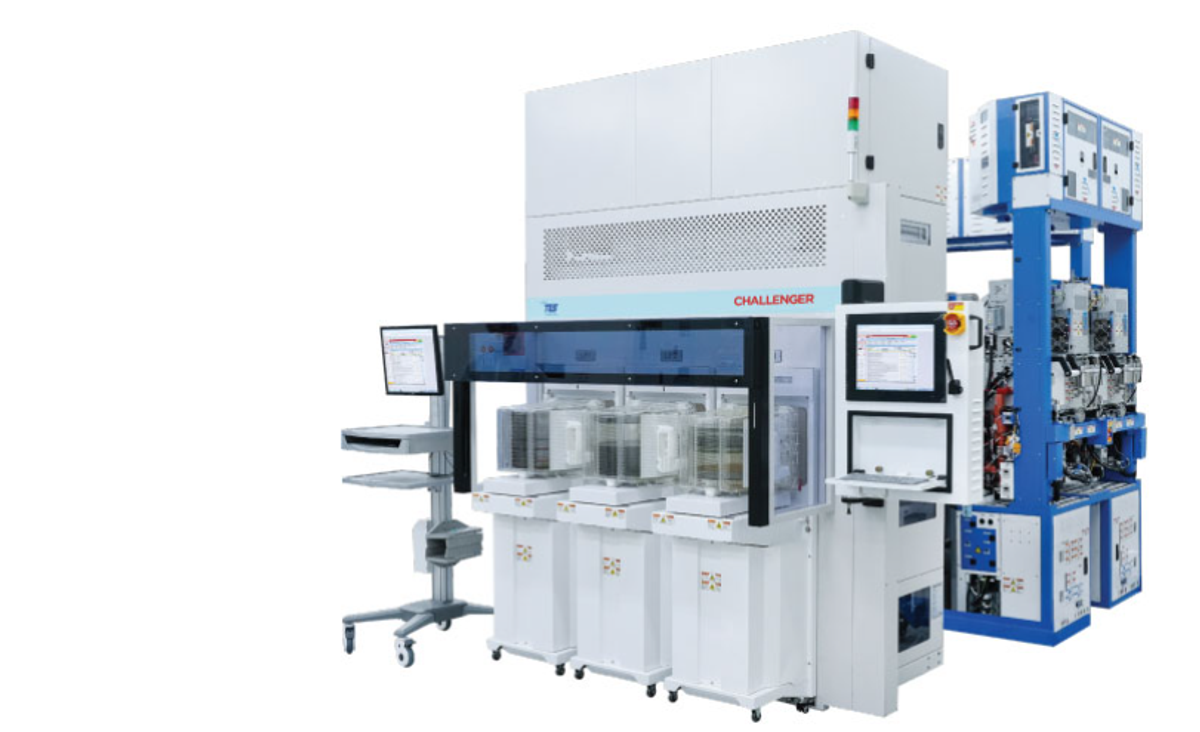
A research report published on the 17th by the Korea IR Council's Corporate Research Centre projects that TES (KOSDAQ: 095610), a specialist in front-end semiconductor deposition equipment, will generate revenues of 484.2 billion won and operating profit of 105.1 billion won in 2026 — increases of 37.9% and 81.7% respectively on the prior year.
Founded in 2002 and listed on the KOSDAQ (South Korea's technology-focused stock exchange), TES supplies Samsung Electronics and SK Hynix with amorphous carbon layer (ACL) deposition equipment and gas-phase etching (GPE) dry-cleaning tools. Semiconductor-related sales account for 98% of its revenues as of the first half of 2026.
Memory investment drives the outlook
The central driver of these forecasts is a wave of new capacity investment in DRAM — centred on Samsung's P4 fabrication plant and SK Hynix's M15X facility. Both customers are ramping up DRAM spending while simultaneously investing in leading-edge NAND processes of 300 layers and above. TES is well-positioned to benefit from both: its flagship ACL product is a hard-mask deposition tool used in the manufacture of both DRAM and NAND chips.
Profitability is also set to improve markedly. The operating margin is expected to rise from 16.5% in 2025 to 21.7% in 2026, a gain of 5.2 percentage points, driven by operating leverage as fixed costs are spread over higher revenues. A favourable base effect from one-off bonuses and similar charges booked in the fourth quarter of 2025 will provide an additional tailwind.
First-half 2026 results already show the momentum building. TES recorded revenues of 220.9 billion won (up 32.6% year on year) and operating profit of 48.2 billion won (up 31.4%). The order backlog stood at 206.9 billion won at the end of the second quarter — equivalent to 94% of first-half revenues — giving the company unusually high earnings visibility for the second half.
Structural shift, not merely a cyclical rebound
What makes TES's outlook particularly interesting is that the improvement is not simply a function of recovering memory-chip demand. Historically, TES's fortunes tracked the NAND investment cycle closely: as memory chips stack more layers, the hard-mask films required become thicker, increasing ACL consumption. Between 2020 and 2023, NAND accounted for 59–64% of TES's semiconductor revenues.
After the memory industry's production cuts in 2023, however, DRAM recovered faster than NAND, propelled by surging demand for high-bandwidth memory (HBM) used in artificial-intelligence servers. By 2024, DRAM had risen to 77% of TES's revenues. As NAND investment resumed in 2025 and into 2026, the mix has rebalanced to roughly 60% DRAM and 40% NAND — reducing the company's dependence on any single memory segment and lending greater stability to its earnings base.
New products add a longer-term growth dimension
Beyond its core ACL, ARC, and GPE product lines, TES is expanding into new equipment categories: Low-k dielectric deposition, BackSide Deposition (BSD), and Quad Systems. In 2025, Low-k and BSD together accounted for roughly 10% of equipment revenues. From the second half of 2026, Quad Systems are scheduled to enter Samsung's DRAM manufacturing process; the report expects new-product revenues to rise to the high teens as a share of the total by 2027.
BSD — which deposits thin films on the reverse side of a wafer to suppress warping as accumulated stress from front-side layers increases — is gaining traction as process geometries shrink. TES completed qualification of its BSD tool for HBM processes at SK Hynix in the first half of 2026, following earlier adoption in NAND, and expects to begin shipments in the second half of the year.
The China wildcard
TES began supplying ACL equipment to Chinese DRAM manufacturers in 2024; China accounted for around 6% of revenues in 2025. CXMT, China's largest DRAM producer, raised approximately 57.9 billion yuan through a listing on Shanghai's STAR Market in July 2026 and plans to expand capacity from 300,000 wafers per month in 2026 to 360,000 in 2027. With American export controls restricting the supply of US-made semiconductor equipment, Korean suppliers such as TES may find themselves well placed to fill the gap.
Risks worth watching
Investors should weigh several meaningful risks alongside the bullish headline numbers.
Customer concentration remains high. In 2025, SK Hynix and Samsung Electronics together accounted for 93% of revenues — 57% and 36% respectively. Any change to either customer's investment schedule would immediately amplify quarterly earnings volatility.
New products carry execution risk. Even after clearing a customer's qualification process, semiconductor equipment suppliers often face a gap before firm orders are placed and deliveries made. Should the ramp of Quad Systems or BSD tools for HBM slip on account of customer scheduling changes, revenue growth from new products could lag expectations.
The China opportunity cuts both ways. US export controls currently benefit TES by excluding Western rivals, but any extension of those controls to Korean suppliers could eliminate the company's Chinese revenues entirely.
Valuation: fairly priced, not obviously cheap
At 129,700 won per share (as of 15th September), TES trades on a forward price-to-earnings ratio of 24.8 times its projected 2026 earnings. That sits in the middle of its historical valuation range of 6.0–47.0 times, and is modestly above the domestic peer average of 22.6 times (excluding Jusung Engineering). Against the 31.8 times average of global equipment leaders such as Lam Research, Applied Materials, and Tokyo Electron, TES still looks relatively inexpensive.
Yet the stock has outperformed the KOSDAQ index by approximately 228% over the past twelve months. On 11th September, the Korea Exchange designated TES as an "investment warning" stock — a formal caution triggered by abnormal price movements. The report does not explicitly address the risk of short-term volatility that typically follows such a surge, but investors would be wise to keep it firmly in mind.