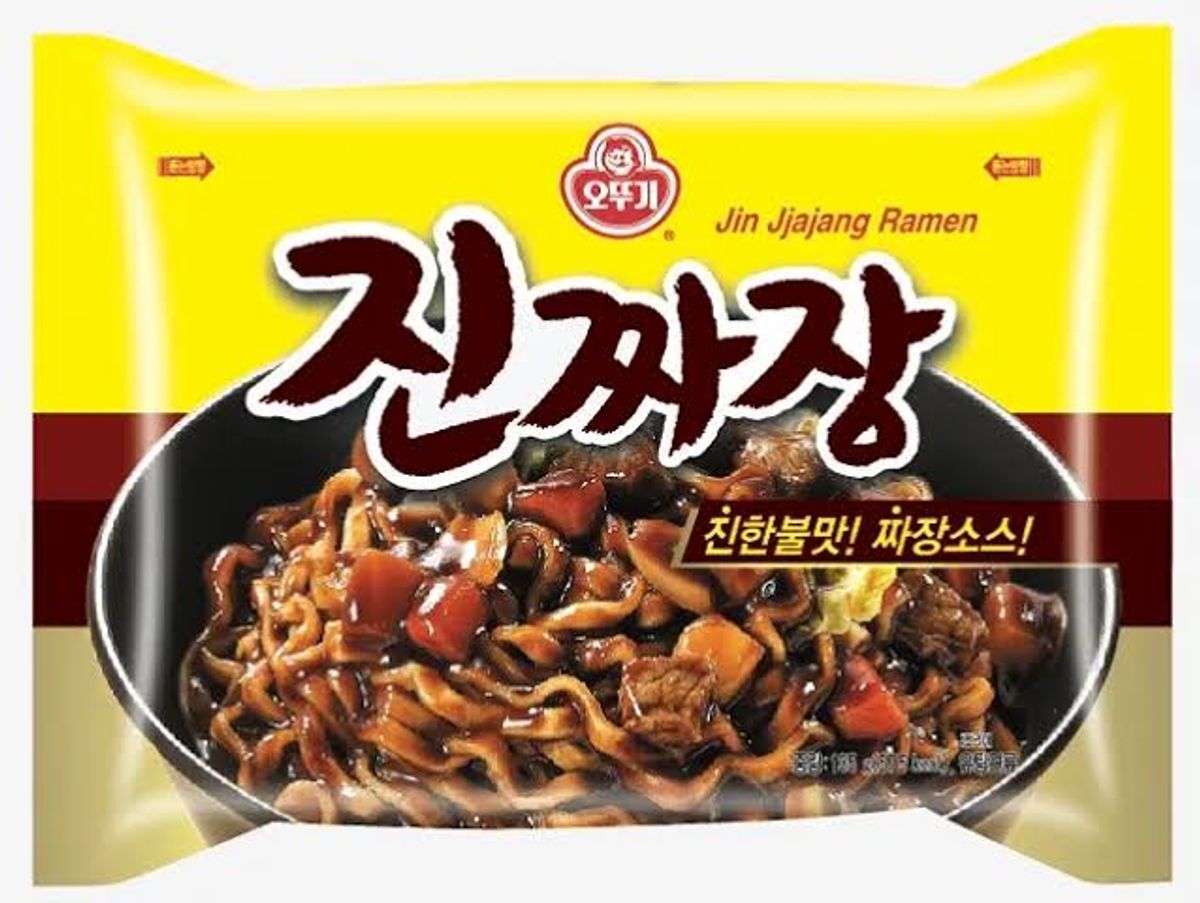
Ottogi Jin Jajang is a premium jajang-style instant noodle launched in 2015. (Jajang noodles — a Korean staple derived from the Chinese-Korean dish jajangmyeon — are coated in a thick black bean sauce and occupy their own fiercely contested corner of the instant-noodle market.) The product was conceived as a direct counter to Nongshim's Jjawang, released the same year, and positioned as the flagship of Ottogi's jajang noodle range, sitting above the existing Bukkyung Jajang line. The name itself has a minor legend attached: Ham Young-joon, Ottogi's chairman, recounted on his daughter's YouTube channel that researchers stumbled upon it almost by accident while debating candidates. When the name was first announced, many consumers noted it rhymed with "Jinjinjara", a well-known ballad by Korean singer Tae Jin-ah.
The product
The sharpest point of difference between Jin Jajang and its rivals lies in the sauce. Where Chapagetti, Jjawang and Jjaseulaeng (the three dominant players in the segment) all use powdered flavouring, Jin Jajang opts for a liquid sauce — though "liquid" is a loose description. The sauce is closer in texture to toothpaste or peanut butter: a dense, viscous paste that resists being squeezed from its sachet. This sets it apart even from other liquid-sauce jajang noodles such as Jjajaronni or Ilpoom Jajangmyeon, which use a thinner retort pouch sauce, suggesting Ottogi invested in a dedicated production process for this product alone.
The noodles, too, have a character of their own. Jin Jajang uses flat noodles, as do most competitors, but they are noticeably thicker than those in Jjayang. Combined with Ottogi's characteristic nutty flavour, the pairing drew respectable reviews at launch.
Taste
The difficulty is that the paste sauce is markedly sweet — and, for some consumers, faintly sour as well. The result is a more polarising product than most in the jajang category. The sourness can be reduced by stir-frying the noodles briefly after draining them of water, a technique that effectively "toasts" the sauce, but this step does not appear in the official cooking instructions. Unlike Jjajaronni, which explicitly calls for a pan-fry stage, Jin Jajang leaves consumers to discover the workaround for themselves.
The sweetness is not without its advocates. Because the sauce is so rich, the residual cooking water — left in the bowl after the noodles are eaten — lends itself naturally to mixing with rice, an improvised second course that Koreans call "bibim-bap style". Jin Jajang tolerates more leftover water than most rivals without the flavour turning thin, so the sweetness inadvertently creates a secondary use case. Even so, for consumers expecting the savoury, smoky, slightly charred quality that defines a well-made jajang noodle, the sweetness leaves an imbalance that is hard to ignore. Where Jjayang and Jjaseulaeng emphasise the earthy depth of chunjang (fermented black bean paste) and the wok-charred finish, Jin Jajang tilts the scales decisively towards sweetness.
A revised version was introduced alongside the launch of Jjaseulaeng, with a reformulated sauce that tempered the sourness and loosened the texture. Reviews suggest, however, that in solving one problem, Ottogi created another: the smoky character was also muted. One improvement traded for another.
Verdict
Jin Jajang has carved a genuine identity in a crowded market through its paste-format sauce — an approach no direct rival has replicated. The problem is that the very quality which defines it, an intense sweetness, undermines the savoury, smoky equilibrium that jajang noodles are supposed to deliver. As a base for mixing with rice it is genuinely appealing; as a standalone bowl of jajang noodles, the scales tip a little too far in one direction.
★★★☆☆ (3.0/5.0)
In a line "Rich and intense, certainly — but all that intensity runs only one way."