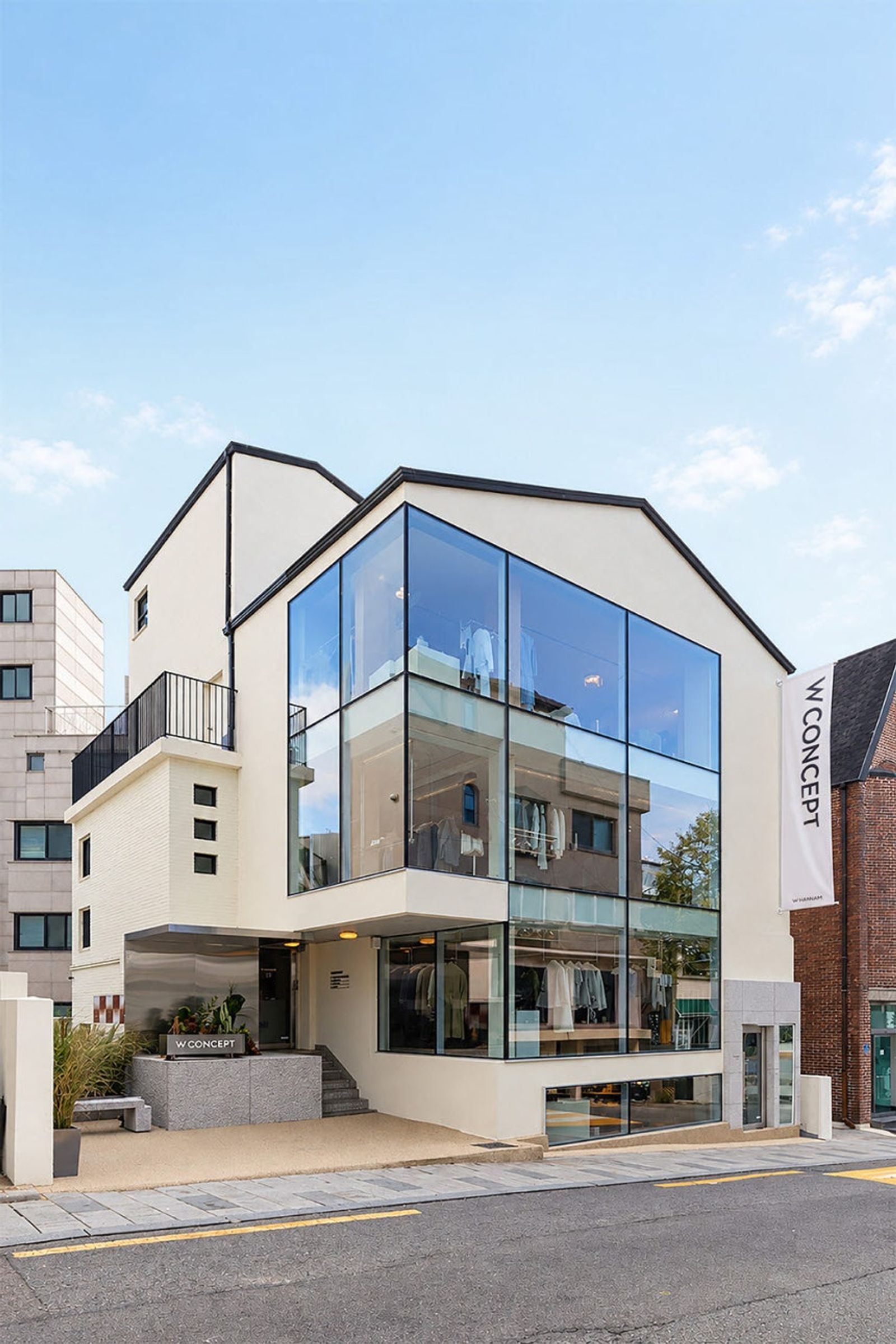
W Concept, an online fashion platform best known for curating South Korean designer labels, has opened its first standalone flagship store in Hannam-dong, one of Seoul's most coveted retail districts. The move is a calculated bet on what the industry calls a "reverse omnichannel" strategy — digital-native brands establishing a physical presence after building their audiences online — and reflects the growing difficulty of standing out in a crowded and expensive online marketplace.
Why Hannam-dong: where taste-makers congregate
The choice of Hannam-dong is no accident. The neighbourhood has become Seoul's foremost destination for fashion-forward consumers — roughly equivalent to London's Carnaby Street or Tokyo's Omotesando — attracting brands such as Gentle Monster, Ader Error and Marhen.J, which have all planted flagship stores there. What distinguishes Hannam-dong from busier commercial districts is not footfall but dwell time: visitors tend to linger, browse and buy, making it a preferred location for companies that prioritise brand experience over sheer transaction volume.
Data from Seoul's commercial district analysis service bears this out. Fashion and beauty sector revenues in Hannam-dong have risen steadily over the past three years, and consumers aged between 25 and 39 account for more than half of all visitors — precisely the demographic that forms the core of W Concept's customer base.
The logic of going physical
W Concept was founded in 2008, building its reputation on the curation of independent designer brands. In 2022 it was acquired by SSG.com, the e-commerce arm of Shinsegae Group, one of South Korea's largest retail conglomerates, which gave it access to a broader distribution infrastructure. Yet competition has intensified sharply. Rivals including Kakao Style, Ably and Musinsa have all jostled for the same customers, squeezing margins and pushing up the cost of customer acquisition.
The domestic online fashion platform market was estimated to be worth roughly 14 trillion won (approximately $10.5bn) in 2023, but the battle for market share among leading platforms has driven customer acquisition costs steeply higher. "The cost of bringing in new customers through digital advertising alone has more than doubled compared with three years ago," said one industry executive. "Offline touchpoints have become more efficient than digital channels for building brand awareness and loyalty."
A path already trodden abroad
The pivot from digital-first to physical retail is by now a well-established playbook in global markets. Warby Parker, the American eyewear brand that began as a direct-to-consumer online business, now operates more than 200 stores across the United States and has demonstrated a clear "halo effect" — online sales in areas surrounding its physical stores rise alongside the opening of those stores. Amazon has moved into physical retail through Amazon Go and Amazon Fresh. In China, the lifestyle platform Xiaohongshu (also known as Little Red Book) has used pop-up events to deepen customer loyalty.
Closer to home, Musinsa — W Concept's most direct rival — has opened physical stores in Seoul's Hongdae, Seongsu and Gangnam districts and reported a meaningful increase in online repurchase rates among customers living near those stores. It is a model W Concept will be hoping to replicate.
Experience over transaction
The Hannam-dong flagship is designed less as a shop than as a showroom for the brand's identity. The premise is that allowing customers to touch, try on and assess the quality of curated designer pieces builds a form of trust that no product page or algorithm can fully replicate — what fashion marketing specialists call "tactile confidence."
This matters especially for W Concept's product range. Its core offering skews towards emerging designer labels at higher price points, where shoppers are particularly sensitive to fabric, cut and fit. The influence of a physical encounter on the final purchase decision is far greater in this segment than in fast fashion, where price and speed dominate.
The risks are real
Not everyone is convinced the economics will work. Operating a flagship in Hannam-dong carries substantial fixed costs: the neighbourhood commands some of the highest commercial rents in Seoul, and staffing, stock management and fit-out expenses add further pressure. Reaching break-even from a standing start could take considerably longer than the company might hope.
There is also strategic pressure embedded in the decision to open at all. If this first store underperforms, it could constrain W Concept's appetite for further physical expansion; if it succeeds, it sets a benchmark that will be difficult to replicate cheaply across multiple locations. Some industry observers caution that without a genuine talent for spatial curation and content creation, the store risks becoming little more than an expensive showroom with no measurable return.
The measure of success: online and offline as one
Ultimately, the flagship's performance will be judged not by sales per square metre alone, but by whether it strengthens the broader platform. The goal is a virtuous cycle: store visitors discover the app; app users are drawn to the physical experience and become more deeply committed customers. How tightly W Concept engineers that loop will determine whether the experiment justifies its cost.
As South Korea's fashion retail market evolves beyond a simple online-versus-offline binary towards what analysts describe as an "experience-centred integrated platform," the Hannam-dong store has become a closely watched test case for the entire industry. Its outcome will shape not only W Concept's strategy but also the decisions of every other digital fashion platform contemplating a similar move.