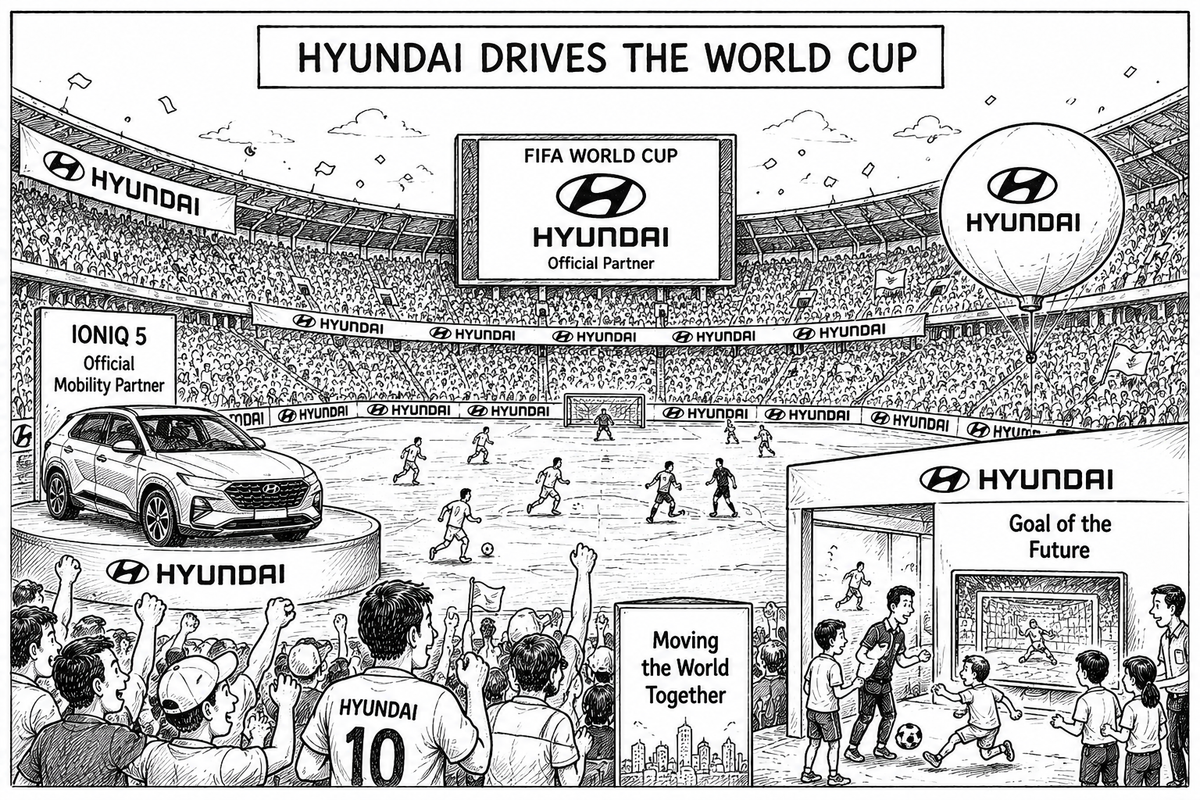
There is a hidden geology to sports marketing. The names on a stadium's advertising hoardings correspond, with remarkable precision, to the industrial order of the day. Read through the official sponsor list for the 2026 FIFA World Cup, co-hosted by the United States, Canada and Mexico, and that stratigraphy has never been more legible. Saudi Aramco, Qatar Airways, China's Lenovo and Hisense, and South Korea's Hyundai and Kia—the slots are the same, but every name has changed.
Forty years, then silence
From the 1980s through to the early 2000s, World Cup hoardings were, in effect, a showcase for Japanese consumer electronics. JVC (Japan Victor Company) was a FIFA partner for twenty years, from 1982 to 2002. Fujifilm held its place from 1982 to 2006—twenty-four years. Seiko served as the official timekeeper at four consecutive tournaments between 1978 and 1990. Sony and Toshiba were fixtures of the era.
Not one of those names appears in the 2026 roster. Japan's Asahi Shimbun ran a piece on 17th June under the headline "Why zero Japanese companies?"—noting that this marks a third consecutive World Cup without a single Japanese sponsor.
Companies that sold appliances no longer sell appliances
The Asahi Shimbun's diagnosis cuts to the bone: Japan's electronics industry has fundamentally changed what it does. Sony, Toshiba and their peers, once dominant forces in global consumer electronics, have dramatically scaled back their finished-goods businesses—televisions, audio equipment and the like—and reoriented themselves towards infrastructure, components and systems integration. Toshiba is the starkest example. A World Cup sponsor in 2002 and 2006, it sold its consumer electronics division to China's Hisense in the 2010s and now derives its revenues from power-transmission equipment and social infrastructure.
Yoshihiro Oi, an associate professor of sports management at Waseda University in Tokyo, frames the shift precisely. Japanese companies, he argues, once valued the sheer visibility that a global stage provided; today they concentrate investment where a direct business return can be demonstrated. World Cup sponsorship is, at its core, a mass-consumer brand exercise. Once a company has nothing left to sell to that mass consumer, its reason to play the game evaporates. "There is a stronger emphasis on efficiency," Professor Oi observes, "and firms are no longer willing to commit large sums to activities where the return on investment is unclear." Japan's corporate priorities, in other words, have been comprehensively reordered.
A second factor compounds the structural one: the weakness of the yen. World Cup sponsorship fees are denominated in dollars. As the yen has depreciated, the real cost of renewing a contract has risen in lockstep. Japan's long economic stagnation—punctuated by the collapse of its asset bubble and the shock of the 2008 global financial crisis—has delivered one further invoice, this time in the form of an unfavourable exchange rate.
How Hyundai took the slot
South Korea's presence at the top table is itself the product of more than twenty years of accumulated strategy. At the 2002 Korea-Japan World Cup, the automotive sponsorship rights were originally held by Germany's Opel, which relinquished them on the grounds that kick-off times in Asia were incompatible with European broadcast schedules. Toyota also made a bid, but attached the implausible condition that matches be staged in Toyota City, the company's home base—a demand that effectively disqualified it. Hyundai stepped in, and the FIFA convention of granting incumbent sponsors right of first refusal did the rest: the South Korean carmaker has retained its position through every tournament since.
At the 2026 edition, Hyundai and Kia are classified as Tier 1 Global Partners—FIFA's highest sponsorship category—alongside Adidas, Coca-Cola, Visa, Qatar Airways, Aramco and Lenovo. The commercial context is unusually favourable: a North American co-hosting arrangement gives this World Cup direct access to the world's largest English-language media market, pushing up both ratings and advertising rates. FIFA's sponsorship revenues have jumped 37% compared with the previous tournament, and inventory is effectively sold out. The slots that Japanese companies vacated have become considerably more expensive—a coincidence of timing that has proved costly to sit out.
On the streets of Seoul
There is an intriguing counterpoint playing out inside South Korea. The retail industry had braced for a muted home response: South Korea's group-stage matches were scheduled for mid-morning on weekdays—the Czech Republic fixture at 11am, Mexico at 10am—hardly ideal for a nation of office workers. The actual reaction has been warmer than expected. One Seoul professional took a day's annual leave to watch the Czech match and was considering joining outdoor public screenings in Gwanghwamun Square the following week. A retail executive confessed to being "surprised by how strong the enthusiasm turned out to be."
Marketing strategies are evolving accordingly. OB Beer's Cass, the only domestic brand with official World Cup sponsorship rights in South Korea, has built its campaign around street-viewing events. Lotte World Mall and The Hyundai Seoul department store have leaned into experiential formats—photo installations and pop-up shops—rather than passive advertising. The direction of travel is clear: from exposure-led to participation-led marketing, from billboards to moments consumers can inhabit and keep.
The same stage, two different lessons
The 2026 World Cup thus illuminates two simultaneous transitions. On the global stage, the withdrawal of Japanese firms has been filled by South Korean, Chinese and Middle Eastern ones—a reordering of industrial influence made visible in real time. At the domestic level, marketers are moving away from reach-and-frequency logic towards experience and engagement.
Hyundai's position on a FIFA hoarding and Cass's street-party activation in central Seoul are different in form but share an underlying logic: both represent an attempt to redefine World Cup sponsorship not as brand exposure for its own sake, but as investment with a direct commercial connection. That is precisely the lesson Japan's companies absorbed—and acted on—first. Everyone else is now arriving at the same conclusion by their own route.
*One figure to watch: whether South Korea advances beyond the group stage. Qualification for the round of sixteen would substantially amplify street-viewing attendance and is likely to prompt retailers to accelerate their World Cup marketing spend in the tournament's latter stages.*