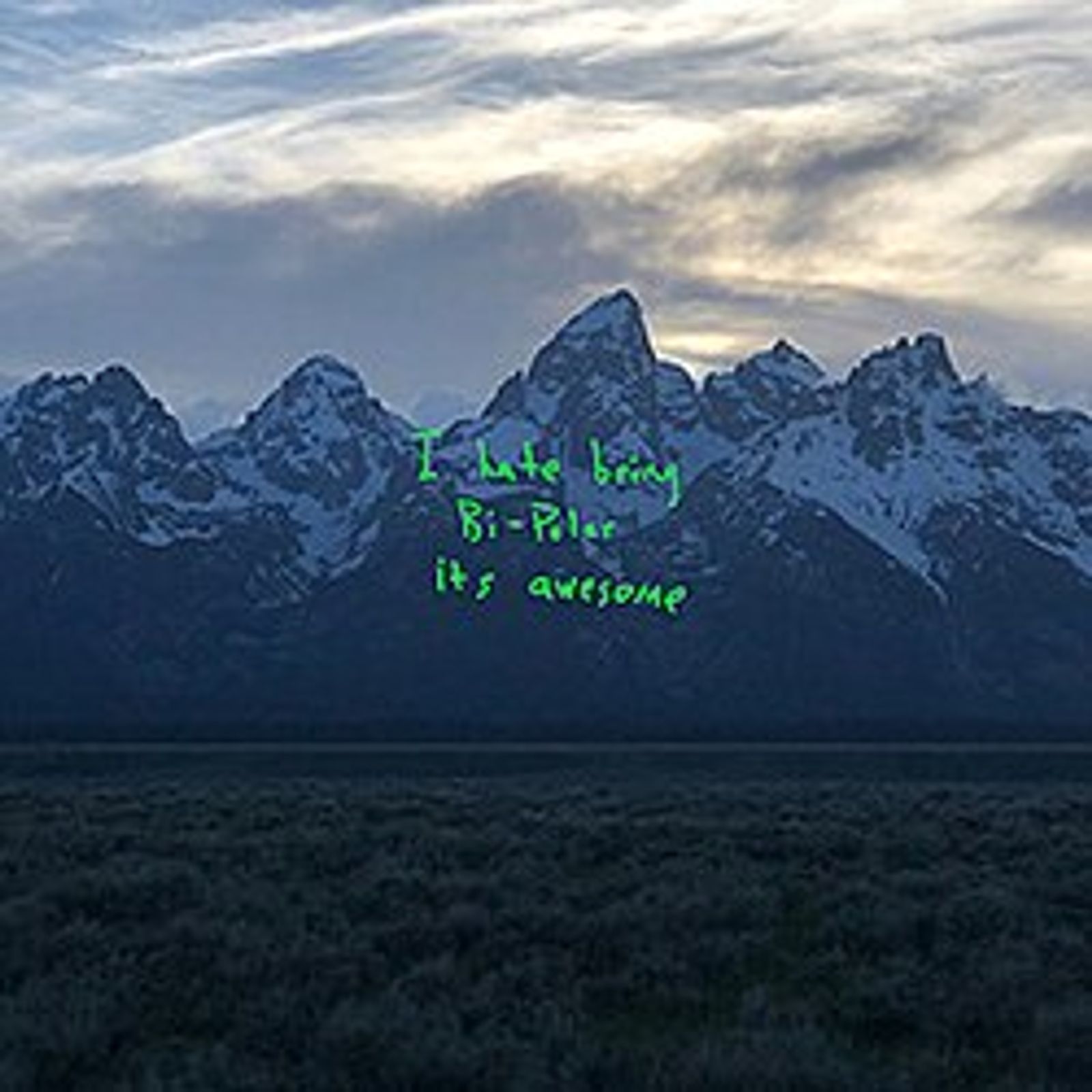
Within its brief running time, *Ye* unloads the full weight of its creator's inner life onto the listener. Buried beneath a dazzling and boundary-pushing career is Kanye West at his most vulnerable — and it is precisely from that vulnerability that he paradoxically asserts his strength. As the artist confronts and acknowledges his inner self, the listener is drawn to his side, accompanying him through each confession, offering comfort or, in turn, drawing courage from it.
Some may find the album chaotic, and not without reason. It mirrors, quite deliberately, the texture of bipolar experience: self-love curdling into self-loathing, blame deflected outward then turned inward, followed by forgiveness and renewed declarations of love. In that shifting current, some listeners will feel lost alongside him; others will find themselves galvanised.
Having scaled the maximalist peak of *My Beautiful Dark Twisted Fantasy* — widely regarded as one of hip-hop's great achievements — and then dismantled everything with the deliberately abrasive *Yeezus*, Kanye arrives on this record at his most painfully interior.
From the opening track, "I Thought About Killing You", he inhabits the contradictory space between narcissism and self-hatred. Loving himself more than he loves his partner, he is tormented by that very tendency, crying out for a way to love himself anew. Yet the second track, "Yikes", deploys that same contradiction in the grammar of hip-hop bravado. Here, his bipolar disorder is reframed as the fuel behind his wealth and fame — a weakness transmuted into a superpower, embraced rather than denied, credited with making him who he is. It is, in its way, the most hip-hop response imaginable to a mental health diagnosis.
The third track, "All Mine", changes the atmosphere through sharp contributions from Valee, Ant Clemons, and Ty Dolla $ign. Raw sexual desire takes centre stage, riding the momentum of what preceded it. The rough-textured, minimal sampling gives the track an appropriately primal energy, and the immersed listener feels his so-called superpower in full effect. But "All Mine" resists being merely a carnal anthem, because the following track, "Wouldn't Leave", recontextualises everything. After the gratification of desire comes a longing for love that will never leave — unconditional, permanent, unwavering. Kanye, for all his mythologising, is revealed as simply human. This emotional register would later become one of the cornerstones of his career, surfacing most fully in *DONDA* (2021), the album dedicated to his late mother. Through this track, the listener understands that what Kanye is ultimately pursuing is the oldest of human needs: a love that does not change.
That feeling, once unlocked in the fourth track, builds steadily through "No Mistakes" and "Ghost Town". This is partly why this reviewer regards *Ye* as the most significant emotional turning point in Kanye's discography — and the album with the most coherent emotional architecture. "No Mistakes" borrows Slick Rick's voice, laying his familiar ad-libs over meditations on love and anxiety. It is the moment where Kanye's gift for sampling expands beyond sonic texture into narrative. Then comes the album's centrepiece: "Ghost Town". Kanye sings with raw desperation of a void that cannot be filled, and turns towards God. Given his subsequent embrace of Christianity and the release of *Jesus Is King* in 2019, the track reads, in retrospect, as a spiritual threshold. Kanye was once mocked and dismissed for attempting rap without gangster credentials; throughout his career he has proved that hip-hop can carry human fragility without apology. On *Ye*, at a crossroads in his life, he makes that case again — with greater honesty and humility than ever before.
That honesty finds its resolution in the closing track, "Violent Crimes", a meditation on his love for his daughter. For longtime fans, it may feel like watching someone grow up in real time. The arc is complete: from the anguish of bipolar disorder, through the pursuit of material and sexual fulfilment, through the emptiness that followed, through dependence on a partner and then on a higher power — and finally, to the arrival of new life and a rediscovered reason for living. The woman once objectified as a source of desire, the lover who could not fill the void, the God sought in desperation: all of it leads here, to a father singing about his daughter, and finding himself whole.
As a final flourish, Kanye casts Nicki Minaj — an artist who has embodied ferocity and aggression as vividly as anyone in hip-hop — as the album's voice of maternal tenderness. The contrast is as deliberate as it is affecting, a reminder that placing opposing textures in the same space is among his most distinctive gifts.
Pretending to be strong may protect you. Confessing weakness may save you. *Ye* belongs unmistakably to the latter category.
★★★★☆ (4.0/5.0)
**"Kanye at his most unguarded — stripped of every defence. *Ye* is the record where an artist capable of turning weakness into power reaches into his most wounded interior, and produces the defining emotional turning point of his career."**