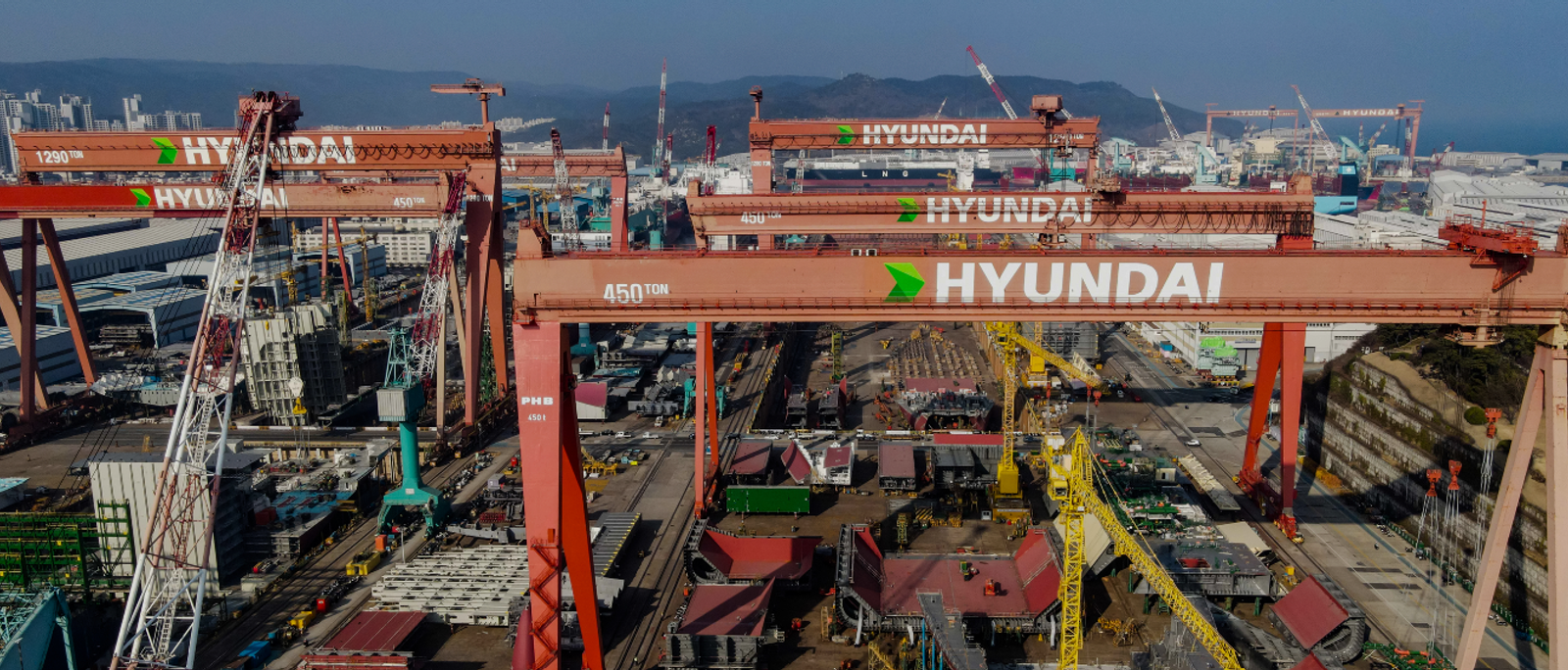
Yuanta Securities has maintained its "Buy" rating on HD Korea Shipbuilding & Offshore Engineering (KOSPI: 009540) whilst nudging its target price down slightly, from 555,000 won to 532,000 won. Based on the closing price of 353,500 won on 24th August, the implied upside is roughly 50%.
Valuation methodology
Yuanta arrived at its target by applying a 50% holding-company discount to the combined market value of HD Korea Shipbuilding's listed subsidiaries, and using a dividend discount model (DDM) for its unlisted unit, HD Hyundai Samho. This exercise yielded an intrinsic value of 18.5 trillion won for Samho alone. Adding the parent company's net cash position of 2.2 trillion won on a standalone basis produced a total fair value of 37.6 trillion won.
The immediate trigger for the lower target was a recalibration of the listed subsidiaries' equity value following share-price movements, most notably at Hyundai Heavy Industries, whose market capitalisation was marked at 4.7 trillion won. The revised listed-subsidiary stake value stands at approximately 16.92 trillion won. The cut of around 4.1% relative to the previous target is modest, but the trend is worth noting: since May 2025, Yuanta has revised its target seven times, raising it on only two occasions.
The holding-company discount: asset or liability?
The central investment thesis hinges on the holding-company discount structure and the prospect of expanded shareholder returns. HD Hyundai Samho's residual value is currently priced by the market at roughly 7.5 trillion won, some 10 trillion won below Yuanta's own fair-value estimate of 18.5 trillion won. In practice, the market is applying a discount of 60–70% rather than the 50% used in Yuanta's model. Were the discount to compress to 70%, Samho's residual value would widen to approximately 14 trillion won, approaching Yuanta's assessed fair value.
Yet the discount cuts both ways. Undervaluation relative to net asset value (NAV) is an attraction, but without confidence that those assets will eventually be monetised, the discount could persist or widen further. In the absence of vigorous capital returns — the conventional mechanism by which holding-company discounts narrow — the investment case for a re-rating remains fragile.
The buyback argument
Yuanta believes a share buyback and cancellation is becoming increasingly likely. As of the first half of 2026, HD Korea Shipbuilding holds net cash of 3 trillion won on a standalone basis, while its operating subsidiaries Hyundai Heavy Industries and HD Hyundai Samho sit on net cash of 5 trillion won and 2.7 trillion won respectively. There is, however, a timing lag: dividends from the operating companies — reflecting profits earned in the second half of 2024 and into 2025 — have yet to flow fully upstream to the parent.
The structural incentive is equally compelling. HD Hyundai, the ultimate parent, holds only a 35.05% stake in HD Korea Shipbuilding. Under the current arrangement, for every 100 won that Hyundai Heavy Industries pays in dividends, HD Hyundai ultimately receives only around 24 won. Yuanta's simulations show that if HD Korea Shipbuilding were to sell a 5% stake in Hyundai Heavy Industries and use the proceeds to buy back and cancel 10% of its own shares, HD Hyundai's effective interest in HD Korea Shipbuilding would rise from 35.1% to 38.9%, lifting its annual dividend receipts from approximately 526 billion won to 584 billion won — a gain of roughly 11%.
Precedent supports this scenario. HD Korea Shipbuilding has already monetised its Hyundai Heavy Industries stake on three occasions: a block sale of 2.83% for 349.7 billion won in May 2024; a private exchangeable bond placement equivalent to a 1.95% stake for 600 billion won in February 2025; and an offshore exchangeable bond issuance representing 4.32% for 2.37 trillion won in April 2026. Each transaction demonstrates a willingness to deploy listed-subsidiary shares as a financing instrument.
Earnings outlook
The financial backdrop is encouraging. Yuanta forecasts consolidated revenue of 34.47 trillion won for 2026, up 15.2% year on year, with operating profit reaching 6.39 trillion won — a rise of 63.6%. Third-quarter 2026 operating profit is projected at 1.5 trillion won, a 42.4% increase on the same period a year earlier, though this would fall 5.1% short of the market consensus of 1.58 trillion won. Return on equity is expected to climb from 11.2% in 2024 to 26.9% in 2026, and the stock currently trades at a price-to-earnings ratio of around 6.1 times — close to historical lows.
Investment conclusion
Yuanta's recommendation is framed as a medium-to-long-term position rather than a short-term trade. The thesis rests on an asymmetric risk-reward profile: the holding-company discount caps the downside, whilst expanding cash flows and potential capital returns provide meaningful upside. Key uncertainties remain, however. Whether the company will honour its stated goal of returning more than 30% of standalone net profit to shareholders over the 2025–27 period — through buybacks, cancellations, or further asset monetisation — and the precise timing and scale of such measures, are still open questions. Investors should monitor closely how, and how quickly, improving earnings translate into tangible returns.