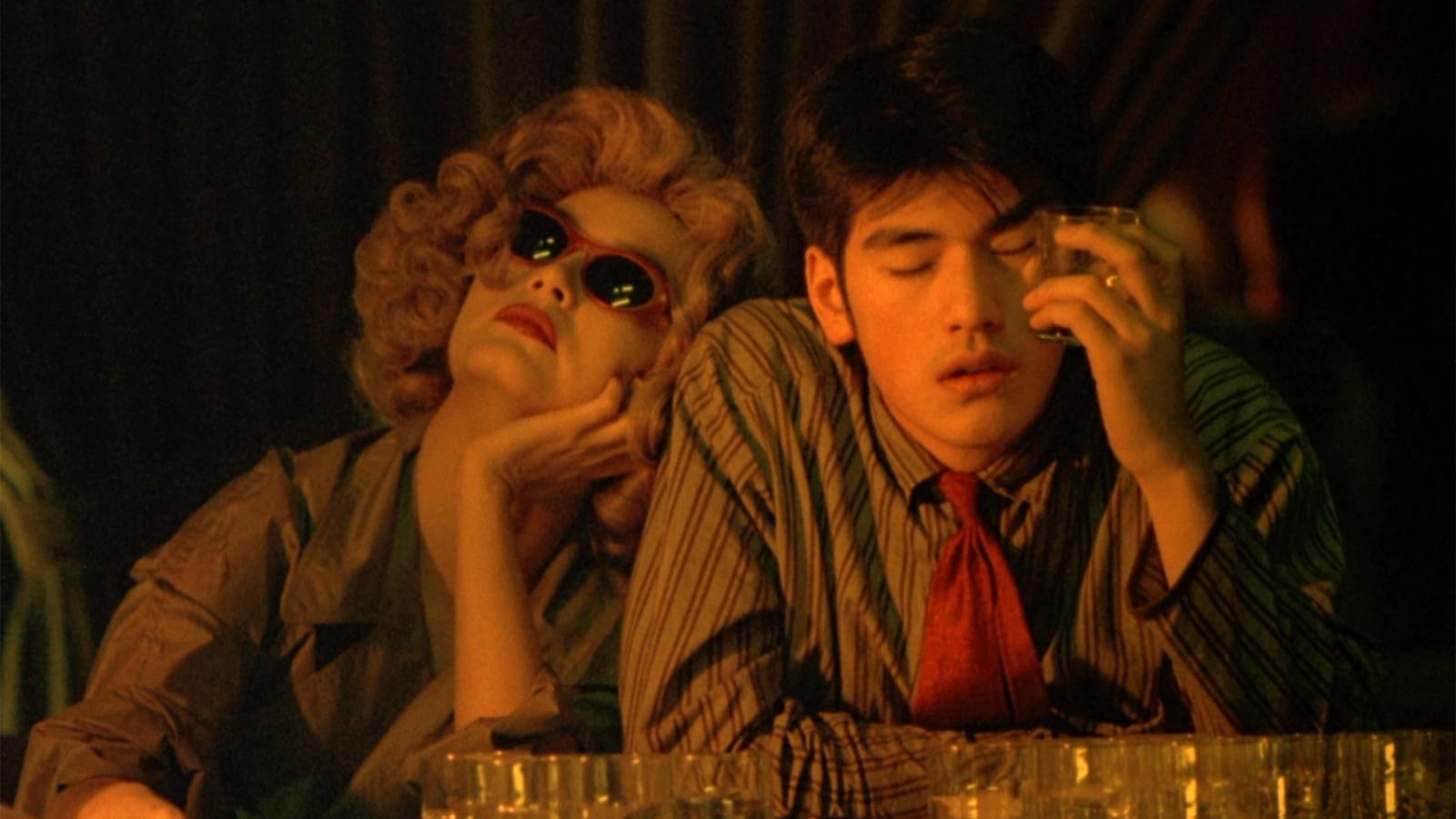
Officer 223 (Takeshi Kaneshiro) has been dumped. From the 1st of May, he buys one tin of pineapple every day — each one stamped with an expiry date of 1st May. He tells himself that when thirty tins are gone, so is his heartbreak. On the final night, he meets a woman in a bar — blonde wig, trench coat, drug trafficker (Brigitte Lin). They spend the night together, and nothing happens. She leaves in the morning. He resolves to fall in love with someone new.
Here the story breaks off and begins again. Officer 663 (Tony Leung) has just been left by his flight-attendant girlfriend. Faye (Faye Wong), the counter girl at the snack bar he visits every day, begins slipping into his flat uninvited — rearranging his things, replacing the fish in his tank, quietly infiltrating his life. Officer 663 doesn't notice. Or perhaps he does, and pretends otherwise. The two brush past each other without quite connecting; Faye leaves to become a flight attendant herself, then returns a year later.
Reduced to plot, these are two stories of almost laughable simplicity. So why, watching the film, does everything feel so impossibly, irretrievably in motion? Christopher Doyle's camera moves through Hong Kong's narrow alleys, its escalators and the fluorescent hum of its snack bars as though held in an unsteady hand. Step-printing blurs the movement of bodies; time smears at the edges. The city never stops, yet the two figures at its centre seem utterly still. Wong Kar-wai compresses urban velocity and private isolation into a single frame, and in doing so transforms Hong Kong — the city itself — into a feeling.
The film's real cruelty lies in what it takes for granted: that love only ever arrives at the wrong moment. Officer 223 and the blonde woman spend a night together asking each other nothing, and it is only afterwards — only as the hours run out — that they begin to understand one another. By the time understanding arrives, it is already time to part. Faye expresses her love for Officer 663 by slipping into his flat and quietly reordering his world, yet cannot bring herself to meet his eyes and speak. When she finally returns, he has become the owner of the snack bar. Love is always a beat too early or a beat too late. Wong does not frame this as tragedy. He lets it pass, calmly, as though it were simply the nature of things.
The expiry dates on the pineapple tins. The repeated refrain of "starting from the 1st of May." "California Dreamin'" looping endlessly out of a tinny speaker. *Chungking Express* asks you to remember love not as narrative but as rhythm. When Faye circles the snack-bar counter, tin in hand, and the song swells around her, the audience receives the film through sensation before it reaches them through story. That sensory residue lingers long after the plot has resolved.
Looking back, no one in this film ever fully possesses another person. Officer 223 finishes all thirty tins and is still alone. Officer 663 lives through an entire year without realising that Faye has remade his life. And yet the film is not merely sad — because it believes, with quiet conviction, that each of those brief, mistimed collisions was among the most achingly beautiful moments a life can hold. Love does not need to be completed. The passing itself was already love.
★★★★★ (5.0/5.0)
In a single line: "Love has an expiry date. That is precisely what makes it so devastating, and so beautiful."