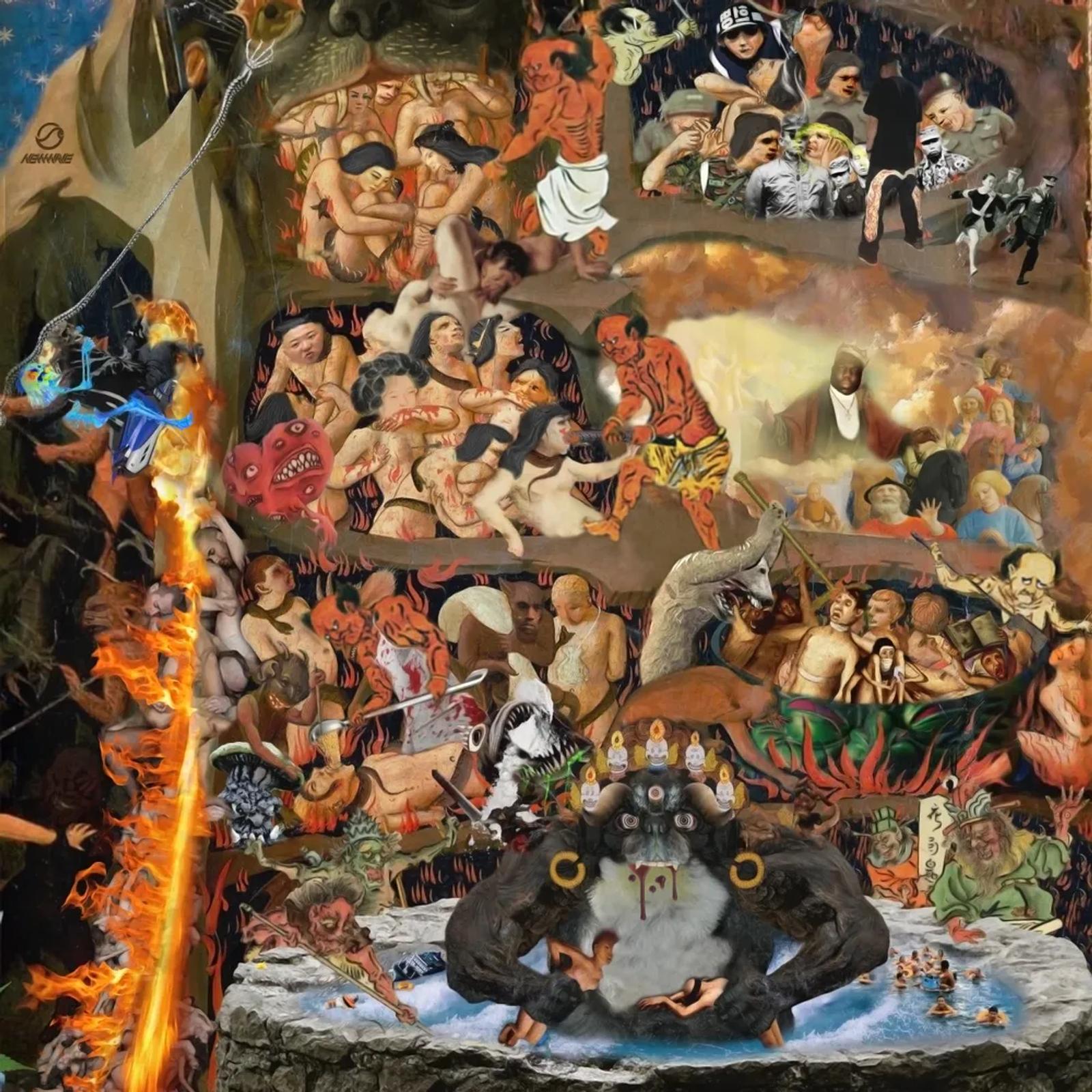
**B-FREE — *FREE THE BEAST***
B-Free stands among the most accomplished hip-hop artists South Korea has produced. His credentials are formidable: technically refined rapping, strong production instincts, coherent album-wide messaging, a keen sense of track sequencing, and sound engineering that gives his records a consistently polished finish. He is, in the parlance of Korean music criticism, a hexagonal artist—complete in every dimension.
Having already won devoted fans with socially resonant tracks such as "Hope" and "Korean Dream", B-Free could have continued down that well-trodden path. Instead, he chose to strip things back and take on the raw, lo-fi aesthetic of Memphis rap—a subgenre rooted in the darker corners of the American South, characterised by slowed, menacing beats, horror-inflected samples, and unvarnished street narratives.
The result is something entirely distinct from the wave of generic trap imitators or novelty rap acts that have flooded the Korean scene. B-Free preserves the fundamentals of his craft—his flow, rhyme schemes, and diction—while successfully inhabiting an entirely new sonic wardrobe. The key lies in his concise, razor-edged lyricism.
This is most apparent on the opening track, "This Time". Lines such as "You think my music's mediocre? You've lost your mind, check yourself in", "Everything I needed was already inside me", and "Living in fear is far more dangerous" sustain a consistent rhyme scheme while articulating the artist's worldview with remarkable directness. Without recourse to elaborate vocabulary or ornate wordplay, B-Free embeds his message in the listener's mind with an ease that few Korean artists can match. The contrast between the slow, simmering drum pattern and his agitated delivery—unhurried in rhythm, yet elevated in tension—makes clear just how singular a figure he is in the scene.
Track two, "Bounty Hunter", demonstrates his production sensibility: a sampled theme introduced and then immediately upended by a trap beat, strings teetering on the edge of dissonance, and distorted vocal samples that generate an atmosphere of genuine unease without ever becoming gratuitous. Rather than resorting to the tired declaration of being "sick of Korean hip-hop" or "sick of idol rap", B-Free channels his frustrations through the persona of a bounty hunter—aggressive and controlled at once. A vocal contribution from long-time collaborator Kokjazz sustains the mood with precision. The album's sonic palette is equally impressive: Memphis grammar is borrowed, its aggressive edge retained, but everything is meticulously tailored. That the mastering was handled by Anthony Kilhoffer—a Grammy Award-winning engineer who has worked with Kanye West—explains the record's uniform texture, and confirms that the consistency is deliberate.
Track three, "Valley of Death", is a masterclass in pacing. In under three minutes, it delivers sharp verses, canonical Memphis cowbell usage, and a mood that builds across each section with studied control.
Track four, "Dracula 2020", recalls "King Vamp" from Playboi Carti's divisive album *Whole Lotta Red*—except that B-Free's record was released a month earlier, a fact that underscores his instinctive reading of where the music was heading. That elevated energy carries into "Conspiracy 2020", which offers perhaps the clearest articulation of what Korean Memphis can mean. By placing the then-controversial emerging rapper Kwon Gi-baek on the opening verse, B-Free evokes the bleak back-streets of Ansan—an industrial satellite city outside Seoul—and naturalises the premise: that a Memphis-inflected life exists in Korea too. Rather than transplanting American hip-hop clichés wholesale, he argues through music that the underlying emotions and social conditions are not so different. In doing so, he finds a new way to capture the spirit of his time.
Track six, "Donné Improvisation", is the album's most deliberately confrontational moment. B-Free brings in Charity and Kwon Gi-baek, layering their voices to amplify raw feeling. Profanity, frustration, shouted rhymes, and heavily distorted 808 bass notes push the listener toward deliberate discomfort. Some will find it too much. But the emotions on display—anger, despair, the urge to rage against one's circumstances—are universal. B-Free simply brings them into the music. It may be the most authentically hip-hop thing on the record.
Track seven, "Rest", opens with the line "Life like a war, I work myself to death just to survive"—a statement that lands harder given who is saying it. The narrator's relationship to life is saturated with anger, but oriented entirely around survival. Where American hip-hop frequently turns outward—revenge fantasies, settling scores—B-Free's narrator turns inward, toward labour. In Korea, where there are no gangs in the Memphis sense and no guns readily available, the only available response to rage is work. For B-Free, making music has long since ceased to be art in any romantic sense; it is survival. He makes this plain at every turn, drawing the listener into his reality by the most direct means possible: showing it.
Track eight, "Bastard", contains a line that reads like a manifesto: "Everyone curses me out—why do I keep pushing happiness?" This flows into "My name is Choi Seong-ho, still alive on the Korean Peninsula"—a precise, defiant rhyme that sounds, in context, like the cry of an artist trying to remain visible in a society where the ladders of social mobility have been quietly removed.
Track nine, "Easter Sunday", is the album's peak. Cowbells detonate across the mix; a sustained 808 note anchors the low end; a heavy snare roll crashes through. Over this, the narrator's energy has moved beyond mere bravado to become something closer to a philosophy of living. B-Free's decision to bring in Munchmane as a featured artist shows equally sharp judgement: the guest's verse extends the album's central critique of society without breaking the thematic thread. To perform, to make music—for B-Free, every such day is an Easter Sunday, a small resurrection.
Track ten, "Life Jacket", arrives like sudden fresh air. PNSB's verse dances across a stripped-back arrangement, cleansing the listener's ear after the dense sampling of tracks three through nine, while simultaneously ratcheting up the anticipatory energy. It is an ideal placement.
The album's second half shifts register. Track eleven, "End of the Shift", inherits the preceding anger but redirects it. Featuring Dustyy Han, the track sketches the exhaustion of someone finishing a day's work—except that, for this narrator, the end of a shift is not rest but another node in the circuit of survival. If the Memphis nights of Memphis, Tennessee are filled with guns and drugs, B-Free's nights are filled with labour. At this moment, the album sheds the Memphis exterior and reveals its Korean interior.
Track thirteen, "Friends 2016", is the moment the beast finally turns to look back. The year in the title is not incidental: it marks a specific point of reckoning. For the first time, the furious narrator pauses, sets down his blade, and calls out the names of those who came with him or fell away. Here, for the first time, the album's true subject—vulnerability, the unguarded face—comes fully into view. The sequence that follows—track fourteen, "Change"; fifteen, "No News Is Good News"; sixteen, "Blood on My Shirt"—presses deeper into that exposure. The narrator examines who he has become, finds relief in silence, and finally confronts the cost of having survived: blood on his clothing, a price paid. An album that began in fury moves through regret toward a reckoning with consequences. This emotional drop is what makes the second half a genuine narrative resolution rather than a gentle wind-down.
Track seventeen, "Closing", places Kwon Gi-baek and Andy Plager side by side to seal the record. It gathers the dispersed anger and regret into a single space—the artist placing a full stop on his own disorder. And then track eighteen: "Blueprint". The title alone, placed at the end, retroactively reframes everything that preceded it.
The album's title, it turns out, is only half true. B-Free did not free the beast. He designed it. The rage, the anxiety, the obscenity, even the distorted 808s—all of it was placed with intention, then finished to a uniform standard by a Grammy-winning engineer's hand. That the final track is called "Blueprint" is not coincidental. The feat of this record is its precision: taking the Memphis genre and transplanting it onto the streets of Ansan and the banks of the Han River, then inserting into that framework the Korean skeleton of labour and survival. *Free the Beast* is not the roar of a wild animal. It is the technical drawing from which the animal was assembled.
Rating: ★★★★☆ (4.0/5.0)
*A proven album-maker sheds his skin—the courage of showing an unguarded face, full of anger and anxiety, without flinching.*