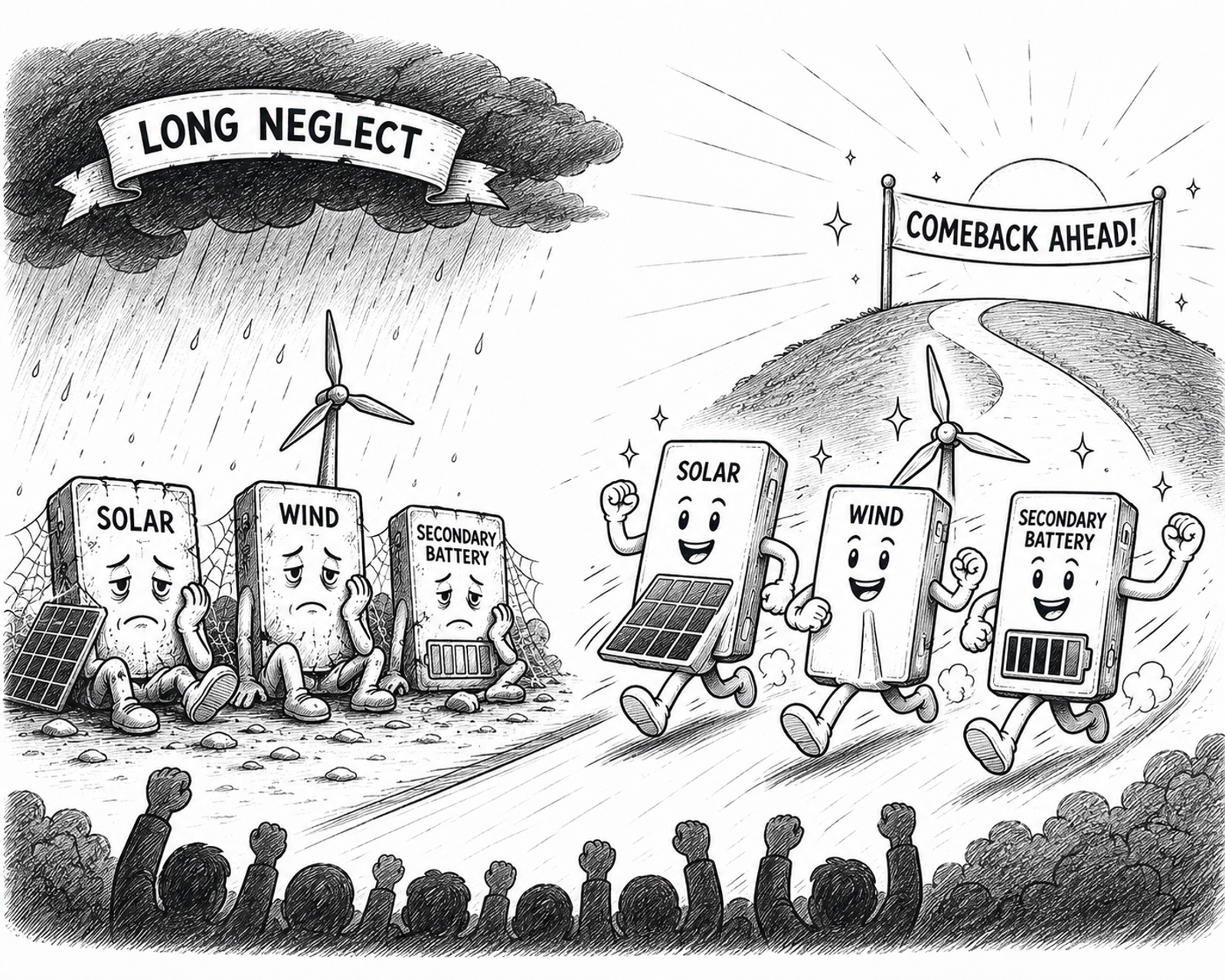
The principle that investors should own the market's leading stocks in a bull run commands near-universal assent. But when those leaders lose momentum, long-neglected sectors have a habit of bouncing back with surprising force. Here are four reasons to take another look at solar, wind, and battery stocks — South Korea's most overlooked corner of the market.
The three things you need to know
Clean-energy stocks — solar, wind, and secondary batteries — spent the entire first half of the year as the market's most conspicuous bystanders, sidelined as capital flooded into semiconductors. It is too soon to declare a full recovery in sentiment, but the grounds for a reassessment are steadily accumulating.
The underlying fundamentals have not deteriorated. Demand for renewable-energy generation and grid-scale battery storage continues to grow, while the government faces its own policy incentive to reduce the market's dangerous dependence on a single sector. South Korea also has the lowest share of renewable energy among major developed economies, which means the structural case for expansion is already made.
Two variables that look straightforwardly negative on the surface — the fallout from the Trump administration's energy policies and elevated oil prices driven by Middle East tensions — tell a more nuanced story on closer inspection. A declining approval rating for President Trump, a shifting outlook for November's mid-term elections, and the geopolitical risk premium baked into oil prices may all prove to be catalysts, or at least effective hedges, for clean-energy stocks.
When the leaders pause, the laggards move
One principle has guided equity markets for as long as anyone can remember: in a rising market, buy the stocks that are leading it. In the first half of this year, the KOSPI's gains were driven largely by just two companies — Samsung Electronics and SK Hynix — and the principle held. But markets also teach a corollary: when the leaders begin to lose steam, capital has a habit of rotating into neglected sectors with greater force than most investors anticipate.
Clean-energy stocks — solar, wind, and battery manufacturers — are the starkest example of that neglect. Throughout the first half, as the semiconductor trade reached its most concentrated, share prices in this sector were suppressed regardless of the underlying business conditions. A straightforward assessment is that it remains too early for a confident bet: the damage to sentiment was deep, and recoveries from that kind of neglect take time. Yet the four arguments below suggest that these stocks now merit close attention.
1. The fundamentals are sounder than the share prices imply
The starting point is the industry itself. Solar and wind capacity installations are growing steadily, both in South Korea and globally. The International Energy Agency projects that by 2030, renewables will account for more than 40% of the world's electricity generation, making them the single largest source of power. Solar, notably, has already overtaken coal by volume of electricity generated. As renewable generation expands, so does the demand for energy storage systems (ESS) to manage it. Solar and wind are intermittent by nature — output fluctuates with weather — so the faster they are deployed, the more critical battery storage becomes. The industry's trajectory has not reversed; it is the stocks that have simply been left behind by the semiconductor frenzy.
2. Two distinct policy tailwinds
Policy support is building from two separate directions.
The first is straightforward. South Korea has one of the lowest shares of renewable energy in its overall energy mix among developed nations. Its renewable energy consumption as a proportion of total final energy use stands at roughly one-quarter of the OECD average, placing it near the bottom of the rankings. That gap is itself an argument for expansion. In May, President Lee Jae-myung's government published its first Renewable Energy Basic Plan, setting a target of 100 gigawatts (GW) of cumulative renewable-energy capacity by 2030. The plan places solar generation at its centre, and signals clearly that the current administration's policy instincts run in clean energy's favour.
The second tailwind is more indirect but potentially just as powerful. The extreme concentration of investment in semiconductors during the first half depressed the share prices of companies with perfectly sound fundamentals elsewhere in the market. The leveraged single-stock products that rode the semiconductor wave also amplified overall market volatility — a side-effect that has drawn regulatory attention. South Korea's financial regulator has recently introduced measures to rein in such products, including higher margin requirements, a moratorium on new listings, and advertising restrictions. Most analysts, however, are sceptical that these steps will do much to reduce volatility on their own. The regulator itself has acknowledged that the root problem lies in the market's structural over-dependence on semiconductor earnings expectations. The logical implication is that genuinely dampening this concentration requires encouraging capital to flow into other sectors — and clean energy, backed by clear policy commitments that align with the current government's agenda, is an obvious candidate.
3. Trump's declining poll numbers and the mid-term wildcard
Clean-energy stocks have been among the most prominent casualties of the second Trump administration. A combination of reduced support for renewable energy, new tariffs, and an explicit preference for fossil fuels battered investor sentiment. But the picture is beginning to shift. President Trump's approval rating has slid from above 50% in the early weeks of his term to 38–40% in recent surveys, with his economic approval rating lower still. Ahead of November's mid-term elections, major international news organisations are increasingly assigning a meaningful probability to Democrats recapturing the House, with the Senate outlook also improving for them relative to earlier in the year.
What makes this particularly instructive is that the same pattern played out during Trump's first term. When Trump won the 2016 election, shares in Vestas — the world's largest wind turbine manufacturer — fell 23% in a single month. Yet over the following four years they climbed steadily, and by the end of his first term stood at roughly three times their level at the time of his election. CS Wind, the leading South Korean wind-energy stock, hit its trough in December 2016, immediately after Trump's first victory. Several American solar companies rose by multiples of ten to several hundred times their value during the 2017–2021 period. The historical precedent is clear: clean-energy stocks that suffer an initial shock from Trump administration policies can find their floor — and stage substantial recoveries — within that very same administration. With approval ratings falling and the mid-term electoral map shifting, the parallels with that earlier episode are worth taking seriously.
4. High oil prices as a hedge
Clean energy's relative attractiveness rises mechanically with the oil price: higher fossil-fuel costs improve the economics of renewables, and elevated energy prices sharpen the political and commercial case for energy security through domestic clean generation. This pattern has already asserted itself twice in the current cycle. When volatility in oil prices spiked in late March, amid tensions between the United States, Israel, and Iran, solar and wind-related stocks moved sharply higher in a single session: SK Iternyx gained 10.5%, HD Hyundai Energy Solutions 9.66%, SK Ocean Plant 3.54%, and Hanwha Solutions 2.66%. A similar episode unfolded in mid-June: even as the prospect of a US-Iran ceasefire emerged, concerns about energy security kept the theme alive — SK Iternyx surged more than 22% in one day, while Hanwha Solutions and OCI Holdings rose more than 10% and 15% respectively. In two separate episodes within a single cycle, clean-energy stocks demonstrated a capacity to outperform when geopolitical uncertainty pushes energy prices higher.
Where to look
In solar, OCI Holdings and Hanwha Solutions are the benchmark names. In wind, SK Ocean Plant and CS Wind are the principal players. In batteries, the sector divides naturally into cell manufacturers — LG Energy Solution and Samsung SDI — and materials companies, including EcoPro BM, POSCO Future M, and L&F. Given the sector's sensitivity to policy announcements and geopolitical events, short-term volatility can be sharp. A focus on companies where improving fundamentals — earnings, order books, and capacity utilisation — provide independent support for the investment case is advisable.
Watch for: The outcome of November's US mid-term elections and any subsequent shift in the legislative landscape; and whether South Korea's government translates its stated desire to reduce semiconductor concentration into concrete measures — tax incentives, inclusion in the "Value-Up" programme, or similar — that direct capital towards other sectors. Both variables will determine whether clean-energy stocks stage an opportunistic bounce or the beginning of a more sustained re-rating.
Factor | Substance | Current status
Fundamentals | Sustained growth in renewable generation and ESS demand | Intact; share prices alone have underperformed
Government policy | 100GW renewable target by 2030; pressure to reduce semiconductor concentration | Policy direction confirmed; concrete capital incentives still pending
Trump variable | Approval rating at 38–40%; rising probability of Democratic gains in mid-terms | Historical precedent from first Trump term (Vestas et al.) supports recovery thesis
Oil-price hedge | Middle East risk premium → higher oil prices → improved relative economics for renewables | Pattern confirmed twice in current cycle (March and June)