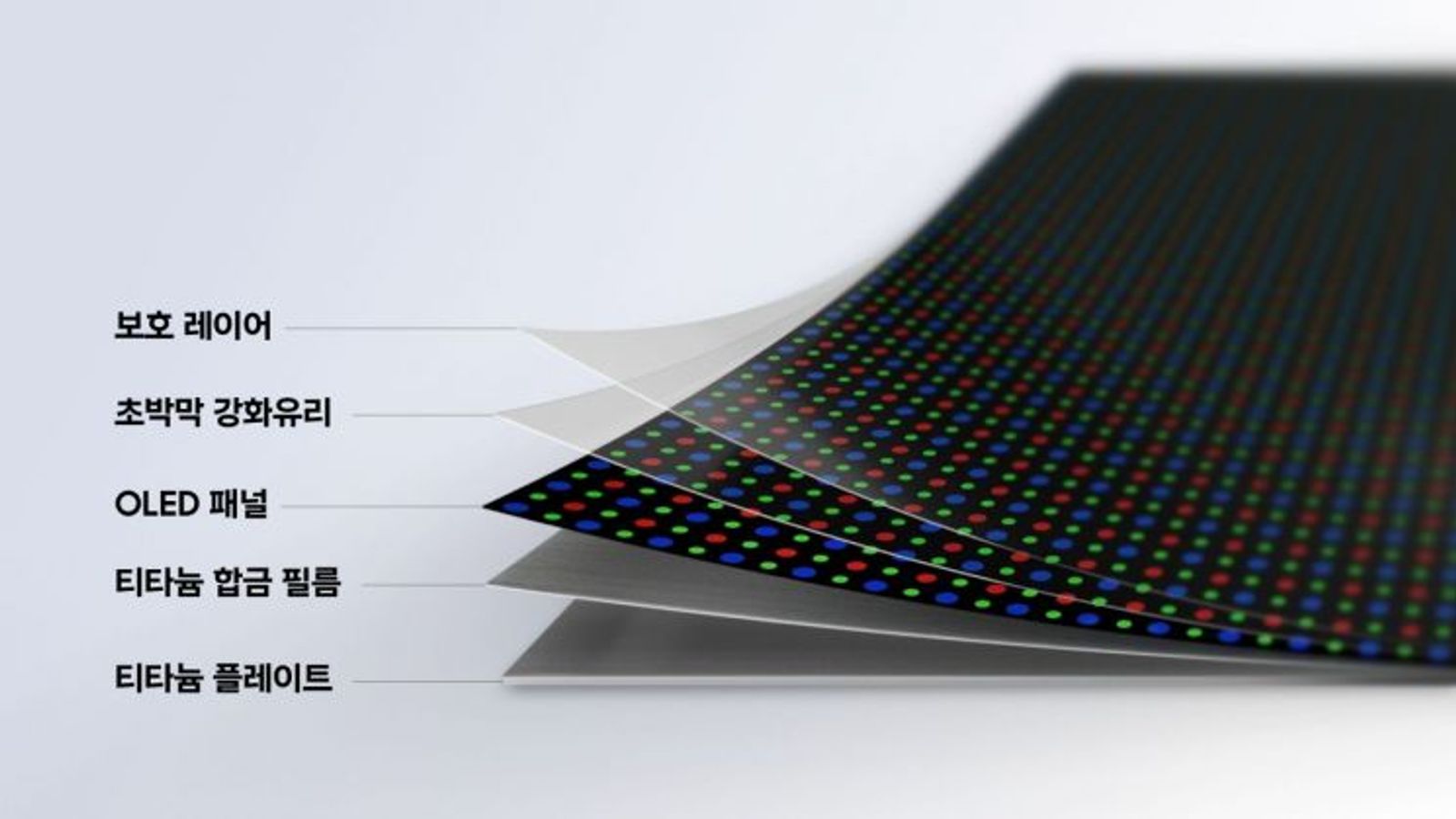
Foldable smartphones have established themselves as the next frontier in mobile design, yet they have long been haunted by a fundamental shortcoming. In July 2025, Samsung disclosed a new hinge architecture built from titanium alloy — a material more commonly found in aircraft — marking what could be a pivotal moment for a category still struggling to win over the mass market.
The most glaring weakness of foldable phones has always been the crease: that visible ridge left across the centre of the screen each time the device is folded. Neither Samsung's Galaxy Z Fold series nor its Flip series has been immune. According to Counterpoint Research, roughly 43% of consumers who hesitate to buy a foldable phone cite screen durability and creasing as their primary concern — a higher share than those deterred by price (38%).
The engineering at the heart of Samsung's new approach lies in replacing stainless steel with a titanium alloy in the hinge mechanism. Titanium offers comparable strength to steel at around 40% less weight, and its properties allow for more precise angular control as the device folds. This distributes mechanical stress more evenly, reducing the physical deformation inflicted on the polyimide (PI) film that forms the display panel. Samsung claims the result is a crease that is 30–40% less visible than on current models.
A research and development official at Samsung Display said the material's resistance to repeated bending far surpasses that of stainless steel, with hinge deformation rates remaining markedly low even after more than 100,000 open-and-close cycles. In adopting titanium for the internal structure of its foldable devices, Samsung is extending a strategy Apple pioneered with the external titanium frame of the iPhone 15 Pro — using the material not only for its physical properties but for its premium associations.
The commercial implications reach well beyond a simple change of materials. IDC forecasts that global foldable phone shipments will grow from roughly 20 million units in 2023 to more than 100 million by 2027. Yet without a convincing solution to the crease problem, mass-market adoption has remained elusive, and demand has been largely confined to high-end early adopters willing to overlook the imperfection.
A look at the competition sharpens the picture. Huawei has partially addressed the crease with its proprietary "teardrop hinge" design, but American semiconductor sanctions have severely constrained its access to advanced materials. Google's Pixel Fold prioritised hinge durability but has not been credited with meaningful progress on crease reduction. Samsung, by contrast, is reported to be planning a phased rollout of the titanium hinge across its Galaxy Z Fold lineup from the Fold 7 onwards.
Not everyone is ready to declare the problem solved. A senior researcher at the Korea Electronics Technology Institute (KETI) draws a careful distinction: "Reducing a crease and eliminating it entirely are physically different challenges by an order of magnitude. Without overcoming the bending-radius limitations of ultra-thin glass (UTG) cover panels, improving the hinge alone cannot remove the structural crease." For consumers, the practical question is how noticeable a 30–40% improvement will feel in everyday use.
Cost presents another complication. Titanium commands a raw material price several times that of stainless steel. Foldable phones already sell for upwards of 2 million Korean won (roughly $1,500), and any further price increase risks undermining the case for broader adoption. Some analysts suggest Samsung will pursue a two-tier strategy — reserving the titanium hinge for an "Ultra" tier while retaining conventional materials in mid-range foldable models.
Precedent offers some encouragement for the bulls. When Apple introduced an aluminium unibody chassis for the MacBook, and later replaced sapphire glass with Ceramic Shield on the iPhone 12, industry standards shifted accordingly. Whether Samsung's titanium hinge proves to be a genuine reset for the foldable category, or merely an attractive bullet point on a premium specification sheet, will become clearer from shipment data and consumer satisfaction metrics over the next year or two.
For foldable phones to become a true mass-market proposition, three forces must converge simultaneously: technological progress, affordable pricing, and a user experience compelling enough to justify the trade-offs. Samsung's titanium hinge represents meaningful progress on the first of these. How the company manages the other two will determine whether this innovation is remembered as a turning point for the industry — or as a feature reserved for those already willing to pay the highest price.